
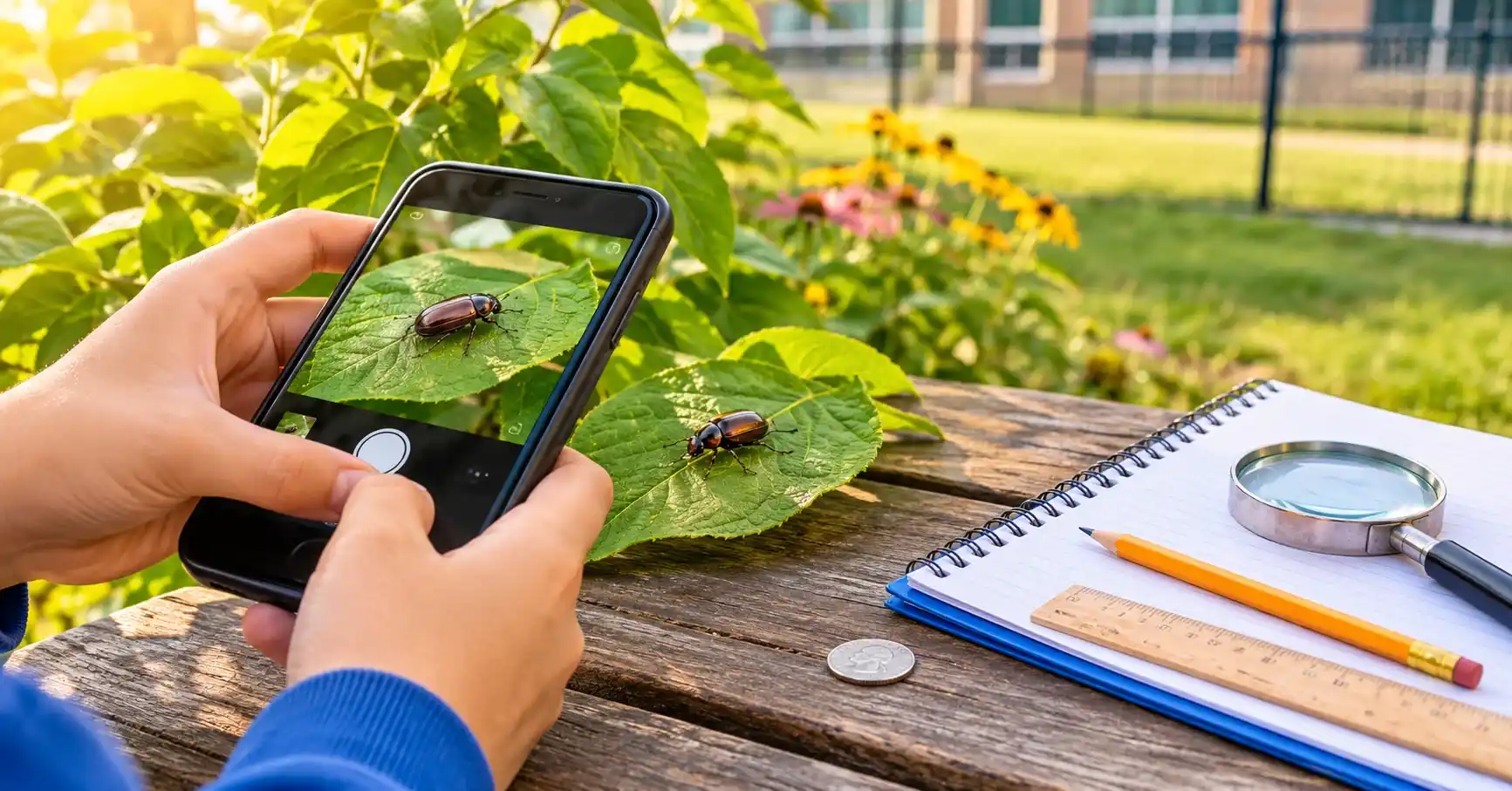
How to Identify a Bug for a School Science Project
You find a strange insect on the schoolyard fence. Your science project is due Friday, and your notebook says “unknown bug.” Most students and teachers hit this wall at some point. The good news: you can name most common bugs with a phone camera, five quick body checks and a little patience. This guide walks you through the whole process, from staying safe to writing the notebook entry, so your project reads like real fieldwork. It also shows you what ends up on the rubric, because on most science projects the identification is only part of the grade.
Pick Your Project Angle Before You Collect Anything
Bug hunting without a question turns into a pile of random photos. A simple question gives your project a spine and gives your teacher something to grade.
A few angles that work well for middle and high school:
- Count and compare bugs in three spots: lawn, garden bed and a paved area.
- Compare sunny and shaded areas at the same time of day.
- Track one kind of bug once a week for a month.
- Sort everything you find into insects, spiders and other groups.
Pick one, write it as a question, and keep it on the first page of your notebook. Every photo you take afterward should help answer it.
Start With Safety Before You Look Closer
Never pick up a bug you cannot name. That rule protects you and it protects the bug. Some spiders, wasps, bees and ants bite or sting, and a startled student does not always react calmly.
Build these habits from the first minute:
- Look with your eyes and a camera, not your fingers.
- Stay about an arm’s length away until you know what you are dealing with.
- Never poke, shake or trap a bug to make it move for a photo.
- Tell an adult right away if you see a wasp nest, a bee swarm or a spider you do not recognize.
- Find out before the activity starts who in your group has a bee or wasp allergy.
If a bite or sting does happen, stop the activity and tell the teacher. That call belongs to an adult, not to the student. For the write-up afterward, a photo tool that answers what kind of bite is this can help you label the entry, and the photo belongs with the same notebook record as everything else.
Teachers can fold this into the grade. A “safe observation” line worth a few points on the rubric tells students that careful behavior counts as much as the right answer.
Take a Photo That Actually Helps
A blurry shot of a moving bug is the reason most identification attempts fail. Spend two minutes on the picture and everything after it gets easier.
- Shoot in daylight and turn the flash off. Flash washes out color and hides markings.
- Stay about 15 to 20 cm (6 to 8 inches) away. Much closer and most phone cameras lose focus.
- Get the whole body in the frame, from the antennae to the back end.
- Take one photo from above and one from the side. The top view shows the pattern. The side view shows the legs and body shape.
- Place a coin or a ruler near the bug, not touching it, so the size is clear.
- Take three or four shots. One of them will be sharper than the rest.
Write down where you found it, the date, the time and what the bug was doing. A bug on a flower at noon and a bug under a log at dusk can point to different species.
Check Five Body Clues in Order
Before you search anything, look at your photo and answer five questions. These checks narrow down the group the bug belongs to, which is the hardest part.
| Clue | What to look for | What it tells you |
|---|---|---|
| Legs | Count them | Six legs means an insect. Eight legs means a spider, tick or mite. |
| Body sections | Count the sections | Insects have three sections. Spiders have two. |
| Wings | Present or not, how many, hard or soft | Beetles have hard wing covers. Flies have one pair. Moths and butterflies have scaled wings. |
| Antennae | Present or not, long or short | Insects have them. Spiders do not. |
| Color and pattern | Stripes, spots, bands, shine | Helps separate lookalikes inside the same group. |
Here is how that plays out. A student finds a small, oval, shiny bug with six legs, short antennae and a hard shell-like back. Six legs puts it with the insects. The hard back cover points to a beetle. That is already a real result for a project, even before anyone has a species name.
Size matters too. Compare the bug with the coin in your photo and write the number down. Two bugs that look alike can be 2 mm and 20 mm, which usually means different species.
Confirm Your Guess With a Photo Identifier
Your five checks give you a group. A photo identifier can help you get closer to the species. A regular image search is an option, but it often returns a pile of loosely related pictures, and students end up matching colors by eye.
A dedicated tool is faster. ScanaBug is a free, browser-based identifier. You upload a photo (JPG, PNG, WEBP or HEIC, up to 10 MB) and it returns the common name, the scientific name and a Harmless, Caution or Avoid rating with next steps. There is nothing to download and no sign-up, so it works on a school laptop or a phone. Upload your best photo to a free identifier that answers the question what kind of bug is this picture and compare the result with your own five checks.
Treat the answer as a lead, not a final verdict. Check that the leg count, wings and size match your notes. If the tool asks for a closer image, that is useful feedback: the photo was not clear enough, so retake it and try again.
For a graded project, show how you confirmed the ID. Your own five checks, a tool result and one more source, such as a library field guide or a university extension fact sheet, tell your teacher far more than a single search result does.
Write It Down Like a Scientist
The identification is half the grade. The notebook entry is the other half. Use the same format every time so your data stays easy to compare.
A good entry includes:
- Date, time and weather
- Location, such as the fence by the gym or the second garden bed
- What the bug was doing
- Size, measured or estimated
- Leg count, wings, antennae and color notes
- Photo file name
- Your best ID and how sure you are: sure, likely or unsure
- The source that confirmed it
Here is a sample: “Oct 14, 10:20 a.m., sunny. Schoolyard fence post, walking slowly upward. About 8 mm. Six legs, short antennae, hard shiny back, dark brown. Photo IMG_204. Likely a beetle, species unsure. Leg and wing checks matched the identifier result.”
Notice that “likely a beetle, species unsure” is a fine answer. Honest uncertainty reads better than a confident wrong name.
Teachers can grade this quickly with a four-line rubric: observation detail, photo quality, evidence for the ID and safe behavior. Students can score themselves first.
How Your Project Gets Graded
Most science project rubrics do not award points for getting the species right. They award points for the process, and the process is the part you control.
Here is what each line of that four-line rubric usually rewards:
| Rubric line | What earns full points |
|---|---|
| Observation detail | Date, time, location, weather and behavior recorded for every find |
| Photo quality | Sharp, well-lit shots from two angles with a size reference in the frame |
| Evidence for the ID | Your own five checks plus at least two independent sources |
| Safe behavior | No handling, correct distance, and an adult told when needed |
Ask your teacher for the rubric before you start collecting. When each line carries the same weight, a project with honest “species unsure” entries, sharp photos and full notes can score higher than one with confident names and thin records. Score yourself against every line before you hand it in, and fix the weakest one first.
Common Mistakes That Cost Students Points
- Guessing from color alone. Many unrelated bugs share the same color.
- Using one photo. A single angle hides legs, wings and markings.
- Calling everything a “bug.” In everyday speech, any small crawler is a bug. Scientists use “true bugs” for the order Hemiptera. Naming the group correctly, insect, spider or true bug, is a quick credibility win.
- Skipping the scale. Without a size, a photo loses half its value.
- Writing “unknown” and nothing else. Leg count, wings and size still count as data.
Make Identification a Habit
Identifying a bug is a skill that builds with practice. Photograph it well, run the five clues, confirm with a second source and log it the same way every time. After three or four rounds, students stop asking an adult what the bug is and start saying, “It has six legs and a hard back, so I think beetle.” That is exactly the kind of thinking a science project is meant to show. And because the rubric rewards that process rather than a lucky guess, the habit is what carries the grade.
Frequently Asked Questions
Can you identify a bug from a picture?
Yes, in many cases. A sharp photo taken in daylight, with the whole body in frame, gives the best chance. Treat any result as a strong lead and confirm it with a second source, such as a field guide, before you put it in a graded project.
How are school science projects usually graded?
Most teachers use a rubric with a handful of lines rather than one overall mark. For a bug survey, that usually means observation detail, photo quality, the evidence behind each identification and safe behavior in the field. Ask for the rubric before you start so you know where the points are.
What is the difference between an insect and a bug?
Every true bug is an insect, but most insects are not true bugs. In casual speech people call any small crawler a bug. In science, true bugs belong to the order Hemiptera, while beetles, ants, flies and moths belong to other orders.
How many legs do insects and spiders have?
Insects have six legs and three body sections. Spiders have eight legs and two body sections, and they have no wings or antennae. That makes the leg count the fastest first check when you are sorting bugs from a photo.
What should I do if my bug photo is blurry?
Retake it. Use daylight, turn off the flash, hold the phone steady about 15 to 20 cm away and take several shots. Photograph from above and from the side. Never move or touch the bug just to get a sharper picture.
Is it safe to touch a bug for a science project?
No. Some bugs bite, sting or cause allergic reactions, and handling can injure the bug. Observe and photograph from a distance. If a student needs a closer look, have an adult guide the activity, and ask about allergies first.