
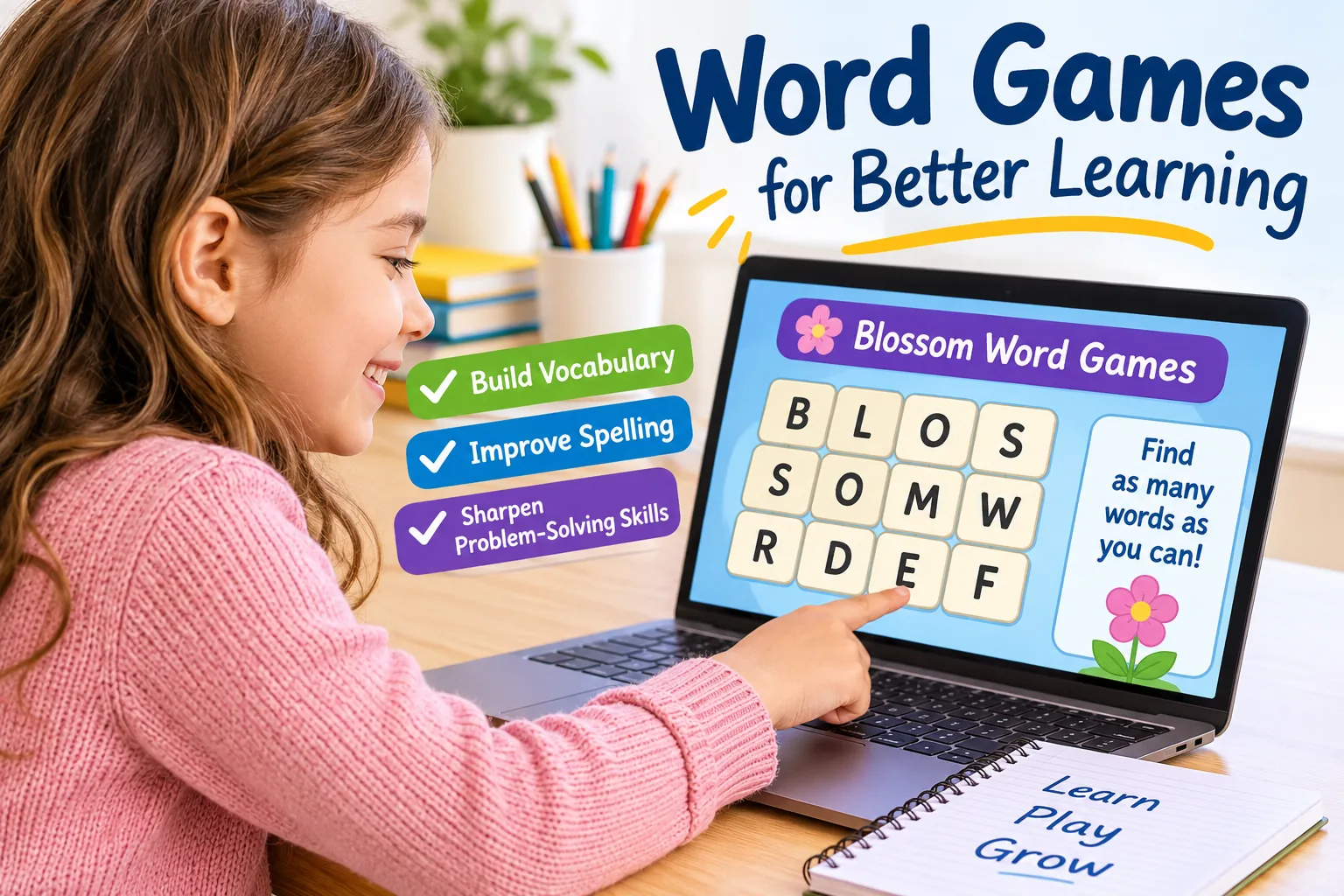
How Word Games Help Students Improve Vocabulary and Spelling
Learning new words helps students become better readers, writers, and communicators. However, memorizing long word lists can feel boring. Word games offer a simple way to practice spelling, recognize letters, and learn new vocabulary while having fun.
Teachers can use word puzzles in the classroom, while parents can encourage children to play them at home. These activities make language practice more interesting and give students a chance to use what they learn.
Why Vocabulary Is Important
Vocabulary includes the words students understand and use when reading, writing, and speaking. A strong vocabulary helps students understand lessons, follow instructions, and express their ideas clearly.
Students need more than word definitions. They also need to know how words are spelled and how to use them in sentences. Reading, writing, and word games can help build these skills.
How Spelling and Vocabulary Affect Grades
Spelling and vocabulary do not only matter in English class. They show up across a student’s report card.
Spelling tests are usually graded directly, so every correct word counts toward the final score.
Written assignments in history, science, and other subjects often include marks for clarity and correct language. Spelling errors can cost points even when the ideas are good.
Essay rubrics in many schools include a line for spelling, grammar, and word choice. A student with a strong vocabulary can express an argument more precisely and score better on that line.
Reading comprehension also gets easier when a student recognizes more words. Fewer unfamiliar words means fewer misread questions.
This is why small amounts of regular practice matter. A student who learns a few new words each week is not only preparing for a spelling test. They are building a skill that supports marks across several subjects.
How Word Games Support Learning
1. Improve Spelling
Word games encourage students to pay attention to letters and their order. Activities such as word scrambles and missing-letter puzzles help learners practice spelling in an active way.
2. Build Vocabulary
Word puzzles introduce students to different words and letter combinations. When students find an unfamiliar word, they can look up its meaning and use it in a sentence.
3. Encourage Problem-Solving
Many word games require players to test different combinations before finding an answer. This encourages students to think carefully, compare possibilities, and try another approach when needed.
4. Make Learning More Interactive
Students can solve puzzles alone or work in teams. Group activities give them a chance to share ideas, discuss spelling, and learn from one another.
Popular Word Games for Students
Teachers and parents can choose activities based on students’ ages and skill levels.
- Word searches: Find hidden words in a grid of letters.
- Crossword puzzles: Use clues to complete words.
- Word scrambles: Rearrange letters to make correct words.
- Missing-letter games: Fill in the letters needed to complete a word.
- Daily word puzzles: Solve a short word challenge each day.
These games offer different ways to practice spelling, recognize words, and expand vocabulary.
Practice with Blossom Word Games
Online word puzzles give students an easy way to practice outside the classroom. Blossom Word Game offers a word game activity for people who enjoy finding words and solving letter challenges.
Students can use it during a study break or as a short daily activity. To get more learning value from each game, they can:
- Look carefully at the available letters.
- Find as many valid words as possible.
- Check the spelling of unfamiliar words.
- Look up new words in a dictionary.
- Use a newly learned word in a sentence.
This turns a simple game into an opportunity to learn and practice vocabulary.
Simple Classroom Activities
Teachers can add word games to lessons without changing their regular teaching plans.
- Start with a short challenge: Give students a set of letters and ask them to create as many words as possible.
- Organize team games: Let small groups work together to solve a word puzzle.
- Introduce a new word: Ask students to explain its meaning and write a sentence using it.
- Review spelling mistakes: Discuss incorrect answers and help students understand the correct spelling.
Even a few minutes of practice can add variety to a language lesson.
Choosing the Right Word Game
The best game depends on the student’s age and reading level. Younger learners may benefit from simple letter and spelling activities, while older students may prefer puzzles with more challenging words.
Parents and teachers should also make sure that students understand the words they find. Reading, writing, and teacher guidance remain important parts of learning. Word games work best as an extra learning activity rather than a replacement for regular lessons.
Final Thoughts
Word games make spelling and vocabulary practice more enjoyable. They help students recognize letters, explore new words, and improve their spelling through regular practice.
Teachers can use them for classroom activities, and parents can encourage children to play at home. With a little practice each day, word puzzles can become a useful part of learning.
Frequently Asked Questions
Do word games really improve spelling?
Word games give students repeated practice with letters, patterns, and word structure, which is the kind of practice that builds spelling skill. They work best alongside regular lessons rather than on their own. A student who plays a word puzzle and then checks the spelling of any unfamiliar word will get more out of it than one who simply plays.
How often should students play word games?
A short session most days works better than one long session once a week. Ten to fifteen minutes is enough for younger students. Regular practice helps new words move into long-term memory.
What age are word games suitable for?
Simple word searches and missing-letter puzzles suit early readers. Crosswords and word scrambles suit older primary students. Teenagers can handle daily word challenges and puzzles with less common vocabulary. Match the game to the student’s reading level rather than only their age.
Can word games replace spelling lessons?
No. Word games are practice, not instruction. Students still need to be taught spelling patterns, rules, and word parts. Games reinforce what has already been taught and keep the practice interesting.
Do word games help with grades?
Indirectly, yes. Spelling and vocabulary affect spelling test scores, written assignments, and reading comprehension across subjects. A student who practices regularly tends to lose fewer marks to spelling errors and can express ideas more clearly in written work.
How can parents support word game practice at home?
Keep it short and low pressure. Ask the child to explain one new word they found, then write it in a sentence together. Avoid turning it into a test, since the point is to keep the practice enjoyable.