
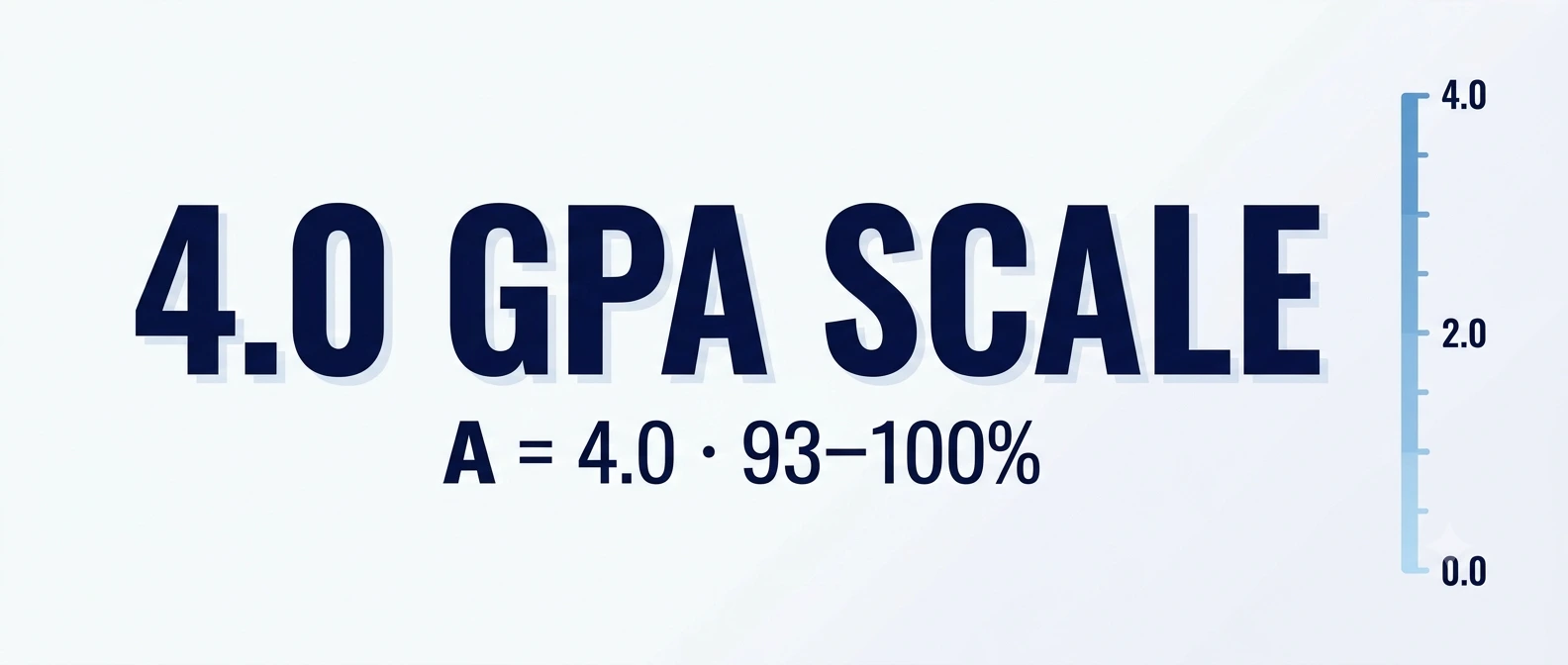
The 4.0 GPA Scale Explained: Chart, Percentages & Conversion
The 4.0 GPA Scale Explained: Chart, Percentages, and How to Convert
The 4.0 GPA scale is the grading system used by most US schools, where every letter grade is worth a set number of points from 0.0 up to 4.0, and a straight-A average earns the top score of 4.0.
Your grade point average is simply the average of those points across all your classes. The scale turns years of letter grades into one clean number between 0 and 4, which gives colleges a fair way to compare students from schools that grade very differently.
| Quick Fact | Answer |
|---|---|
| Highest score | 4.0 (an A average) |
| Lowest score | 0.0 (an F average) |
| A 4.0 in percentage | 93% to 100% |
| Standard type | Unweighted (caps at 4.0) |
| Weighted version | Goes up to 5.0 |
| Who uses it | Most US high schools and colleges |
What Is the 4.0 GPA Scale?
The 4.0 GPA scale is a point system that converts letter grades into numbers, running from 0.0 for an F up to 4.0 for an A. Your GPA is the average of all those points, which is why a perfect 4.0 means you earned A’s in every class.
It exists to fix a simple problem. Letter grades on their own do not average neatly, and raw percentages swing wildly from one teacher to the next. One school’s 90 percent might be another school’s 85. The 4.0 scale flattens all of that into a single standardized number, so a 3.6 means roughly the same thing in Texas as it does in Ohio.
This is the version colleges think in. When an admissions officer reads your file, they are picturing where you fall on a 0 to 4 line, not a 0 to 100 one. Knowing how the scale works puts you on the same page as the people reading your application.
How the 4.0 Scale Assigns Points to Each Letter Grade
Each letter grade is worth a fixed number of grade points. At its simplest, an A is 4 points, a B is 3, a C is 2, a D is 1, and an F is 0. Most schools then add plus and minus grades to fill in the gaps between whole numbers.
The logic is easy to follow. Every step up a letter is worth a full point, and every plus or minus shifts the value by roughly three tenths. So a B sits at 3.0, a B plus nudges up to 3.3, and an A minus lands at 3.7. Those decimals are what let a GPA land on a number like 3.4 or 3.8 instead of only hitting round figures.
Unweighted vs Weighted 4.0 Scale (Why Some GPAs Go Above 4.0)
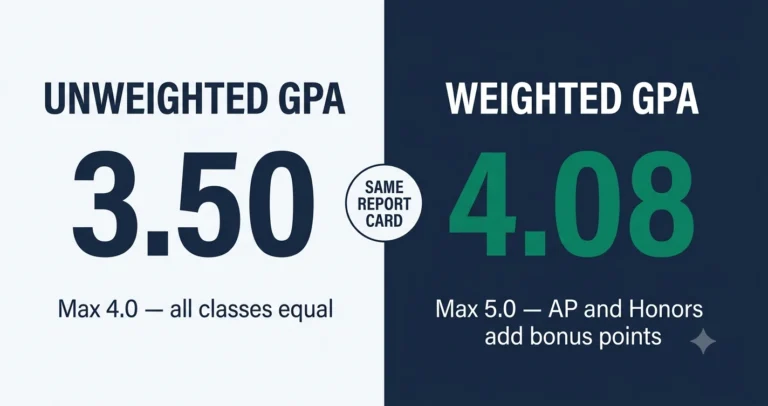
An unweighted 4.0 scale caps every class at 4.0, no matter how hard the course is. A weighted scale adds bonus points for advanced classes, which is exactly why some students post GPAs above 4.0.
On an unweighted scale, an A is worth 4.0 whether you earned it in standard English or AP Physics. The scale treats every class as equal. This is the cleaner number for comparing students fairly, which is why most colleges lean on it.
A weighted scale rewards difficulty. Schools commonly add half a point for honors classes and a full point for AP or IB courses, so an A in an AP class can be worth 5.0 instead of 4.0. Stack enough of those together and a student can finish high school with a 4.3 or even a 4.5. The number looks bigger, but it only makes sense once you know the course load behind it.
4.0 GPA Scale Chart (Letter Grade, Percentage, and Points)
This chart shows how letter grades, percentages, and grade points line up on the standard unweighted 4.0 scale used by most US schools. Exact percentage cutoffs vary slightly between schools, so always check your own school’s official scale before treating a single number as final.
| Letter Grade | Percentage | 4.0 Scale Points |
|---|---|---|
| A+ | 97–100% | 4.0 |
| A | 93–96% | 4.0 |
| A- | 90–92% | 3.7 |
| B+ | 87–89% | 3.3 |
| B | 83–86% | 3.0 |
| B- | 80–82% | 2.7 |
| C+ | 77–79% | 2.3 |
| C | 73–76% | 2.0 |
| C- | 70–72% | 1.7 |
| D+ | 67–69% | 1.3 |
| D | 65–66% | 1.0 |
| F | Below 65% | 0.0 |
A few things stand out once you see the full picture. An A+ and a plain A usually carry the same 4.0 value, since the standard scale does not reward going above a 4.0 unless the school uses a special system. The drop from an A to an A minus costs three tenths of a point, the same as every other minus step. And the gap between a B plus at 3.3 and an A minus at 3.7 is where a lot of GPAs live, which is why moving a few high B’s up to A minuses can lift an average more than students expect.
Plus/Minus Grade Values on the 4.0 Scale
Plus and minus grades adjust a letter’s base value by about three tenths of a point. A plus adds roughly 0.3, and a minus subtracts roughly 0.3, with one common exception at the very top.
Here is how it plays out. A straight B is 3.0. Add a plus and it becomes 3.3. Add a minus instead and it drops to 2.7. The same pattern repeats for every letter, so a C plus is 2.3 and a C minus is 1.7. The exception is the A. Many schools cap an A plus at 4.0 rather than 4.3, because the unweighted scale is not designed to go higher. Schools that do award a 4.3 for an A plus are using a slightly expanded version of the scale, which is worth confirming in your student handbook.
Not every school uses plus and minus grades at all. Some keep it simple with whole letters only, where every A is 4.0 and every B is 3.0. On those scales, GPAs tend to cluster on rounder numbers because there are no decimals feeding in from individual grades.
What Percentage Is a 4.0 GPA?
A 4.0 GPA equals 93 to 100 percent on the standard scale. That range reflects a straight-A average, since most schools set the cutoff for a full A at 93 percent.
People often expect a 4.0 to mean a flawless 100 percent, but it does not. The scale stops distinguishing once you cross into A territory. A 94 and a 99 both count as a 4.0, because both are A’s, and the 4.0 system rewards the letter rather than the exact percentage behind it. That is good news for students, since it means you do not need perfect scores to reach a perfect GPA. You need consistent A’s.
Why a 4.0 Equals 93–100%, Not a Single Number
A 4.0 covers a range because grade points are tied to letter grades, and each letter grade spans a band of percentages. The A band starts at 93 percent and runs to 100, so every percentage inside it converts to the same 4.0.
Think of it as a ladder rather than a slope. Inside each rung, the value stays flat. A 93 and a 96 sit on the same rung, so they share the same grade point. You only change your grade point when you step up or down a full letter or a plus-minus notch. This is why a student with all 93s and a student with all 100s can both graduate with an identical 4.0, even though their raw percentages look very different.
It also explains why chasing percentage points past the A cutoff does not raise your GPA. Once you are safely above 93 in a class, extra points pad your class grade but do nothing for your 4.0 average. Your effort is better spent pulling up a class sitting at a B.
How to Convert Your Percentage to a 4.0 Scale
To convert a percentage to the 4.0 scale, match your percentage to its letter grade, then read off the grade point that letter is worth. A 90 percent becomes an A minus, which is 3.7. An 85 percent becomes a B, which is 3.0.
The key thing to understand is that there is no single math formula that fits every school, because the cutoffs differ. The reliable method is always to convert through the letter grade rather than running a percentage through an equation. The chart below does that work for you across the full range.
Percentage-to-4.0 Conversion Chart (60% to 100%)
Find your percentage in the left column to see its letter grade and exact value on the 4.0 scale. This is the standard conversion most US schools follow.
| Percentage | Letter Grade | 4.0 Scale |
|---|---|---|
| 97–100% | A+ | 4.0 |
| 93–96% | A | 4.0 |
| 90–92% | A- | 3.7 |
| 87–89% | B+ | 3.3 |
| 83–86% | B | 3.0 |
| 80–82% | B- | 2.7 |
| 77–79% | C+ | 2.3 |
| 73–76% | C | 2.0 |
| 70–72% | C- | 1.7 |
| 67–69% | D+ | 1.3 |
| 63–66% | D | 1.0 |
| 60–62% | D- | 0.7 |
| Below 60% | F | 0.0 |
Two conversions trip people up the most, so they are worth calling out. A 90 percent is not a 4.0. On the standard scale it is an A minus, worth 3.7, because the full A does not begin until 93. And a score in the high 80s, like an 89, lands as a B plus at 3.3 rather than rounding up to an A. Those few points right at the boundary make a real difference to your average, which is why knowing the exact cutoffs matters.
Worked Example: Converting an 89% to the 4.0 Scale
An 89 percent converts to a B plus, which is worth 3.3 on the 4.0 scale. It does not round up to an A minus, even though it sits just one point below the 90 percent cutoff.
Here is the full walk-through. You earned an 89 in a class. You look at the chart and find that 87 to 89 percent is the B plus band. B plus carries 3.3 grade points. So that single class contributes 3.3 to your average, not the 3.7 you would have earned with one more percentage point.
This example shows why borderline grades are worth fighting for. The difference between an 89 and a 90 is a single point in the class, but on the 4.0 scale it is the difference between 3.3 and 3.7. Across several classes, those boundary points add up fast. If you are sitting at an 89 late in a term, that is the grade to focus on, because pushing it over the line moves your GPA more than improving a grade you have already locked into a band.
How to Convert a Weighted or 5.0 Scale GPA to 4.0
To convert a weighted or 5.0 scale GPA to the standard 4.0 scale, go back to your original letter grades and recalculate without the bonus points. There is no accurate shortcut formula, because weighting is added on top of the base grades rather than baked into a fixed ratio.
This surprises people who expect a clean conversion like dividing by five and multiplying by four. That math does not hold, because two students with the same weighted GPA can have completely different underlying grades depending on how many advanced classes they took. The only dependable path is to strip the weighting and rebuild from the letters.
Converting a 5.0 Weighted GPA to the Unweighted 4.0 Scale
Start with your list of classes and the actual letter grade you earned in each one. Ignore whether the class was honors, AP, or standard for a moment, and assign each grade its base 4.0 value. An A is 4.0, a B is 3.0, and so on. Average those base values and you have your unweighted GPA on the 4.0 scale.
An example makes it concrete. Say a student has a 4.5 weighted GPA built on three AP classes where they earned A’s and two standard classes where they earned B’s. The weighted number counted each AP A as 5.0. To unweight it, you drop the AP A’s back to 4.0 and keep the B’s at 3.0. The recalculated average lands around 3.6 on the 4.0 scale. The weighted 4.5 and the unweighted 3.6 describe the exact same report card.
How Colleges Recalculate Your GPA to a 4.0 Scale
Many colleges ignore the GPA printed on your transcript and recalculate their own. They commonly strip out weighting, drop non-academic electives, and convert everything to a clean unweighted 4.0 scale so that applicants from different schools can be compared on equal footing.
The process usually looks like this. An admissions office keeps your core academic grades in subjects like math, science, English, social studies, and world language. They set aside classes like physical education or study hall. They convert each remaining grade to the standard 4.0 value, removing any honors or AP bonus. Then they evaluate course rigor as a separate factor rather than letting it inflate the number itself.
The takeaway for you is reassuring. You do not need to do this recalculation yourself before applying, since each school applies its own method. What you can control is the raw material: strong letter grades in challenging classes look good under every recalculation system, weighted or not.
How to Calculate Your GPA on a 4.0 Scale
To calculate your GPA on a 4.0 scale, convert each grade to its point value, multiply by the course’s credit hours, add those results together, and divide by your total credit hours. The answer is your grade point average.
Credit hours matter because not every class carries equal weight toward your GPA. A four-credit course pulls on your average four times as hard as a one-credit elective, so the math has to account for that. Skipping the credit step is the most common mistake students make when figuring their GPA by hand.
Step-by-Step: Grade Points × Credits ÷ Total Credits
Follow these four steps to find your GPA for a single term.
- Convert each grade to points. Use the scale chart above. An A is 4.0, a B plus is 3.3, and so on for every class.
- Multiply each by its credit hours. If you earned a 4.0 in a 3-credit class, that is 4.0 times 3, which equals 12 quality points.
- Add up all the quality points. Total the results from every class to get your sum of quality points for the term.
- Divide by total credit hours. Take that sum and divide it by the total number of credits you took. The result is your GPA.
Here is a quick worked example. A student takes three classes: an A (4.0) in a 4-credit class, a B (3.0) in a 3-credit class, and a B plus (3.3) in a 3-credit class. The quality points are 16, 9, and 9.9, which add up to 34.9. The total credits are 10. Dividing 34.9 by 10 gives a GPA of about 3.49 for the term.
Calculating Cumulative GPA Across Semesters
Your cumulative GPA is the average of every class across every semester, not the average of your semester GPAs. To find it, add the quality points from all terms together, then divide by the total credit hours from all terms combined.
This distinction catches a lot of people. You cannot simply average a 3.8 from fall and a 3.4 from spring to get 3.6, because the two semesters may carry different numbers of credits. A semester with more credit hours pulls the cumulative number toward itself. The accurate method is always to go back to the raw quality points and total credits, then divide once at the end.
This also explains why your cumulative GPA gets harder to move over time. Early on, a single strong semester can shift it noticeably. After three or four semesters, the weight of all those past credits anchors the number in place, so even a perfect term only nudges it.
Skip the Math With a 4.0 Scale GPA Calculator
Doing this by hand works, but it is slow and easy to slip up on, especially once you have several semesters and varied credit hours to track. The free GPA calculator at TheEasyGrader runs the whole process in seconds. You enter each class, its grade, and its credit value, and it returns your GPA on the 4.0 scale instantly, with no sign-up required.
It is also the fastest way to test scenarios before grades are final. You can plug in the grades you expect this term to see where your GPA will land, or check what you need in your remaining classes to reach a target like a 3.7. Running those numbers takes a minute and removes the guesswork that leads to nasty surprises at report card time.
How Do You Get a 4.0 GPA?
You get a 4.0 GPA by earning an A in every class, since the unweighted scale caps each grade at 4.0 and a perfect average requires straight A’s. On most scales an A means a percentage of 93 or higher in each course.
In practice, a 4.0 comes down to consistency more than brilliance. One low grade can pull a 4.0 down quickly, and unlike a class grade, a GPA never fully recovers, because past grades stay in the average. That puts the focus on steady habits rather than last-minute heroics.
A few approaches tend to separate students who hold a 4.0 from those who fall just short. They protect their grade in the classes that count for the most credits, since one slip there does the most damage. They stay on top of the work that is graded most heavily, like exams and major projects, instead of treating every assignment as equal. And they track their grades through the term rather than hoping it works out, so they can catch a sliding grade while there is still time to fix it. None of that requires being the smartest person in the room. It requires not letting any single grade quietly drop below an A.
Can You Get a GPA Higher Than 4.0?

Yes, you can get a GPA higher than 4.0, but only on a weighted scale. Weighted scales add bonus points for advanced classes, so an A in an AP or honors course can be worth more than 4.0, pushing your average as high as 5.0.
On an unweighted scale, 4.0 is the ceiling. Every A is worth exactly 4.0, and there is no way to climb past it, since the system does not reward course difficulty. A student taking all standard classes and a student taking all AP classes both top out at 4.0 if they earn straight A’s.
Weighted scales change that. A common setup gives an honors A a value of 4.5 and an AP or IB A a value of 5.0. A student loading up on those courses and earning A’s can finish with a 4.3, 4.5, or in rare cases close to 5.0. This is why valedictorians at competitive high schools sometimes report GPAs well above 4.0. It does not mean they scored above 100 percent. It means the scale gave extra credit for the difficulty of their schedule.
One caution worth keeping in mind. A GPA above 4.0 only impresses when the reader knows it came from a hard course load. Since colleges frequently recalculate to an unweighted scale anyway, the safest goal is strong grades in challenging classes, which wins on both the weighted and the unweighted version at once.
Is a 4.0 GPA Good?
Yes, a 4.0 GPA is excellent. It represents a straight-A average and sits well above the national average, which hovers around 3.0. A 4.0 places you among the top academic performers at almost any school.
It is the strongest unweighted GPA you can earn, so by definition nothing beats it on that scale. A 4.0 signals consistency, discipline, and command of your coursework, and it clears the academic bar for honors programs, competitive scholarships, and selective colleges. The only nuance is that at the most elite universities, a 4.0 is common among applicants, so it becomes the expected baseline rather than a standout feature, and the rest of your application carries more weight.
Is a 4.0 GPA Good in High School vs College?
A 4.0 is impressive in both settings, but it carries slightly different meaning in each. In high school, an unweighted 4.0 is the top of the scale and signals you are ready for rigorous college work. In college, a 4.0 is rarer and harder to sustain across demanding major courses, so it stands out even more.
High school grading tends to offer more cushion. Homework, participation, and extra credit can help protect an A, which makes a 4.0 achievable for a disciplined student. Admissions officers read it alongside your course rigor, so a 4.0 built on honors and AP classes reads stronger than one built entirely on standard sections.
College is a different game. Grades often hinge on a handful of high-stakes exams and papers, curves can be steep, and the material is harder. Holding a 4.0 through an entire degree is genuinely difficult, which is why a college 4.0 carries real weight with graduate programs and employers who screen by GPA. In both cases the number is excellent. College simply makes it tougher to earn.
Frequently Asked Questions
What is a 4.0 GPA in percentage?
A 4.0 GPA equals 93 to 100 percent on the standard scale. Any percentage inside the A range converts to a 4.0, because the scale rewards the letter grade rather than the exact score, so a 94 and a 99 both count as a perfect 4.0.
Is a 90% a 4.0 GPA?
No, a 90 percent is not a 4.0 on the standard scale. A 90 percent is an A minus, which is worth 3.7. The full A, valued at 4.0, usually begins at 93 percent, so a 90 falls just short. Some schools use different cutoffs, so check your own scale to be sure.
What grades do you need for a 4.0 GPA?
You need an A in every class to earn a 4.0 GPA on the unweighted scale. A single B drops the average below 4.0, and because past grades stay in your cumulative GPA, recovering a perfect 4.0 after one B is mathematically impossible unless it is very early in your record.
Is a weighted GPA on a 4.0 scale?
A weighted GPA is based on the 4.0 scale but extends above it. Standard classes still top out at 4.0 for an A, while honors and AP classes add bonus points, often reaching 4.5 or 5.0 for an A. So a weighted GPA uses the 4.0 scale as its foundation but is not capped at 4.0.
Can your GPA be higher than 4.0?
Yes, but only on a weighted scale. Bonus points for honors, AP, and IB classes can push a weighted GPA above 4.0, sometimes as high as 5.0. On an unweighted scale, 4.0 is the maximum and cannot be exceeded.
What is a 4.0 GPA out of 5.0?
On a 5.0 weighted scale, a 4.0 sits below the top and usually reflects strong grades without a heavy load of weighted classes, or solid B-level work in advanced courses. The 5.0 ceiling is reserved for A’s earned in AP or IB classes, so a 4.0 on that scale is good but leaves room above it.
Do colleges prefer a 4.0 unweighted or a higher weighted GPA?
Colleges generally value a strong GPA paired with challenging courses over a high number alone. A higher weighted GPA earned through AP and honors classes often signals more rigor than a 4.0 unweighted from standard classes. Since many colleges recalculate to their own scale, the safest aim is top grades in demanding courses, which looks strong either way.
Calculate Your GPA on the 4.0 Scale
Knowing how the 4.0 scale works is the first step. Knowing your own exact number on it is what actually helps you make decisions, whether you are aiming for a scholarship cutoff, a Dean’s List spot, or simply a clear picture of where you stand.
Run your real grades through the free GPA calculator at TheEasyGrader. Enter each class, grade, and credit value to see your GPA on the 4.0 scale in seconds, with no sign-up. Then test what your upcoming grades would do to the number, so you know exactly which classes to focus on. The students who hit their GPA goals are usually the ones who keep an eye on the number all term instead of waiting for the final report.




Normally I don’t learn post on blogs, but I would like to say that this write-up very forced me to take a look at and do so!
Your writing taste has been amazed me. Thanks, very great article.