
What Is a 3.5 GPA? Letter Grade, Percentage & Is It Good
What Is a 3.5 GPA? Letter Grade, Percentage & Is It Good
Written by Safeer · Reviewed by Danish, a former high school teacher. Last updated: August 2026

A 3.5 GPA is equal to a B+ letter grade and roughly 87 to 90 percent on the standard 4.0 unweighted scale, and it is considered a good GPA.
It sits well above the national high school average of about 3.0, which puts you in strong shape for most colleges and many merit scholarships. The exact percentage depends on the grading scale your school uses, which is why you will see slightly different conversions from one source to another.
| Quick Fact | Answer |
|---|---|
| GPA | 3.5 on a 4.0 scale |
| Letter grade | B+ (rounds to A- on some scales) |
| Percentage | 87% to 90% |
| National HS average | About 3.0 |
| National percentile | Around the 70th to 80th percentile |
| Is it good? | Yes, above average |
| College ready? | Competitive at most schools |
Is a 3.5 GPA Good?
Yes, a 3.5 GPA is a good GPA. It means you earned mostly A’s and B’s across your classes, and it clears the cutoff for honors programs, many merit scholarships, and the published GPA range at hundreds of colleges.
Here is the practical way to think about it. A 3.5 will not close any doors on its own. The most selective schools in the country will want more than the number, but everywhere else, a 3.5 keeps you firmly in the conversation.
Is a 3.5 GPA bad? No. A 3.5 is the opposite of a bad GPA. The only time it feels like a weak spot is when you are applying to a handful of elite schools where admitted students average close to 4.0. Against the national picture, a 3.5 is an above-average result that most students would be glad to hold.
What Does a 3.5 GPA Mean?
A 3.5 GPA means your grades, averaged across every class and weighted by credit, came out to a high B. In plain terms, you have been a consistent A-and-B student rather than a straight-A student or a straight-B student. It signals reliable academic performance without claiming perfection, and that is exactly how colleges and employers read it.
It is not perfection. But it reflects someone who shows up, does the work, and performs consistently across their courses. That matters more than people think.
3.5 GPA vs the National Average
The average high school GPA in the United States sits around 3.0. A 3.5 puts you a full half point above that, which is a bigger gap than it sounds. On a scale that only runs from 0 to 4, half a point separates a B student from a B+/A- student.
In practical terms, a 3.5 places you somewhere around the 70th to 80th percentile nationally among high school students. You are performing better than roughly three out of every four peers.
In college, the average GPA runs slightly higher, usually around 3.1 to 3.15 depending on the institution. A 3.5 in college still lands you comfortably above the middle of the pack.
3.5 GPA in High School vs College
The same number carries different weight in each setting. In high school, a 3.5 is mainly judged by admissions officers, and they read it alongside your course rigor. A 3.5 built on AP and honors classes reads stronger than a 3.5 built entirely on regular sections.
In college, a 3.5 is judged by graduate programs and employers. It typically qualifies you for Dean’s List consideration at many universities, keeps you eligible for cum laude honors at some schools, and clears the screening cutoff that certain employers and grad programs apply to applications.
What Percentage Is a 3.5 GPA?
A 3.5 GPA converts to approximately 87 to 90 percent. The most commonly cited single figure is 88 percent, which lands in the middle of the B+ range on the standard US grading scale.
This conversion holds whether the 3.5 is a single semester GPA or a cumulative GPA built across several terms. A cumulative 3.5 simply means that once every class from every semester is averaged together, the result still lands at that high-B, 87 to 90 percent level.
Why the Answer Ranges from 87% to 90%
GPA and percentage do not convert through one universal formula. A GPA is an average of grade points, and each letter grade covers a band of percentages, not a single number. A B+ covers 87 to 89 percent, and an A- starts at 90.
A 3.5 sits exactly between a B+ (3.3) and an A- (3.7) in grade points. Depending on how a school or evaluator maps that midpoint, the conversion lands anywhere from 87 to 90 percent. Some simple linear formulas even produce 87.5 percent. All of these answers are correct within their own systems, which is why you should always check the conversion chart your own school publishes before quoting a single number on an application.
3.5 GPA Conversion Chart (4.0 Scale)
This chart shows where a 3.5 falls within the standard unweighted scale used by most US high schools and colleges.
| GPA | Letter Grade | Percentage |
|---|---|---|
| 4.0 | A | 93–100% |
| 3.7 | A- | 90–92% |
| 3.5 | B+ / A- borderline | 87–90% |
| 3.3 | B+ | 87–89% |
| 3.0 | B | 83–86% |
| 2.7 | B- | 80–82% |
| 2.3 | C+ | 77–79% |
| 2.0 | C | 73–76% |
What Letter Grade Is a 3.5 GPA?
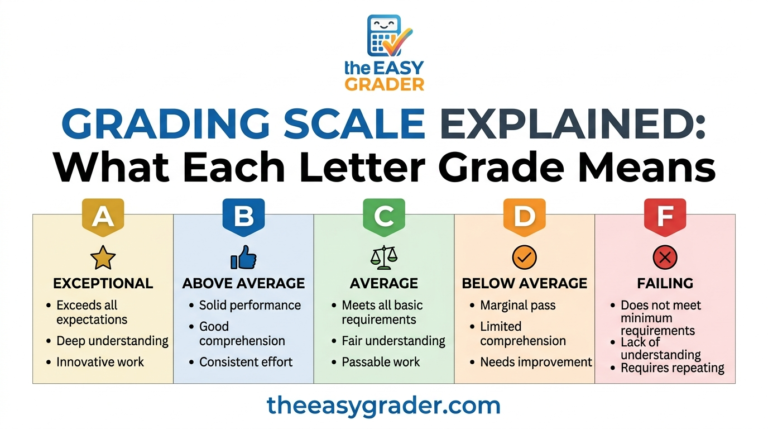
A 3.5 GPA is a B+ letter grade on the standard 4.0 scale. It tells colleges and employers that your typical grade was a high B, with enough A’s mixed in to pull the average above a plain B.
In real transcripts, a 3.5 rarely comes from earning a B+ in every single class. It usually comes from a mix, something like half A’s and half B’s. Two students can both hold a 3.5 with completely different grade patterns, and the average smooths it into one number.
When a 3.5 Rounds to A- Instead of B+
Some schools and scholarship committees treat 3.5 as the floor of the A- band rather than the ceiling of the B+ band. On those scales, anything from 3.5 to 3.69 displays as an A- average.
This matters most for honor roll cutoffs and Latin honors. A school that defines honor roll as an A- average and sets the line at 3.5 will include you. A school that sets the line at 3.7 will not. The number itself never changes, only the label attached to it, so check the exact cutoff in your school handbook before assuming either way.
Weighted vs Unweighted 3.5 GPA
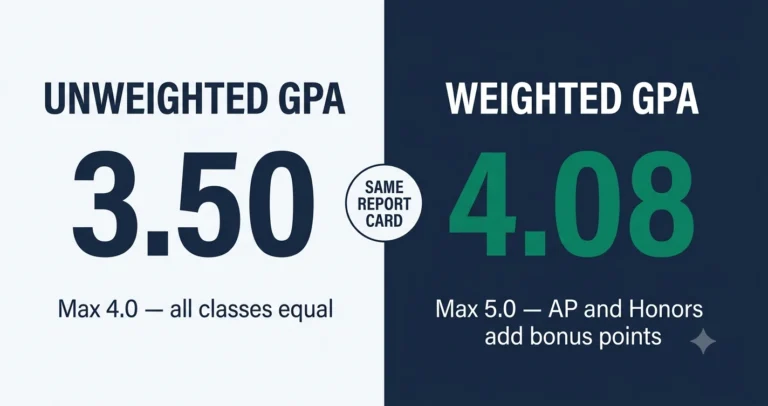
An unweighted 3.5 and a weighted 3.5 are not the same achievement. Unweighted GPA caps every class at 4.0 points. Weighted GPA awards bonus points for advanced coursework, typically 4.5 for honors and 5.0 for AP or IB classes.

Unweighted 3.5 GPA Explained
On an unweighted scale, an A earns 4.0 points whether it came from regular English or AP Calculus. A 3.5 unweighted means your raw grades averaged out to mostly A’s and B’s, with no adjustment for difficulty. This is the cleaner number for comparing students across different schools, which is exactly why many colleges recalculate every applicant’s GPA to an unweighted scale.
Weighted 3.5 GPA Explained
On a weighted scale that tops out at 5.0, a 3.5 tells a different story. Because advanced classes earn bonus points, a student taking several AP courses can hold a weighted GPA above 4.0. A weighted 3.5 in a schedule full of AP classes may reflect raw grades closer to a B average.
Context decides what the number means. A weighted 3.5 with a light course load and a weighted 3.5 with a heavy AP load represent very different transcripts, even though the GPA reads identically.
Which One Do Colleges Look At?
Most selective colleges look at both, then recalculate. Admissions offices commonly strip electives, convert your core academic grades to an unweighted 4.0 scale, and evaluate course rigor as a separate factor rather than letting bonus points inflate the number.
Admissions readers pay close attention to this distinction. A student who earned a 3.5 while taking eight AP courses looks very different from a student who earned the same number in all standard-level classes. They want to see that you pushed yourself with the opportunities your school offered.
The practical takeaway: do not chase a weighted number for its own sake. Strong grades in challenging classes win on both measurements at once.
What Colleges Can You Get Into with a 3.5 GPA?
A 3.5 GPA puts you inside the typical admitted-student range at the majority of four-year colleges in the United States. Hundreds of schools report average freshman GPAs at or below 3.5, which makes them realistic targets, and hundreds more sit close enough that strong test scores or essays can close the gap.
The usual way to organize your list is into three tiers: reach, match, and safety.
Reach Schools (Top 20 / Ivies)
Admission to Ivy League and top-20 universities is possible with a 3.5, but it is an uphill climb. Admitted students at schools like Harvard, Stanford, and MIT typically average 3.9 or higher unweighted, so a 3.5 sits below their usual range.
Applicants who get in at this level with a 3.5 almost always bring something else that stands out: exceptional test scores, a strong upward grade trend, a notable talent or achievement, or a compelling personal story. Think national awards, published research, or a background that genuinely sets the application apart. Apply if a school truly fits your goals, but treat it as a reach and build the rest of your list around more probable outcomes.
Match Schools (Top 50 / State Flagships)
This tier is where a 3.5 does its best work. Many state flagship universities and well-regarded private colleges report middle-50-percent GPA ranges that include 3.5.
Schools like Michigan State, Penn State, the University of Oregon, and Temple University regularly admit students in the 3.3 to 3.7 range, which means a 3.5 is not a reach at all. You belong there academically, and the rest of your application does the work of standing out.
A step up from that, schools such as Boston University, Northeastern, and Tulane admit students who typically fall between 3.5 and 3.9. A 3.5 keeps you in the conversation but places you at the lower edge of the window, so a strong test score or a meaningful extracurricular commitment matters more here.
If you took honors or AP courses on the way to your 3.5, mention course rigor prominently. Admissions readers at this tier reward students who challenged themselves.
Safety Schools
With a 3.5, your safety list is long. Hundreds of accredited four-year colleges admit the majority of applicants and report average GPAs below 3.5, which means your number sits above their typical admit. Pick two or three safeties you would genuinely attend, confirm you exceed their published GPA range, and you have a secure floor under your entire application strategy.
Does Your Major Change What a 3.5 Means?
It does, and the people reviewing your transcript know it.
STEM fields grade harder. At large public universities, average GPAs in disciplines like chemical engineering, applied mathematics, and physics typically fall between 3.2 and 3.4. Earning a 3.5 in those programs means you are outperforming the average student in your department.
Humanities and social sciences tend to cluster higher. English, history, and communications majors often see averages between 3.5 and 3.7. A 3.5 in those areas is respectable, but it does not jump off the page the way it would in a harder grading environment.
The point is that context matters. A 3.5 in mechanical engineering and a 3.5 in sociology represent different levels of difficulty, and the people evaluating your record generally understand the grading norms for your field. This is also why many programs and employers look at your major GPA separately from your cumulative one.
Is a 3.5 GPA Good for Graduate School?
Most master’s programs set their minimum requirement around 3.0, so a 3.5 puts you above that bar with room to breathe. For many programs, especially outside the top tier, this number alone will not hold you back.
More competitive programs in fields like law, medicine, and business tend to expect higher numbers, often 3.7 or above, paired with strong entrance exam scores. But graduate admissions weigh far more than your transcript. Research experience, professional work, letters of recommendation, and your personal statement all play significant roles. A complete application with a 3.5 and strong supporting materials can absolutely get you into excellent programs.
One thing worth noting is that many programs look at your major courses separately from your overall average. If you performed better in your field of study than in your general education classes, highlighting your major performance can work to your advantage.
What a 3.5 GPA Means for Jobs and Employers
Once you step out of academia and into the job market, the rules shift. Your transcript still matters early on, but the way employers use it is far more straightforward than college admissions.
Your First Job
Most companies that hire recent graduates use 3.0 as their screening cutoff. A smaller group of competitive employers in consulting, investment banking, and big tech raises that bar to 3.5. If you are at or above that mark, your resume will not get filtered out at either level.
Career experts generally advise putting your academic performance on your resume if it falls at 3.5 or above. At that level, it signals discipline and consistency, which are qualities hiring managers value in candidates who do not yet have extensive work history.
Competitive Industries
In fields like finance, accounting, engineering, and technology, academic performance carries more weight during campus recruiting. Companies that receive hundreds of applications use it as a quick way to narrow the pool. Being at 3.5 keeps you competitive in those environments, especially when paired with relevant internship experience.
The Shift That Happens After Year One
Here is something most students do not hear often enough. Once you land your first role and build a year or two of professional experience, your academic record becomes largely irrelevant for most employers. Hiring managers care about what you have accomplished at work, the skills you bring, and the results you can point to.
Most career advisors suggest removing academic details from your resume entirely after about three to five years in the workforce. At that point, your professional track record speaks for itself.
Is a 3.5 GPA Enough for Scholarships?
Yes. A 3.5 GPA meets or exceeds the eligibility line for a large share of merit scholarships. Most merit awards set their minimum somewhere between 3.0 and 3.5, so a 3.5 clears nearly all of those thresholds.
Merit-Based Scholarships
Merit aid rewards academic performance directly. Three common places to find it with a 3.5:
- Automatic university awards. Many public universities publish GPA-based scholarship grids. A 3.5 frequently lands in a middle or upper tier that discounts tuition without any separate application. A 3.5 paired with a strong test score often qualifies for partial tuition at public institutions.
- Private and foundation scholarships. Community foundations, employers, and national programs often set a 3.0 or 3.25 floor. A 3.5 qualifies and competes well.
- Departmental awards. Once enrolled, academic departments offer scholarships to continuing students, and a 3.5 college GPA typically keeps you eligible.
One caution: the most competitive full-ride programs often expect 3.8 and above. A 3.5 qualifies you for the broad middle of the scholarship market rather than the very top of it.
Athletic and Need-Based Aid
Athletic scholarships work on different rules. NCAA Division I and II eligibility requires a minimum core-course GPA far below 3.5, so a 3.5 comfortably exceeds the academic floor and can strengthen a recruit’s profile with coaches who care about team academic standing.
Need-based aid, including federal grants, is calculated from family finances rather than grades. Your 3.5 does not increase need-based awards, but many schools require you to maintain satisfactory academic progress to keep receiving them, and a 3.5 clears that bar easily.
Graduating With Honors
There is also the matter of Latin honors. At many colleges, a cumulative average of 3.5 or above earns you a cum laude designation. That distinction appears on your diploma and your transcript, and it carries real weight early in your career.
What Grades Do You Need for a 3.5 GPA?
To reach a 3.5 GPA on a standard scale where an A is 4.0 and a B is 3.0, you need an equal split of A’s and B’s: one B for every A. Ten classes with five A’s and five B’s average exactly 3.5.
Plus and minus grades shift the math. An A- (3.7) paired with a B+ (3.3) also averages 3.5, so a transcript full of A- and B+ grades reaches the same number without a single flat A or flat B. Credit hours matter too. A B in a 4-credit course pulls your average down more than a B in a 1-credit elective, so two students with identical letter grades can hold slightly different GPAs.
If Your GPA Is Below 3.5
If your average falls somewhere in the 3.0 to 3.4 range, you are still in a perfectly respectable position. That range sits at or above the national average, and it does not close as many doors as you might fear.
What it does mean is that other parts of your profile need to do more work. Strong test scores, relevant internships, leadership experience, and thoughtful application essays can all compensate for numbers that are not at the top of the scale.
Colleges that use holistic admissions, which most of them do, evaluate your full picture. A student with a 3.3 who held a part-time job, led a campus organization, and earned a strong entrance exam score tells a more compelling story than someone with higher marks and nothing else to show for their years in school.
The same logic applies when you start applying for jobs. Employers want evidence that you can perform professionally. Real-world experience, skills, and initiative often matter more than a fraction of a point on a transcript.
How to Raise a 3.5 GPA to 3.7 or 4.0
Raising an already good GPA takes targeted effort, because every new grade gets averaged into everything you have already earned. The later you start, the more A’s it takes to move the number. These three levers move it fastest.
Focus on High-Credit Courses
Not all classes pull equally on your average. A 4-credit course influences your GPA four times as much as a 1-credit course. If your study time is limited, protect the A in your highest-credit classes first. One slip in a heavy course can erase the gains from three perfect electives.
The math also explains why early semesters matter so much. A 3.5 after one year can still reach 3.7 with strong grades. A 3.5 after three years has so many credits behind it that even straight A’s barely move it past 3.6. Start now, not next term.
Be realistic about your course load while you do it. Stacking five demanding classes in a single semester is a fast track to burnout. Balancing harder courses with lighter ones gives you the bandwidth to perform well where it counts.
Retake Policies and Grade Replacement
If one or two low grades are dragging your average down, a retake may be the single fastest fix available. School policies fall into three camps: some replace the original grade entirely, some average the two attempts, and some show both grades and count both.
Full grade replacement is the jackpot. Turning one C (2.0) into an A (4.0) in a 3-credit course lifts a GPA more than earning A’s in two brand-new classes. Read your school’s exact retake policy before deciding where to spend your effort, because the same retake produces very different results under each system.
Track Every Grade with a GPA Calculator
Students who raise their GPA share one habit: they always know their exact number and what each upcoming grade will do to it. Guessing leads to nasty surprises at the end of the semester.
The free GPA calculator at The Easy Grader handles this in seconds. Enter each course, grade, and credit value to see your current GPA, then test scenarios. What happens if the B+ in chemistry becomes an A-? What does next semester need to look like to hit 3.7? Running those numbers once a month keeps your target realistic and your effort pointed at the classes that actually move the average.r target realistic and your effort pointed at the classes that actually move the average.
Frequently Asked Questions
Is a 3.5 GPA an A or B?
A 3.5 GPA is a B+, sitting at the top of the B range. Some grading scales treat 3.5 as the start of the A- band instead, so the label depends on your school’s cutoffs, while the number itself stays the same.
What percentile does a 3.5 GPA put me in?
Nationally, a 3.5 places you around the 70th to 80th percentile among high school students. You are performing better than roughly three out of four peers.
What is a 3.5 GPA out of 5.0?
On a 5.0 weighted scale, a 3.5 is below the midpoint and usually reflects a B-range performance in a schedule with advanced classes. Converted proportionally, a 3.5 on a 4.0 scale corresponds to roughly a 4.4 on a 5.0 scale, though most schools weight by course type rather than converting directly.
Can I get into Harvard with a 3.5 GPA?
It is possible but rare. Admitted Harvard students typically hold unweighted GPAs near 4.0, so a 3.5 falls below the usual range. Applicants who succeed with a 3.5 generally bring an exceptional talent, achievement, or circumstance that the rest of the application makes unmistakable. Treat Harvard as a far reach and build a balanced list around it.
Does a 3.5 GPA qualify for honors or Dean’s List?
Often, yes. Many colleges set Dean’s List at a 3.5 semester GPA, which means you qualify exactly at the line. Others require 3.6 or 3.7. Latin honors at graduation usually start higher, with cum laude commonly beginning around 3.5 to 3.7 depending on the institution. Check your school’s published thresholds.
Is a 3.5 weighted GPA the same as a 3.5 unweighted GPA?
No. An unweighted 3.5 means your raw grades averaged between B+ and A- with no difficulty bonus. A weighted 3.5 includes bonus points for honors or AP classes, so the underlying grades are usually lower, often closer to a B average. Colleges know the difference and frequently recalculate to compare students fairly.
What jobs accept a 3.5 GPA?
Nearly all of them. Most employers never ask for a GPA, and among those that do, the common screening cutoff is 3.0. A 3.5 clears the bar at competitive programs in consulting, finance, engineering, and government that screen by grades. After your first job, work experience replaces GPA almost entirely.
Should I put a 3.5 GPA on my resume?
Yes, especially as a recent graduate. Career professionals widely recommend listing academic performance of 3.5 or higher, since it signals consistency when you do not yet have much work history. Once you have three to five years of experience, it becomes less relevant and can be removed.
Is a 3.5 GPA good for graduate school?
Yes, a 3.5 is a competitive GPA for most graduate programs, which commonly set minimums at 3.0. The most selective programs in law, medicine, and top-ranked doctoral fields skew higher, with admitted averages of 3.7 and above, so a 3.5 there needs support from strong test scores, research, or recommendations.
Is a 3.5 GPA good enough for medical school?
A 3.5 sits near the lower edge of the typical medical school admit range, where averages often land around 3.6 to 3.7. It is workable, not disqualifying. Applicants who get in with a 3.5 usually pair it with a strong MCAT score, since the two are weighed together. A high MCAT with a 3.5 GPA is a recognized and successful combination, while a low MCAT makes the 3.5 much harder to overcome.
How fast can I raise my GPA from 3.5 to 4.0?
Honestly, reaching a true 4.0 from a 3.5 is mathematically impossible unless you are very early in your academic career, because past grades never leave the average. What is realistic: a student with one year of credits can reach about 3.7 to 3.75 with straight A’s over the next year. Set 3.7 as the target, earn A’s from this point forward, and let the average climb as far as the credit math allows.
Calculate Your Exact GPA
A 3.5 is a number worth knowing precisely, not approximately. One rounding error or one forgotten credit value can put you on the wrong side of a scholarship cutoff or a Dean’s List line without you realizing it.
Take five minutes and run your real transcript through the free GPA calculator at TheEasyGrader. Enter every course, letter grade, and credit value to see your exact unweighted and weighted GPA instantly, with no sign-up. Then test what next semester’s grades would do to the number. Students who check their GPA regularly are the ones who hit their targets, because they always know exactly where they stand.