

What Is a Cumulative GPA? How to Calculate It + Examples
What Is a Cumulative GPA? How to Calculate It and Why It Matters
A cumulative GPA is the average of all your grades across every semester you have completed, combined into one number on a 0 to 4.0 scale.
It is the single figure that sums up your entire academic record so far, not just your most recent term. When a college, scholarship committee, or employer asks for your GPA, this is almost always the number they mean.
The part that trips people up is how it is built. Your cumulative GPA is not the average of your semester GPAs. It is calculated from every individual class and the credit hours behind each one, which is why a strong semester does not always move it as much as you would expect.
| Quick Fact | Answer |
|---|---|
| What it is | Your overall GPA across all completed terms |
| Scale | Usually 0.0 to 4.0 (unweighted) |
| Based on | Every class plus its credit hours |
| Different from | Semester GPA (one term only) |
| Used for | College applications, scholarships, honors, jobs |
| Changes over time | Yes, but more slowly as you earn more credits |
What Does Cumulative GPA Mean?
Cumulative GPA means your total grade point average across all the classes you have taken, added together into one running number. The word cumulative is the key. It accumulates. Every new grade gets folded into everything that came before it.
Picture a student who has finished two years of high school. Their cumulative GPA reflects all four semesters at once, every class from freshman and sophomore years combined. It is the long view of their performance, not a snapshot of how one term went.
Cumulative GPA in Simple Terms
In plain terms, your cumulative GPA is your grade average for your whole school career up to today. If you have taken thirty classes, it reflects all thirty, weighted by how many credits each one was worth.
Here is a simple way to think about it. Each class you finish drops a new grade into a jar. Your cumulative GPA is the average of everything in the jar right now. Add an A and the average ticks up. Add a C and it dips. The more grades already in the jar, the less any single new one moves the total.
This is different from a class grade, which only covers one course, and different from a semester GPA, which only covers one term. Cumulative GPA is the whole picture stitched together.
Cumulative GPA vs Overall GPA: Are They the Same?
Yes, in most cases cumulative GPA and overall GPA mean the same thing. Both describe your combined grade average across every term. Schools simply use different words for the same idea.
There is one situation where they can differ. Some colleges separate your overall GPA, which includes every class you ever took, from a major GPA, which counts only the classes in your field of study. A few schools also report a cumulative GPA that excludes certain courses, like classes you retook or transferred in. So while the two terms usually match, it is worth checking how your specific school defines each one before you assume they are identical.
Cumulative GPA vs Semester (Term) GPA
A semester GPA covers the grades from one single term. A cumulative GPA combines every term you have completed into one ongoing average. The semester GPA is a snapshot. The cumulative GPA is the full story.
Both matter, but for different reasons. Your semester GPA shows how you are doing right now, which is useful for catching a bad stretch early. Your cumulative GPA is the number that follows you onto applications and transcripts, because it reflects your performance over time rather than a single good or bad term.
Quick Comparison Table

This table makes the difference clear at a glance.
| Feature | Semester (Term) GPA | Cumulative GPA |
|---|---|---|
| Covers | One term only | All completed terms |
| Resets each term? | Yes | No, it carries over |
| Best for | Tracking recent performance | Applications and transcripts |
| Moves quickly? | Yes | Slows down over time |
| What colleges look at | Sometimes (for trends) | Almost always |
A useful way to hold both in mind: your semester GPA tells you how this chapter is going, while your cumulative GPA tells you how the whole book reads so far. A single rough chapter does not ruin the book, but it does pull the overall average down a little.
Why Your Cumulative GPA Changes More Slowly Over Time

Your cumulative GPA gets harder to move as you complete more classes, because each new grade is averaged against a larger and larger pile of past credits. Early on, one semester carries a lot of weight. Later, the same semester barely registers.
The math behind this is worth seeing, because it explains a frustration almost every student eventually feels. Imagine two students who both currently have a 3.0, and both take a perfect 4.0 semester worth 15 credits.
- The freshman has only 15 credits so far. After the perfect semester, their cumulative becomes (45 + 60) divided by 30 credits, which equals 3.5. Their GPA jumped half a point.
- The senior has 105 credits already. After the same perfect semester, their cumulative becomes (315 + 60) divided by 120 credits, which equals about 3.13. Their GPA moved barely more than a tenth.
Same effort, same perfect grades, wildly different results. The senior’s huge bank of past credits anchors the number in place. This is why fixing a low GPA is so much easier early in your school career, and why advisors push freshmen to start strong rather than planning to recover later. The longer you wait, the more A’s it takes to move the needle even slightly.
How to Calculate Your Cumulative GPA
To calculate your cumulative GPA, multiply each grade’s point value by the course’s credit hours, add all of those results together, then divide by your total credit hours from every term. The answer is your cumulative GPA.
The reason credit hours sit at the center of the formula is that not all classes count equally. A four-credit lab affects your average far more than a one-credit seminar, so the calculation has to weight each grade by its credits. Skip that step and the number comes out wrong. This is the single most common mistake students make when they try to figure their GPA by hand, and it is the reason a quick mental average rarely matches the official transcript.
The Cumulative GPA Formula

The formula is short, and every cumulative GPA calculation uses it.
Cumulative GPA = Total Quality Points ÷ Total Credit Hours
Quality points are what you get when you multiply a class’s grade value by its credit hours. An A worth 4.0 in a 3-credit class earns 12 quality points. You add up the quality points from every class across every term, divide by the total credits you have taken, and the result is your cumulative GPA. The grade values come from the standard scale, where an A is 4.0, a B is 3.0, and so on. If you need a refresher on those values, our guide to the
4.0 grading scale breaks down what each letter is worth. You can read it here: the 4.0 GPA scale explained.
Step-by-Step Example (Two Semesters)
Here is the full process worked out for a student with two completed semesters. Follow each step and you can do the same with your own grades.
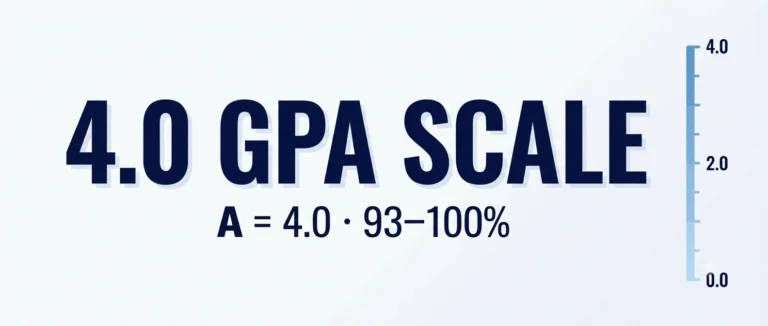
- Convert each grade to its point value. Use the standard scale: A = 4.0, A- = 3.7, B+ = 3.3, B = 3.0, C = 2.0, and so on.
- Multiply each grade value by the class credit hours. This gives you the quality points for each class.
- Add up all quality points from both semesters. Combine every class, not just one term.
- Add up all credit hours from both semesters. This is your total credits attempted.
- Divide total quality points by total credit hours. The result is your cumulative GPA.
Semester 1
| Class | Grade | Value | Credits | Quality Points |
|---|---|---|---|---|
| Biology | A | 4.0 | 4 | 16.0 |
| English | B+ | 3.3 | 3 | 9.9 |
| History | B | 3.0 | 3 | 9.0 |
| Semester 1 totals | 10 | 34.9 |
Semester 2
| Class | Grade | Value | Credits | Quality Points |
|---|---|---|---|---|
| Chemistry | A | 4.0 | 4 | 16.0 |
| Algebra | A- | 3.7 | 3 | 11.1 |
| Spanish | C | 2.0 | 3 | 6.0 |
| Semester 2 totals | 10 | 33.1 |
Now combine both terms. Total quality points are 34.9 plus 33.1, which equals 68.0. Total credits are 10 plus 10, which equals 20. Divide 68.0 by 20 and you get a cumulative GPA of 3.4.
Notice that this student earned a 3.49 in the first semester and a 3.31 in the second. Their cumulative landed at 3.4, right between the two, because both semesters happened to carry the same number of credits. When the credits are not equal, the cumulative shifts toward the heavier term, which is exactly what the next section explains.
Why You Can’t Just Average Your Semester GPAs
You cannot simply average your semester GPAs because semesters often carry different numbers of credits, and the term with more credits pulls the cumulative average toward itself. Averaging the two GPAs treats both terms as equal when they usually are not.
An example shows how far off the shortcut can be. Picture a student with two very different semesters.
- Semester 1: a heavy 12-credit term with strong grades, earning a 3.75 semester GPA.
- Semester 2: a light 6-credit term that went badly, earning a 2.00 semester GPA.
If you average the two semester GPAs, you get (3.75 + 2.00) divided by 2, which is 2.88. But that is wrong, because the first semester had twice as many credits. The correct method uses quality points. Semester 1 produced 45 quality points over 12 credits. Semester 2 produced 12 quality points over 6 credits. Adding them gives 57 quality points over 18 total credits, which works out to a cumulative GPA of 3.17.
That is a gap of nearly three tenths of a point between the shortcut and the truth. The heavier, stronger semester rightly counts for more, so the real cumulative sits well above the simple average. This is why your transcript GPA can surprise you if you have only been averaging your term numbers in your head.
How to Calculate Cumulative GPA Across All Semesters
To find your cumulative GPA across every semester, you extend the same formula to all of your terms at once. Add the quality points from every class you have ever taken, add every credit hour, and divide once at the very end. You do not calculate each semester separately and then combine the results.
The cleanest approach is to keep a running total. Each time you finish a term, add that term’s quality points to your existing total and its credits to your existing credit total, then divide. This works whether you have two semesters or twelve, and it matches how your school builds the cumulative GPA on your transcript.
One practical note for students who already have a GPA on record. If you do not want to re-enter years of past classes, you can use your current cumulative GPA and total credits as a starting point. Multiply your existing GPA by your existing credits to get your quality points so far, then add your new term on top. It saves a lot of typing and gives the same answer.
Skip the Math With a Cumulative GPA Calculator
Working this out by hand is doable, but it gets tedious fast once you have several terms and varied credit hours, and a single arithmetic slip throws off the whole number. The free GPA calculator at TheEasyGrader does the entire calculation for you. Enter each class, its grade, and its credit value, and it returns your cumulative GPA on the 4.0 scale in seconds, with no sign-up.
It also makes it easy to plan ahead. You can enter the grades you expect this term to see where your cumulative will land, or test what you would need next semester to reach a specific target. Running those scenarios takes a minute and replaces guesswork with a clear number, which is far more useful than finding out at report card time.
Is a Cumulative GPA Weighted or Unweighted?
A cumulative GPA can be either weighted or unweighted, depending on the school and level. Most colleges report an unweighted cumulative GPA on the 4.0 scale. Many high schools calculate both a weighted and an unweighted cumulative GPA and show them side by side.
The confusion is understandable, because the word cumulative describes how the GPA is combined over time, not whether it includes difficulty bonuses. Those are two separate questions. A GPA can be cumulative and unweighted, or cumulative and weighted. The cumulative part only means it covers all your terms.
Cumulative GPA vs Weighted GPA
These are not opposites, and that is the root of the mix-up. Cumulative refers to the time span the GPA covers, while weighted refers to whether harder classes earn bonus points. A single GPA can be both at once.
Here is the cleanest way to keep them straight. Ask two questions about any GPA. First, does it cover one term or all of them? That answer tells you whether it is a semester GPA or a cumulative GPA. Second, do honors and AP classes earn extra points? That answer tells you whether it is weighted or unweighted. A weighted cumulative GPA, common on high school transcripts, simply answers both at once: it covers all terms and gives bonus points for advanced courses, which is how some students post a cumulative number above 4.0.
Cumulative Unweighted GPA Explained
A cumulative unweighted GPA is your overall average across all terms, with every class capped at 4.0 regardless of difficulty. An A is worth 4.0 whether it came from a standard class or an AP class, and the result reflects your raw grades over your whole record.
This is the version colleges lean on most, because it lets them compare students from different schools fairly. Course rigor still matters to admissions officers, but they usually judge it separately by reading your transcript, rather than letting bonus points inflate the GPA itself. Many high schools report your unweighted cumulative GPA right next to the weighted one for exactly this reason, so colleges can see both the raw average and the difficulty behind it. If your school uses plus and minus grades, our breakdown of
the grading scale shows how each one converts to points.
What Is a Good Cumulative GPA?
A good cumulative GPA is generally 3.0 or higher, with 3.5 and above considered strong and competitive for most goals. The national average sits around 3.0, so clearing it means you are doing well, and pushing past 3.5 opens doors to scholarships, honors, and selective programs.
That said, the word good depends entirely on what you are aiming for. A 3.2 is solid for many state universities and perfectly fine for graduation, while a top medical or law program may expect a 3.7 or higher. Context decides the answer, so it helps to measure your cumulative GPA against your specific target rather than a single universal cutoff.
Good Cumulative GPA in High School vs College
In high school, a good cumulative GPA is usually 3.0 or above, with 3.5 and up making you competitive for selective colleges. In college, the same numbers apply for general standing, but a strong cumulative GPA matters most within your major and for graduate school plans.
The difference comes down to how the number is read. High school GPAs are judged by admissions officers alongside your course load, so a 3.5 built on honors and AP classes carries more weight than a 3.5 from standard sections. In college, employers and graduate programs often apply their own cutoffs, and a cumulative GPA in demanding major courses is harder to earn, so it tends to impress more. If you want to see how a specific number lands, our breakdown of
what counts as a strong average covers the details: what is a 3.5 GPA.
Cumulative GPA for Scholarships and Honors
Most scholarships and honors programs base their cutoffs on your cumulative GPA, not a single semester. Common thresholds include a 3.0 to 3.5 minimum for many merit scholarships, a 3.5 for Dean’s List at many colleges, and roughly 3.5 to 3.9 for Latin honors at graduation.
The exact lines vary widely by institution, so treat these as general ranges rather than fixed rules. As a guide, Latin honors usually break down like this, though every school sets its own bar:
- Cum laude: often around a 3.5 cumulative GPA.
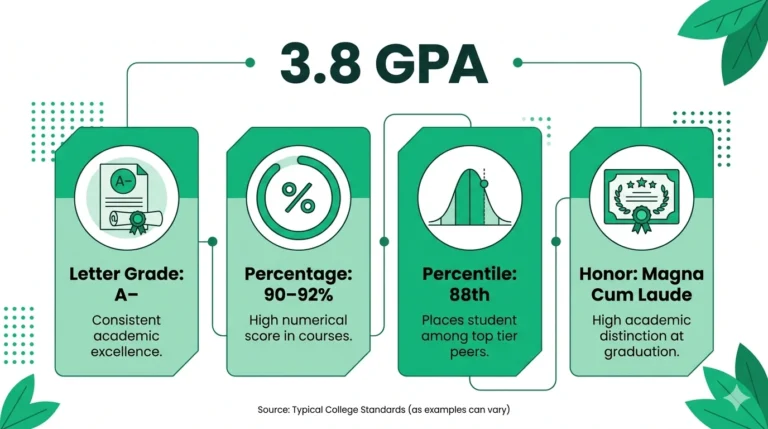
- Magna cum laude: often around a 3.7.
- Summa cum laude: often around a 3.9 or higher.
Because these awards rely on the cumulative number, a single weak term hurts less than you might fear, as long as your overall average stays above the line. It also means a strong finish can lift you over a threshold if your cumulative GPA is climbing toward it.
How to Raise Your Cumulative GPA
To raise your cumulative GPA, you need to earn grades higher than your current average, and the earlier you do it, the more it moves. Because past credits stay locked in, raising a cumulative GPA is about consistent strong terms rather than one dramatic comeback.
Set realistic expectations first. If you have a 2.8 cumulative GPA after three years, reaching a 3.5 before graduation may not be mathematically possible, simply because too many credits are already averaged in. Knowing your ceiling keeps you from chasing a number you cannot hit and helps you set a target you actually can.
A few strategies do the most work. Protect your grades in high-credit classes, since they pull hardest on the average. If your school allows it, retaking a course with grade replacement can erase a low grade entirely, which often moves a cumulative GPA more than a brand-new A does. And track your number through the term so you can act on a sliding grade while there is still time. For a fuller set of tactics, our guide on
how to raise your GPA goes deeper into what actually works.
How to Convert a Cumulative GPA to the 4.0 Scale
To convert a cumulative GPA to the 4.0 scale, translate each grade into its 4.0 point value through the standard letter-grade scale, then recalculate using quality points and credit hours. This matters most if your school reports grades as percentages or on a different scale, like a 5.0 weighted or a 10-point system.
The reliable method is always to work through letter grades rather than running your existing GPA through a single formula, because cutoffs differ between systems. Convert each class to its letter grade first, assign the standard 4.0 value, then apply the cumulative formula. If you are starting from a weighted GPA, strip the bonus points back to their base values before recalculating.
Our full guide to the 4.0 GPA scale includes a complete conversion chart that maps percentages and letter grades to their 4.0 values, which makes this conversion straightforward for any class on your transcript.
Frequently Asked Questions
Quick answers to the most common questions about cumulative GPA.
What does cumulative GPA mean?
Cumulative GPA means your overall grade average across every term you have completed, combined into one number on the 4.0 scale. It reflects all of your classes at once, weighted by credit hours, rather than the grades from a single semester.
Is cumulative GPA the same as overall GPA?
In most cases, yes. Cumulative GPA and overall GPA both describe your combined average across all terms. The exception is that some schools report a separate major GPA, which counts only the courses in your field, so it helps to confirm how your school defines each term.
How do I figure out my cumulative GPA?
Multiply each grade’s point value by its credit hours to get quality points, add the quality points from every class together, then divide by your total credit hours. The result is your cumulative GPA. A GPA calculator does this instantly if you would rather skip the arithmetic.
Is a cumulative GPA weighted or unweighted?
It can be either. Most colleges report an unweighted cumulative GPA capped at 4.0, while many high schools calculate both a weighted and an unweighted version. The word cumulative refers to covering all your terms, not to whether harder classes earn bonus points.
What is the difference between term GPA and cumulative GPA?
A term GPA covers the grades from one semester only, while a cumulative GPA combines every completed term into one ongoing average. Your term GPA shows recent performance, and your cumulative GPA is the number that appears on transcripts and applications.
Does cumulative GPA include all four years?
Yes. In most schools, your cumulative GPA includes every graded class from all years of high school or college. A few schools apply special policies, such as excluding retaken or transferred courses, but the standard transcript GPA reflects your full record.
Can my cumulative GPA go down?
Yes. Any term where your grades fall below your current cumulative average will pull the number down. The drop is usually smaller the more credits you have already earned, because each new grade carries less weight against a large total.
Is a 3.5 cumulative GPA good?
Yes, a 3.5 cumulative GPA is good. It sits well above the national average of around 3.0 and is competitive for most colleges, scholarships, and honors like Dean’s List. For a full breakdown of what the number means, see our guide to what a 3.5 GPA is.



The worked example with credit hours is the part that makes this click — plenty of students average their GPAs term by term and wonder why the number never matches the transcript. Working backwards from a target cumulative GPA is the harder direction, and it eventually comes down to individual course grades, which come down to individual finals. That last link in the chain is where I point people at a grade calculator, so the abstract GPA goal becomes a concrete score to aim for this week.
It’s a shame you don’t have a donate button! I’d most certainly
donate to this outstanding blog! I guess for now i’ll settle for bookmarking and adding your RSS feed to my Google account.
I look forward to brand new updates and will talk about this website with my Facebook group.
Chat soon!
Having read this I thought it was very informative.
I appreciate you spending some time and energy to put this informative article together.
I once again find myself personally spending a lot of time both reading and commenting.
But so what, it was still worth it!