Grading Scale Explained: What Each Letter Grade (A, B, C, D, F) Really Means
Most students have seen letter grades their whole academic life, but few actually know what the exact percentage ranges are, how each grade affects a GPA, or why the scale jumps from D straight to F with no E in between. This guide covers all of it: the full grading scale, what each letter grade means in practice, how schools use plus and minus grades, and answers to the questions students search for most.
The Standard US Grading Scale
The letter grading system used across American schools and colleges converts percentage scores into five main letter grades: A, B, C, D, and F. Most schools apply this scale to every test, quiz, project, and assignment.
Here is the full grading scale including plus and minus grades:
| Letter Grade | Percentage Range | GPA Points | Meaning |
|---|---|---|---|
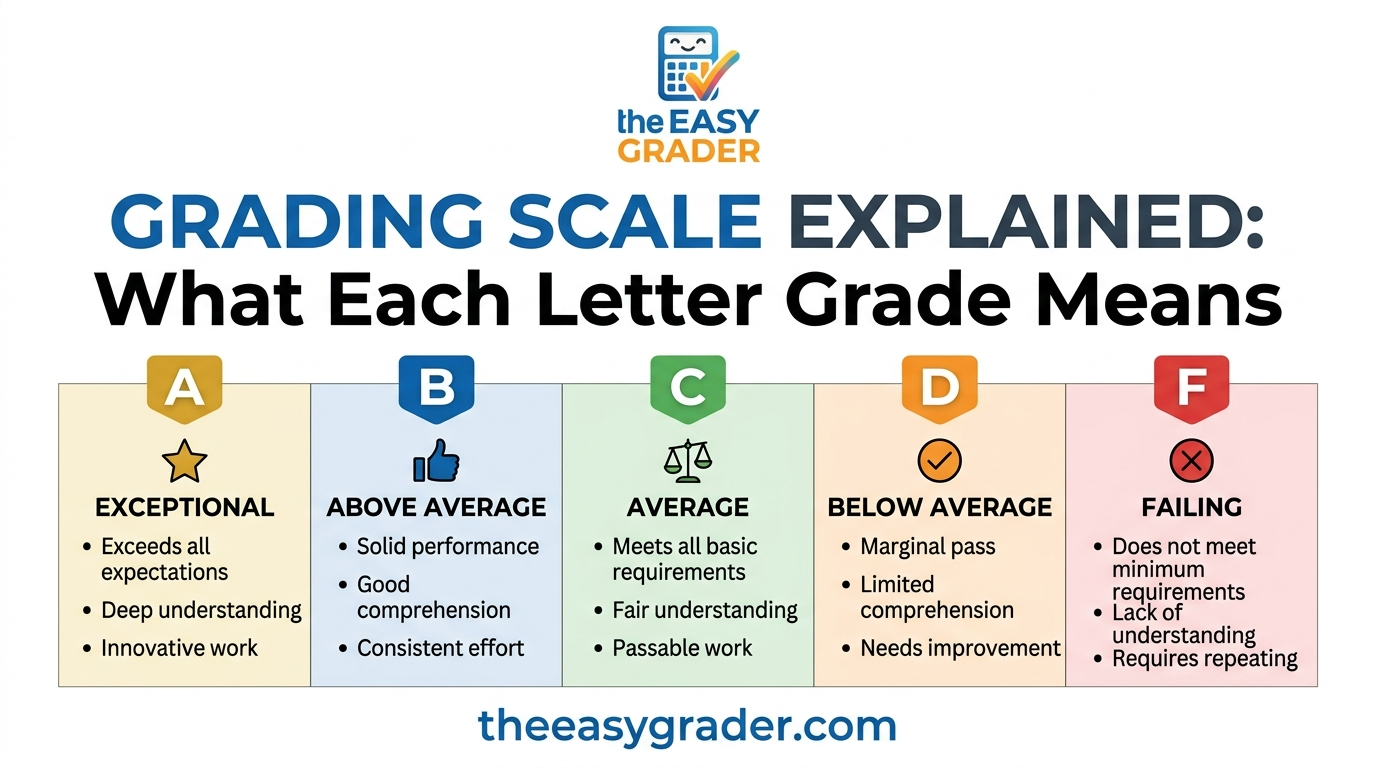
| A+ | 97 – 100% | 4.0 | Exceptional |
| A | 93 – 96% | 4.0 | Excellent |
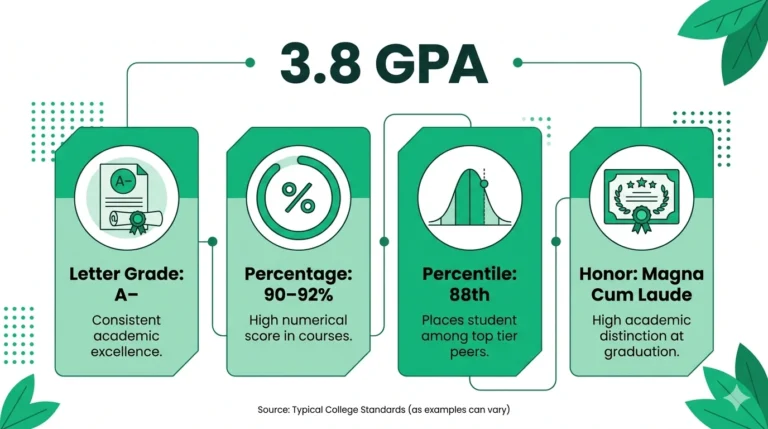
| A- | 90 – 92% | 3.7 | Near excellent |
| B+ | 87 – 89% | 3.3 | Above average |
| B | 83 – 86% | 3.0 | Good |
| B- | 80 – 82% | 2.7 | Slightly above average |
| C+ | 77 – 79% | 2.3 | Decent |
| C | 73 – 76% | 2.0 | Average |
| C- | 70 – 72% | 1.7 | Below average |
| D+ | 67 – 69% | 1.3 | Struggling |
| D | 63 – 66% | 1.0 | Poor |
| D- | 60 – 62% | 0.7 | Barely passing |
| F | Below 60% | 0.0 | Failing |
One important note: these ranges are the most widely used in the US, but not every school follows them exactly. Some schools set an A at 90% and above, others at 93% and above. Always check your syllabus for the exact cutoffs your teacher uses. To turn these grade points into a usable GPA number, follow the full method in our guide on how to calculate GPA in high school.
What Does Each Letter Grade Mean?
The A Grade (90% – 100%)
An A means a student has a strong understanding of the material. On a 4.0 GPA scale, an A earns 4.0 grade points. An A- earns 3.7 and an A+ is also recorded as 4.0 at most schools, though a small number use 4.3 for an A+.
Students who consistently earn A grades tend to qualify for honor roll, merit scholarships, and competitive college programs. In terms of what it signals on a transcript, an A says the student not only understood the core material but could apply it accurately under test conditions.
One thing worth knowing: a 90% and a 99% are both A grades on most scales. That 9-point gap can matter when a school uses a weighted GPA or when class rank is calculated, even though both show up as A on a report card.
The B Grade (80% – 89%)
A B is a good grade. It means above-average performance. The student understood the material and answered the majority of questions correctly. A B earns 3.0 GPA points, a B+ earns 3.3, and a B- earns 2.7.
For most students aiming at four-year universities, B grades are a solid baseline. A GPA in the 3.0 to 3.5 range, made up mostly of B grades, puts a student in competitive standing at the majority of colleges. A B is not something to stress over. It is a genuinely strong grade.
A common question is whether an 88% is an A or a B. On the standard scale, an 88% is a B+. An A grade starts at 90%.
The C Grade (70% – 79%)
A C means average performance. The student passed and answered roughly three out of four questions correctly, but there are clear gaps in understanding. A C earns 2.0 GPA points.
Most schools consider a C a passing grade, but whether it counts as satisfactory depends on context. In high school, C grades will lower a GPA toward 2.0, which can limit college options. In college, some programs require a C or better in prerequisite courses before a student can move forward. In graduate school, a C is often considered unsatisfactory.
A 79% is a C+, not a B. That single percentage point separates the two, and it catches students off guard when results come back.
A specific score that confuses students most is 77 percent. Read our breakdown of what 77 percent really means for your transcript and GPA.
The D Grade (60% – 69%)
A D is technically a passing grade at most schools, but it is barely so. It earns 1.0 GPA points and represents below-average performance. The student passed the class but missed a substantial amount of the material.
The problem with D grades is what they do downstream. In high school, a D pulls the cumulative GPA down significantly. In college, many programs require a C or better in core courses, so a D means repeating the class. In some programs, like nursing or engineering, even a D in a prerequisite can disqualify a student from continuing. If a low grade is dragging your average, our guide on how to raise your GPA covers exactly what to focus on next.
At the college level specifically, a D is often described as an “unsatisfactory passing grade.” You technically passed, but you probably did not retain enough to succeed in the next course.
The F Grade (Below 60%)
An F means failing. The student did not demonstrate sufficient understanding of the material. An F earns 0.0 GPA points and can seriously damage a cumulative GPA.
A 60% is not an F. On the standard US grading scale, a 60% is a D-. An F only begins below 60%.
The impact of an F depends on the situation. In high school, a failed class may need to be retaken for credit. In college, an F goes on the transcript permanently unless the school has a grade forgiveness or repeat policy. One F in a 3-credit course pulls a 3.5 GPA down to roughly 3.2, a hit that can take a full semester to recover from.
Why Is There No E Grade?
Students notice this eventually. The alphabet goes A, B, C, D, then skips straight to F. There is no E.
The letter grade system in the US started at Mount Holyoke College in Massachusetts in 1897. Their original scale actually did include an E, where E stood for failing. The problem was that parents and teachers kept reading E as “Excellent,” which defeated the purpose. Schools gradually replaced E with F, and since “F for Fail” was completely unambiguous, the change stuck.
By the early 1900s, most American schools and universities had standardized around A through D and F. The E was dropped and never came back. A handful of schools still use E in certain contexts, but it remains the exception.
Plus and Minus Grades: Do They Matter?
Not every school uses plus and minus grades. Some schools assign only the main letter grades (A, B, C, D, F) with no modifiers. But at schools that do use them, the difference matters more than students often realize.
The gap between a B+ (3.3) and a B- (2.7) is 0.6 GPA points. Across a full semester of six courses, a pattern of earning the low end of each grade versus the high end can shift a semester GPA by nearly half a point. Over four years, that kind of consistent difference shapes whether a student graduates with a 3.0 or a 3.5.
Teachers use plus and minus grades to distinguish between students who just cleared the threshold and those who were close to the next level. A student at 87% has done noticeably better work than one at 80%, even though both receive a B without the modifiers.
How Letter Grades Connect to GPA
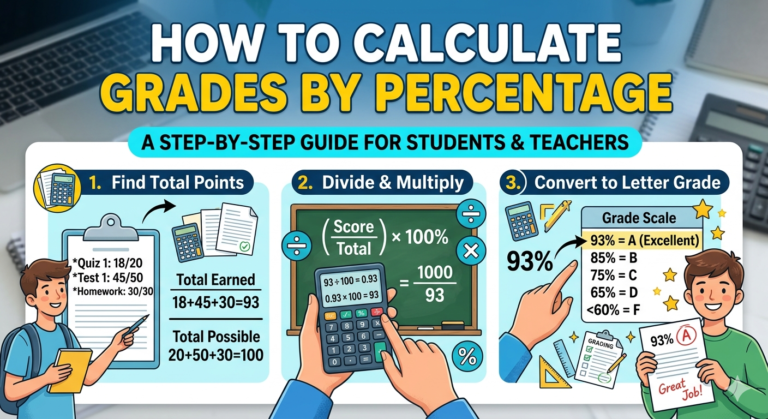
Every letter grade maps to a number on the 4.0 scale. GPA is calculated by multiplying the grade points for each course by the number of credits that course is worth, adding everything together, then dividing by the total credits.
A practical example: a student takes five 3-credit courses and earns A, A, B+, B, and C. That works out to:
- A (4.0) x 3 = 12.0
- A (4.0) x 3 = 12.0
- B+ (3.3) x 3 = 9.9
- B (3.0) x 3 = 9.0
- C (2.0) x 3 = 6.0
Total quality points: 48.9 / 15 credits = 3.26 GPA
The C in that example, despite being just one of five courses, pulled the GPA down from what would have been a 3.575 if that class had been a B. That is why high-weight courses and easy wins in high-credit classes matter so much for GPA management.
If you want to calculate your exact grade percentage for any test, including seeing what letter grade different numbers of wrong answers produce, use the Easy Grade Calculator on this site. Enter total questions and how many were wrong, and the result comes back instantly.
What Is a Passing Grade?
The answer depends on where you are and what you are trying to do.
In most US high schools, anything above an F, meaning a D- or higher, is technically a passing grade. A student earning a 60% passes the class and earns credit.
In college, the standard is similar on paper, but the practical implications are different. A D is still technically passing, but:
- Many major-specific courses require a C or better to count toward graduation requirements
- Financial aid can require students to maintain a minimum GPA, often 2.0
- Graduate programs and professional school applications treat anything below a B as a weak grade
- Pass/fail courses usually require a C or better to receive the “pass” designation
- curve a set of class scores
The short version: a D keeps you from failing, but it does not mean you are in good standing.
Grading Scale Variations by School
The scale described in this guide is the most common one used in the US, but schools do vary. Some differences worth knowing:
Some schools set the A threshold at 90%, others at 93%. A student who earns an 91% may have an A at one school and a B+ at another.
Some schools use a 4.33 scale where an A+ earns 4.33 rather than 4.0. This creates a small GPA bonus for students who consistently earn scores in the 97–100% range.
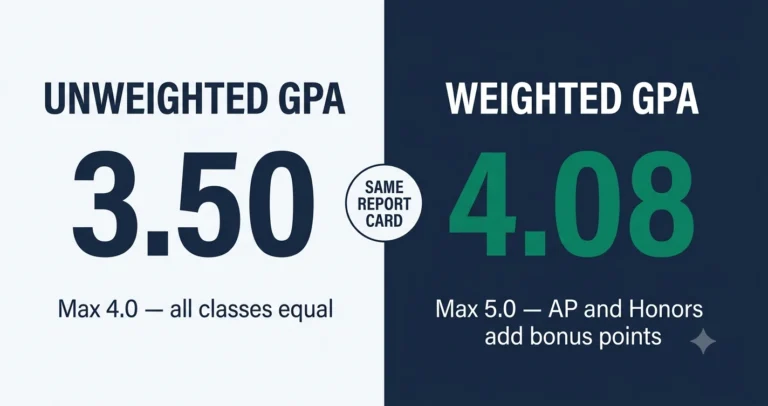
AP and Honors courses at many high schools use weighted GPA, where an A earns 5.0 instead of 4.0. This means a student’s weighted GPA can exceed 4.0, which is something colleges account for when reviewing transcripts.
Some college programs, particularly in medicine, law, and engineering, use stricter internal cutoffs. A 70% might earn a C at one institution and a D at another.
The safest approach is always to check the grading scale listed in the course syllabus before assuming the standard scale applies.
Knowing what each grade means is one half of the picture. The other half is knowing what GPA range counts as good for your goals. Our good GPA benchmarks guide covers high school, college, scholarships, and graduate admissions.
Common Questions About Letter Grades
Is a 70 a passing grade?
At most high schools, yes. A 70% falls in the C- range on the standard scale, which is above the D and F threshold. In college, a 70% is still technically passing, but whether it satisfies specific course requirements depends on the program.
What grade is an 85%?
An 85% is a B on the standard grading scale. It falls in the 83–86% range for a straight B.
Is a C+ a good grade?
A C+ (77–79%) is above average relative to a straight C, but below a B-. In terms of GPA, a C+ earns 2.3 points. For students aiming at competitive universities or professional school, a pattern of C+ grades is going to limit options. For a difficult elective or a challenging subject outside your major, a C+ is entirely fine.
What is the lowest passing grade?
At most schools, a D- (60–62%) is the lowest passing grade. Below that is an F. However, passing a class with a D- is not the same as meeting program requirements. Many courses have a higher minimum.
Does a D hurt your GPA?
Yes, significantly. A D earns 1.0 GPA points. If most of your grades are B’s and A’s, one D pulls the average down sharply. In a semester of four courses, three B’s and one D averages to roughly a 2.5, which is a noticeable drop from the 3.0 you would have with all B’s.
A Quick Reference Summary
- A (90–100%): Excellent. 4.0 GPA points.
- B (80–89%): Good. 3.0 GPA points.
- C (70–79%): Average. 2.0 GPA points.
- D (60–69%): Below average. 1.0 GPA points. Technically passing at most schools.
- F (below 60%): Failing. 0.0 GPA points.
For any test score you want to check right now, whether you are a teacher grading papers or a student checking a quiz before results are posted, the grade calculator on this site converts wrong answers to percentages and letter grades in seconds. No signup, no ads, just the number you need.
If you are trying to figure out how letter grades roll up into a GPA, see the GPA calculator. If finals are coming up and you need to know what score you need to pass, the final grade calculator walks through the exact math.