How to Calculate GPA in High School?
How to Calculate GPA in High School:
Your GPA shapes every college application you submit. Understanding how it is calculated means you can track it accurately, plan your course load strategically, and avoid the small errors that quietly pull the number down over four years.
This guide covers the exact calculation method for unweighted GPA, weighted GPA, and cumulative GPA, with worked examples at each step.
Use the free High School GPA Calculator to check your results instantly as you follow along.
What Is a High School GPA
GPA stands for Grade Point Average. It converts your letter grades into numerical points, weighs those points against the credit value of each course, and produces a single number that represents your overall academic performance.
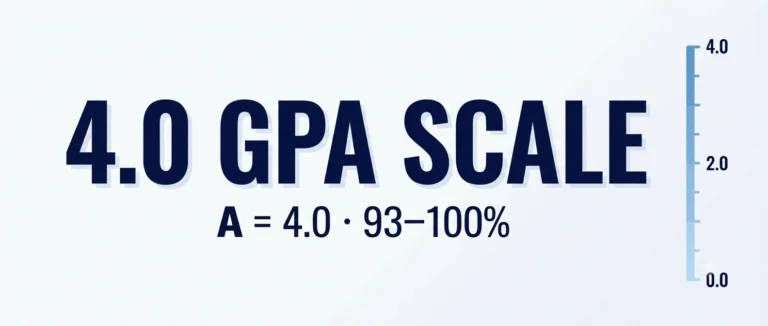
Most high schools in the United States report GPA on a 4.0 scale. Some schools also report a weighted GPA that gives bonus points for advanced coursework, which can push the number above 4.0.
Colleges use GPA to compare applicants, but many recalculate it using their own rules, typically stripping electives and focusing on core academic subjects only.

Step 1 — Convert Letter Grades to Grade Points
Every calculation starts here. Before any math, each letter grade becomes a number.
| Letter Grade | Grade Points |
|---|---|
| A / A+ | 4.0 |
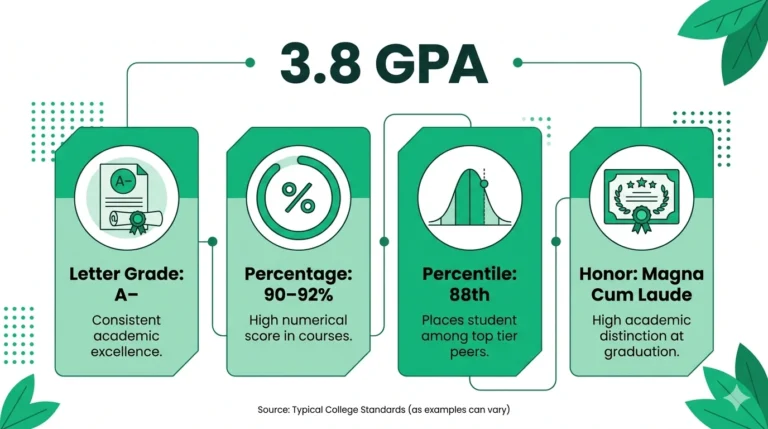
| A- | 3.7 |
| B+ | 3.3 |
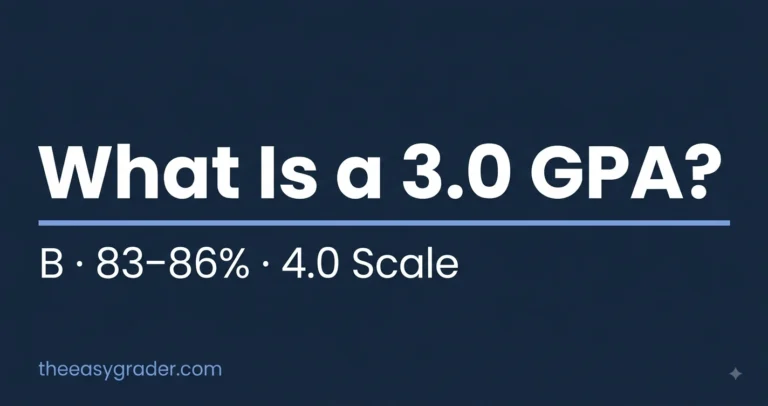
| B | 3.0 |
| B- | 2.7 |
| C+ | 2.3 |
| C | 2.0 |
| C- | 1.7 |
| D | 1.0 |
| F | 0.0 |
Want to know exactly which percentage range each letter covers? Our complete grading scale guide breaks down every cutoff, including plus and minus grades.
Some schools do not use plus and minus grades, treating every A as 4.0 and every B as 3.0. That difference accumulates over eight semesters and can shift your GPA by several tenths of a point. Check your school handbook for the exact scale your transcript uses.
Step 2 — Find the Credit Value of Each Course
Every course on your schedule carries a credit value. Full year courses typically carry 1.0 credit. Semester courses typically carry 0.5 credits. Your transcript lists the exact credit values from your school records, and those are the numbers to use.
Credits matter because they determine how much each course moves your GPA. A 1.0 credit math class influences your average twice as much as a 0.5 credit elective, even when both earn the same letter grade.
Step 3 — Calculate Quality Points for Each Course
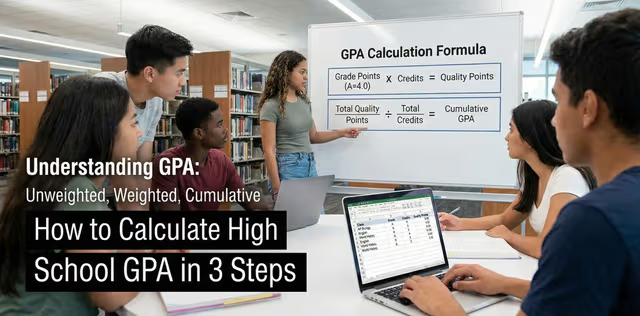
Quality points are the core building block of GPA. The formula is straightforward:
Quality Points = Grade Points x Credits
Examples:
A course worth 1.0 credit where you earned a B gives 3.0 x 1.0 = 3.0 quality points.
A course worth 0.5 credits where you earned an A gives 4.0 x 0.5 = 2.0 quality points.
A course worth 1.0 credit where you earned a B+ gives 3.3 x 1.0 = 3.3 quality points.
This step is where most students make mistakes. Adding grade points and dividing by the number of classes only works when every class carries identical credit weight, which is rarely the case.
How to Calculate Unweighted GPA
Unweighted GPA treats every class equally on the 4.0 scale, regardless of whether it is a regular section or an advanced placement course.
Formula: GPA = Total Quality Points divided by Total Credits
Full semester example:
| Course | Grade | Points | Credits | Quality Points |
|---|---|---|---|---|
| English | B+ | 3.3 | 1.0 | 3.3 |
| Algebra 2 | A | 4.0 | 1.0 | 4.0 |
| World History | B | 3.0 | 1.0 | 3.0 |
| Biology | A | 4.0 | 1.0 | 4.0 |
| PE | A | 4.0 | 0.5 | 2.0 |
Total quality points: 16.3 Total credits: 4.5
Unweighted GPA: 16.3 / 4.5 = 3.62
How to Calculate Weighted GPA
Weighted GPA adds bonus points to advanced courses. The most common system used by US high schools applies the following scale:
| Course Level | Grade A is earned. |
|---|---|
| Regular | 4.0 |
| Honors | 4.5 |
| AP or IB | 5.0 |
The formula is identical. Only the grade point value changes based on course level.
Same semester with two advanced courses:
| Course | Level | Grade | Points | Credits | Quality Points |
|---|---|---|---|---|---|
| English | Regular | B+ | 3.3 | 1.0 | 3.3 |
| Algebra 2 | Honors | A | 4.5 | 1.0 | 4.5 |
| World History | Regular | B | 3.0 | 1.0 | 3.0 |
| Biology | AP | A | 5.0 | 1.0 | 5.0 |
| PE | Regular | A | 4.0 | 0.5 | 2.0 |
Total quality points: 17.8 Total credits: 4.5
Weighted GPA: 17.8 / 4.5 = 3.96
Worried that one tough class will pull your GPA down? Calculate exactly what score you need on your final exam to pass before finals week starts.
One thing worth knowing: adding a regular class with an A can pull a weighted GPA down if your current weighted average sits above 4.0. A regular A is worth 4.0 points, and any value below your current average lowers that average. This is not a reason to avoid regular classes, but it is worth understanding when scheduling.
How to Calculate Cumulative GPA?
Cumulative GPA covers every semester you have completed, not just the current one.
The calculation uses the same formula. The only change is that you include quality points and credits from all semesters.
The most common mistake is averaging two semester GPAs directly:
Wrong: (3.6 + 3.8) / 2 = 3.7
This only works if both semesters have identical credit loads. The correct method always goes through quality points.
Example across two semesters:
Semester 1: 16.3 quality points, 4.5 credits Semester 2: 14.8 quality points, 4.0 credits
Cumulative GPA: (16.3 + 14.8) / (4.5 + 4.0) = 31.1 / 8.5 = 3.66
A stronger semester adds more to the cumulative number. A weaker one pulls it down. Because early semesters stay in the calculation permanently, freshman year grades follow you all four years. If your cumulative number is lower than you want, here is exactly how to raise your GPA semester by semester.
Frequently Asked Questions
How do you calculate a high school GPA step by step?
Convert each letter grade to grade points. Multiply grade points by the credit value of each course to get quality points. Add all quality points together. Divide by total credits. The result is your GPA.
What is a good GPA in high school?
A 3.0 unweighted GPA meets minimum eligibility for most colleges. For full benchmarks across high school, college, and graduate admissions, see our guide on what counts as a good GPA
Does taking AP classes help my GPA?
On a weighted scale, yes. An A in an AP class earns 5.0 points compared to 4.0 in a regular class. On an unweighted scale, both earn 4.0, and the course level makes no difference to the number.
Do colleges use my school GPA directly?
Most selective colleges recalculate GPA independently. They typically use core academic subjects only, convert everything to an unweighted 4.0 scale, and evaluate course rigor separately from the number itself.
What if my school uses percentage grades?
Convert each percentage to the corresponding letter grade using your school’s cutoff chart, then apply the standard grade point values and calculate quality points as normal.
How do retakes affect GPA?
School policies vary. Some schools replace the original grade entirely. Some average both grades. Some keep both grades on the transcript and count them separately. Your school handbook lists the exact policy.
Calculate Your High School GPA Now
Work through your own courses using the steps above, then verify your result with the free GPA calculator at TheEasyGrader.com. Enter each course, grade, and credit value and see your unweighted and weighted GPA calculated instantly.
For semester planning and final exam targets, the Final Grade Calculator and Weighted Grade Calculator are also available free with no signup required.