
How to Calculate Grades by Percentage
Knowing how to turn raw scores into a percentage grade is one of those skills every student needs but few ever get taught directly. Teachers hand back tests with marks like 37 out of 45 or 82 out of 110, and you sit there wondering what that actually means for your overall grade.
This guide walks through every method you will encounter, from a single test score all the way to weighted course grades across a full semester. The math is simpler than you think, and once you understand the formulas, you can track your own progress without waiting for your teacher to update the gradebook.
The Basic Formula Every Student Should Know
Start here. Every percentage grade calculation comes down to one formula:
Percentage = (Points Earned / Points Possible) x 100
That is it. Divide what you got by what you could have gotten, then multiply by 100 to turn the decimal into a percentage.
Say you score 42 out of 50 on a quiz. Divide 42 by 50 and you get 0.84. Multiply that by 100 and your grade is 84 percent.
Another example. You earn 27 out of 30 on a homework assignment. Divide 27 by 30 to get 0.90. Multiply by 100 and your grade is 90 percent.
This formula works for any single assignment, test, quiz, project, or exam regardless of how many total points the assessment carries. A score of 18 out of 20 gives you the same percentage as 90 out of 100. Both equal 90 percent.
How to Calculate Your Overall Grade Using Points
Some teachers use a total points system where every assignment, quiz, test, and project earns a certain number of raw points. Your final grade equals the total points you earned divided by the total points available across the entire course.
Here is how that looks in practice. Imagine a class where the semester includes the following:
Five homework assignments worth 10 points each (50 points total). Three quizzes worth 20 points each (60 points total). Two tests worth 100 points each (200 points total). One final project worth 90 points.
The total possible points for the course add up to 400.
Now say you earned 45 out of 50 on homework, 52 out of 60 on quizzes, 174 out of 200 on tests, and 81 out of 90 on the project. Your total earned points come to 352.
Divide 352 by 400 and multiply by 100. Your overall course grade is 88 percent.
The strength of this system is its simplicity. Every point counts equally, and you can check your standing at any time by adding up what you have earned so far and dividing by the total points available.
How to Calculate Weighted Grades
This is where most students get confused, and it is the grading method most high schools and colleges actually use.
In a weighted system, different categories of work count for different portions of your final grade. A syllabus might break it down like this: homework counts for 20 percent, quizzes count for 15 percent, midterm exams count for 30 percent, and the final exam counts for 35 percent. Those weights always add up to 100 percent.
The formula for a weighted grade looks like this:
Overall Grade = (Category Average x Category Weight) + (Category Average x Category Weight) + …
Walk through it step by step. First, calculate your average percentage in each category separately. Then multiply each average by its weight expressed as a decimal. Finally, add all the weighted scores together.
Here is a real example. Say your syllabus lists these weights: homework at 20 percent, quizzes at 15 percent, midterm at 30 percent, and final exam at 35 percent. Your averages in each category are 92 percent for homework, 85 percent for quizzes, 78 percent on the midterm, and 88 percent on the final.
Multiply each average by its weight. Homework gives you 92 times 0.20, which equals 18.4. Quizzes give you 85 times 0.15, which equals 12.75. The midterm gives you 78 times 0.30, which equals 23.4. The final gives you 88 times 0.35, which equals 30.8.
Add those together: 18.4 plus 12.75 plus 23.4 plus 30.8 equals 85.35 percent.
Notice something important here. Even though your homework average sat at 92 percent, it only contributed 18.4 points to your final grade because it carried just 20 percent of the weight. Meanwhile, your final exam average of 88 percent contributed 30.8 points because it carried 35 percent of the weight. The categories with the highest weight have the biggest impact on your overall grade, so knowing the weights helps you decide where to focus your study time.
How to Calculate Your Grade Midway Through the Semester
This trips up a lot of students. If you want to know your current standing but only some categories have grades in them, you cannot just plug zeros in for the missing categories. That would drag your grade down unfairly.
Instead, add up the weights of only the categories you have scores in, then divide your weighted total by that combined weight.
Here is how that works. Say your course has four categories: homework at 20 percent, quizzes at 15 percent, exams at 40 percent, and a final project at 25 percent. Halfway through the semester, you have homework grades and one exam score, but no quiz grades or project grade yet.
Your homework average is 90 percent and your exam score is 82 percent. The combined weight of those two categories is 20 plus 40, which equals 60 percent.
Calculate the weighted scores: 90 times 0.20 equals 18, and 82 times 0.40 equals 32.8. Add those together to get 50.8.
Now divide 50.8 by 0.60 (the combined weight of the completed categories). That gives you 84.67 percent. That is your current standing based on the work completed so far.
This method gives you an accurate snapshot of where you stand without penalizing you for assignments that have not happened yet.
How Percentage Grades Convert to Letter Grades
Once you have your percentage, most schools in the United States convert it to a letter grade using a standard scale. The most common version looks like this:
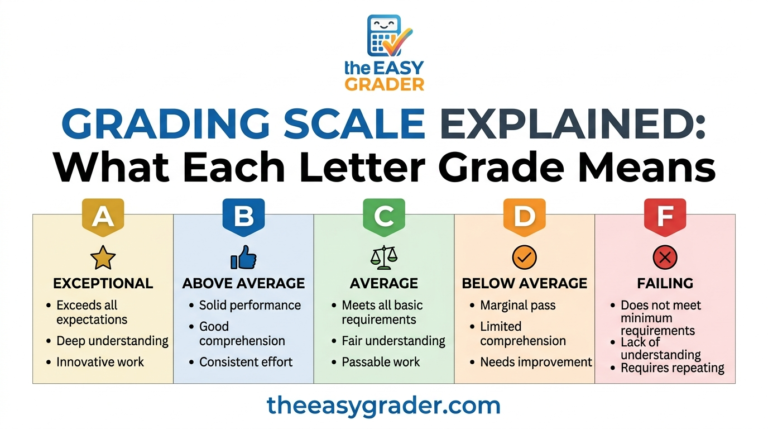
A ranges from 90 to 100 percent. B ranges from 80 to 89 percent. C ranges from 70 to 79 percent. D ranges from 60 to 69 percent. F falls below 60 percent.
Many schools add plus and minus modifiers for more precision. On that scale, an A runs from 93 to 100, an A minus covers 90 to 92, a B plus covers 87 to 89, a B covers 83 to 86, a B minus covers 80 to 82, and the pattern continues downward through each letter.
One thing to keep in mind is that grading scales vary from school to school. Some high schools use a seven point scale where 93 and above earns an A, while others use a ten point scale where 90 and above earns an A. A few schools set the A threshold at 95. Always check the specific scale listed on your syllabus or in your school handbook, because the same percentage can result in different letter grades depending on where you go to school.
How Letter Grades Convert to GPA
After the letter grade comes the GPA conversion. Most schools in the United States use a 4.0 scale where each letter grade carries a specific point value.
An A equals 4.0. A B equals 3.0. A C equals 2.0. A D equals 1.0. An F equals 0.0.
With plus and minus modifiers, the scale gets more granular. An A minus typically equals 3.7, a B plus equals 3.3, a B minus equals 2.7, and so on.
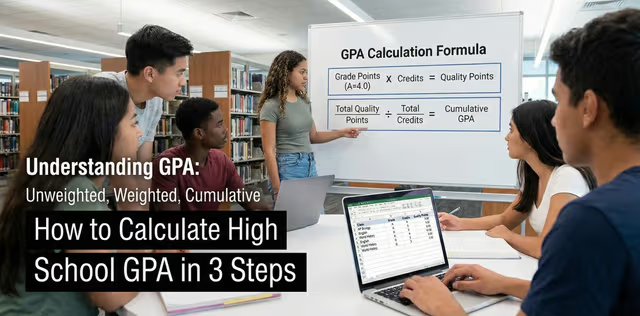
To calculate your GPA for a semester, multiply each course’s grade point value by the number of credit hours for that course. Add all those products together, then divide by the total number of credit hours.
For example, say you take four courses in a semester. You earn an A in a 3-credit course, a B+ in a 4 credit course, a B in a 3 credit course, and an A minus in a 3 credit course. Multiply each grade point by its credits: 4.0 times 3 equals 12, 3.3 times 4 equals 13.2, 3.0 times 3 equals 9, and 3.7 times 3 equals 11.1. Add those together: 12 plus 13.2 plus 9 plus 11.1 equals 45.3. Divide by your total credit hours (13), and your semester GPA is 3.48.
How to Figure Out What You Need on a Final Exam
This is the question every student asks at the end of the semester. You know your current grade, you know how much the final exam weighs, and you want to know the minimum score you need to hit a target grade.
The formula is straightforward:
Required Score = (Target Grade – Current Grade x (1 – Final Weight)) / Final Weight
Say your current grade before the final is 82 percent, the final exam counts for 30 percent of your overall grade, and you want to finish the course with at least a B, which means 80 percent or higher.
Plug in the numbers. Subtract the final weight from 1 to get 0.70. Multiply your current grade by that: 82 times 0.70 equals 57.4. Subtract that from your target grade: 80 minus 57.4 equals 22.6. Divide by the final weight: 22.6 divided by 0.30 equals 75.33.
You need at least a 75.33 percent on the final to finish the course with an 80 percent overall. That is a C grade on the final to keep a B in the class. Knowing this before you walk into the exam changes how you study and how much pressure you put on yourself.
Common Mistakes Students Make When Calculating Grades
A few errors come up again and again when students try to figure out their grades on their own.
Treating all assignments as equal weight when the syllabus clearly lists different category weights is the most common one. Getting a 95 on a homework assignment that counts for 10 percent of your grade does not offset a 65 on an exam that counts for 40 percent. Always check the weights.
Forgetting to convert percentages to decimals before multiplying causes calculation errors. Twenty percent needs to become 0.20 in the formula, not 20. Multiplying by 20 instead of 0.20 produces a number that makes no sense.
Including zeros for work that has not been assigned yet skews your midterm calculation downward. Only include categories that have actual grades when calculating your current standing.
Assuming every school uses the same grading scale leads to confusion when transferring between schools or comparing grades with friends at different institutions. Always verify the scale your specific school uses.
A Practical Tip for Tracking Grades All Semester
Do not wait until finals week to figure out where you stand. Set up a simple spreadsheet at the start of the semester with columns for the assignment name, the score earned, the total points possible, the percentage, the category, and the category weight. Update it after every graded assignment.
This takes five minutes per week and gives you a running view of your grade in every course. You can spot problems early, figure out which categories need more attention, and walk into final exams knowing exactly what score you need instead of guessing.
If spreadsheets feel like too much work, a grade calculator does the same thing faster. Enter your scores, add the weights, and get your current percentage instantly.
Common Questions
What percentage is an A? On the most common grading scale used in the United States, an A starts at 90 percent. Schools that use plus and minus modifiers typically set a straight A at 93 to 96 percent and an A plus at 97 to 100 percent. Check your school’s specific scale because thresholds vary.
How do I calculate my grade if my teacher uses total points instead of weights? Add up every point you have earned across all assignments, quizzes, tests, and projects. Divide that total by the maximum number of points available. Multiply by 100 to get your percentage.
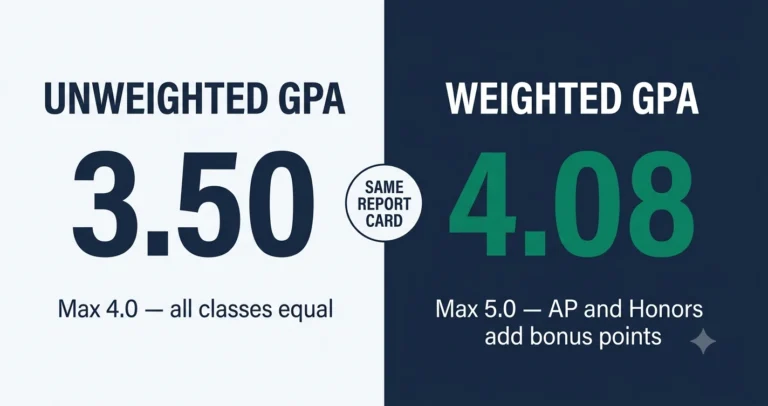
What is the difference between weighted and unweighted grades? An unweighted grade treats every assignment equally regardless of type. A weighted grade assigns different levels of importance to different categories. In a weighted system, a test worth 40 percent of your grade has more impact than a homework assignment worth 10 percent, even if you scored higher on the homework.
Can I calculate my grade if I only have some of my scores? Yes. Add up the weighted scores for the categories you have grades in, then divide by the combined weight of those categories. This gives you an accurate current percentage without penalizing you for work that has not been assigned yet.
What score do I need on my final to pass? Use the formula: Required Score = (Target Grade – Current Grade x (1 – Final Weight)) / Final Weight. Plug in your current percentage, the weight of the final exam, and the minimum passing grade you need. The result tells you exactly what score to aim for.
Is a 70 percent passing? At most schools in the United States, 70 percent earns a C, which counts as a passing grade. However, some programs and courses require a C minus (70 percent) or higher, while others set the passing bar at D (60 percent). Graduate programs often require a B (80 percent) or higher. Check your school’s policies for the specific requirement.
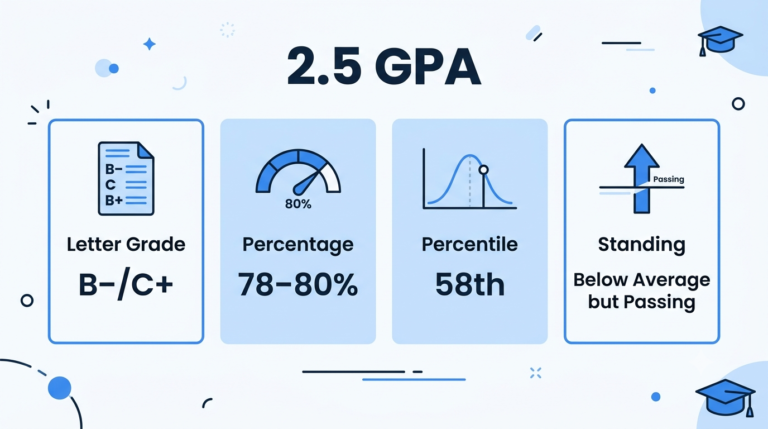
How do I convert a percentage to a GPA? First convert the percentage to a letter grade using your school’s grading scale. Then convert the letter grade to a grade point value on the 4.0 scale. An A equals 4.0, a B equals 3.0, a C equals 2.0, a D equals 1.0, and an F equals 0.0. For plus and minus grades, add or subtract approximately 0.3 from the base value.
Start Calculating
Understanding how grades work by percentage gives you control over your academic results. You stop guessing and start planning. You know which assignments to prioritize, where your grade sits at any point in the semester, and exactly what you need on upcoming work to hit your target.
If you want to skip the manual math, try our free grade calculator to check your scores, test different scenarios, and figure out what you need on your next exam in seconds.