
Is 77% a Passing Grade? What It Really Means for Students
Most students panic when they see 77% on a test. Some feel relieved. The truth is, whether 77% is a passing grade depends entirely on where you are, what subject you’re in, and what you’re trying to achieve academically.
Let me break this down properly so you actually understand what that number means for your situation.
What Grade Letter Is 77%?
On the standard US grading scale, 77% falls in the C+ range. Here is how the full scale looks:
For the full A-to-F scale, including plus and minus grades and what each one means academically, read our complete grading scale guide.
90 to 100 percent is an A, 80 to 89 percent is a B, 70 to 79 percent is a C, 60 to 69 percent is a D, and below 60 percent is an F.
So 77% sits comfortably in the C range, slightly toward the upper end. It is not failing. It is not great. It is average, and depending on your context, that matters a lot.
Is 77% Passing in High School?
In most US high schools, the passing grade is 60% or 65% depending on the district. By that standard, 77% is a passing grade with room to spare.
But passing and good are two different things.
Take a student named Marcus who attends a public high school in Texas. His school considers anything above 70% passing. Marcus scored 77% on his biology midterm. He passed, but his teacher flagged that he is struggling with cell division concepts, which will carry into the next unit. Passing the test did not mean he understood the material fully.
This is the real-world problem with just checking if you passed. A 77% can hide gaps in understanding that catch up with you later.
In states like California, some districts set the passing threshold at 70%, while others accept 65%. If you are unsure about your school’s specific threshold, check your student handbook or ask your teacher directly.
Is 77% Passing in College?
This is where it gets more complicated. In college, the stakes attached to your grade percentage go beyond just passing or failing.
Most universities consider 60% or D the minimum passing grade for a course credit. So yes, 77% passes. But here is the problem for college students: financial aid, scholarships, athletic eligibility, and graduate school applications all look at your GPA, not just whether you passed.
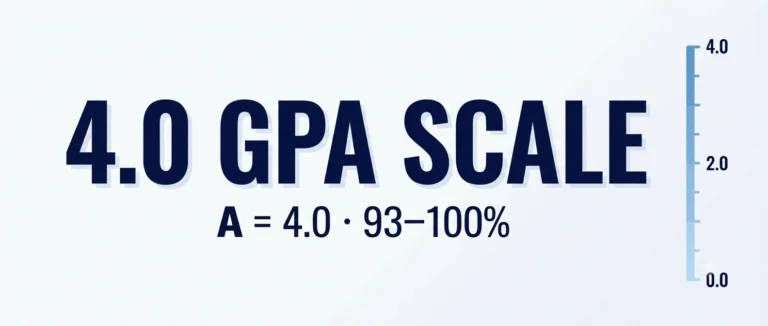
A 77% translates to roughly a 2.3 GPA on a 4.0 scale for that course. If your scholarship requires a 3.0 GPA and you score 77% across most of your classes, you are at serious risk of losing funding even though you technically passed every course.
Sarah is a sophomore at a university in Ohio on a merit scholarship that requires a 3.0 cumulative GPA. She scored 77% in economics, 75% in statistics, and 80% in English in one semester. Her semester GPA came out to 2.7. She passed all three courses but lost her scholarship because she fell below the 3.0 threshold. Passing was not enough.
If your GPA is sitting near a scholarship cutoff, learn how to raise your GPA strategically before the next semester closes.
How Is 77% Actually Calculated?
Understanding the calculation helps you figure out exactly where you stand and what you need to improve.
the UniversityThe basic formula is straightforward. You take the number of correct answers, divide by the total number of questions, then multiply by 100.
Weighted course grades feed directly into your overall GPA. The full method for calculating that final number is in our guide on how to calculate high school GPA.
If you got 23 questions right out of 30, the calculation is 23 divided by 30, which equals 0.766, multiplied by 100, giving you 76.6%, which rounds to 77%.
For weighted grades, the formula changes. Each category has a different weight. Say your class grades on this breakdown: homework counts for 20%, quizzes count for 30%, and the final exam counts for 50%.
If you scored 85% on homework, 72% on quizzes, and 74% on the final exam, the calculation works like this. Multiply 85 by 0.20 to get 17. Multiply 72 by 0.30 to get 21.6. Multiply 74 by 0.50 to get 37. Add all three together: 17 plus 21.6 plus 37 equals 75.6%. Your final grade is 75.6%, not a simple average of the three scores.
This weighted calculation trips up a lot of students. They average their scores in their heads and think they are doing better than they actually are.
Does 77% Affect College Admissions?
If you are applying to college, a consistent 77% average puts your GPA around 2.7 on a 4.0 scale. Here is what that realistically means for admissions.
itself,Community colleges and open-enrollment schools accept students with a 2.7 GPA without issue. State universities vary widely. A school like Arizona State University accepts students with GPAs around 3.0 as a general benchmark, so a 2.7 puts you in a borderline range where your test scores, essay, and extracurriculars carry more weight. For full admissions benchmarks across community colleges, state universities, and Ivy League schools, see our good GPA guide.
Competitive universities like UCLA, University of Michigan, or Georgetown typically look for GPAs of 3.7 and above among admitted students. A 2.7 GPA from consistent 77% scores would make admission to these schools very difficult without exceptional circumstances elsewhere in your application.
The honest answer is that a 77% average does not close doors to college, but it significantly narrows which doors are open.
What Should You Do If You Are Scoring 77%?
The first thing to understand is that 77% usually means you understand the core concepts but are losing points on details, application, or specific question types. It is rarely a complete knowledge gap.
A practical approach is to look at where exactly you are losing points. If you scored 77% on a 30-question test, you got roughly 7 questions wrong. Go back and categorize those 7 wrong answers. Are they from one specific topic? Are they all application questions rather than recall questions? Are they questions from the last section of the test, which might suggest a time management issue?
James, a junior in high school, was consistently scoring between 74% and 78% on his chemistry tests. When he went back through his wrong answers over four tests, he realized 80% of his mistakes were on stoichiometry problems specifically. He was not bad at chemistry overall. He had one weak area that was pulling his score down by 10 to 15 points every time. He spent two focused study sessions on stoichiometry with a YouTube tutorial and his textbook. His next test score was 89%.
That is the value of treating 77% as diagnostic information rather than just a grade.
The Bottom Line
A 77% is a passing grade in virtually every US high school and college. But passing is not the same as being on track for your actual goals. If your goal is to maintain a scholarship, get into a competitive college, or advance in a subject that builds on itself like math or science, 77% is a signal to pay attention to, not a reason to panic but also not a reason to feel settled.
-questionUse your grade as a starting point. Understand the calculation behind it. Find where specifically you are losing points. That process turns a 77% into an 87% faster than most students expect.
If finals week is approaching and you want to pull a 77 percent average up, run the numbers first. Our guide on what grade you need on your final to pass shows you the exact score required for any target.
FAQ
What is 77% as a letter grade?
77% is a C+ on the standard US grading scale. It sits in the 70 to 79 percent range which is classified as a C, with 77 being at the upper portion often noted as C+.
Is 77% a good grade?
It depends on your context. For simply passing a course, yes. For maintaining scholarships, college admissions to competitive schools, or subjects that require strong foundational knowledge, 77% is below where most students want to be consistently.
What GPA does a 77% equal?
A 77% typically converts to approximately a 2.3 GPA on a 4.0 scale, though some schools use slightly different conversion scales.
Can you get into college with a 77% average?
Yes, many colleges accept students with a 2.7 GPA. Community colleges, trade schools, and many state universities are accessible. Highly selective universities become significantly more difficult to get into with this average.
How many questions wrong is 77% on a 20 question test?
On a 20 question test, 77% means you got approximately 15 to 16 questions correct, meaning 4 to 5 questions wrong. The precise calculation is 20 multiplied by 0.77 which equals 15.4 correct answers.