
What Is a Good GPA? High School and College Guide
Your GPA follows you from freshman year through graduate school applications, scholarship reviews, and even some job screenings. Yet most students never get a straight answer on what number actually counts as a good GPA. This guide breaks down good GPA benchmarks by education level, explains weighted versus unweighted GPA, and tells you exactly what admissions officers, scholarship committees, and employers look for in 2025 and beyond.
What Does GPA Mean?
GPA stands for grade point average. It converts your letter grades into a single number on a 4.0 scale. Most American high schools and colleges use this standard:
| Letter Grade | GPA Points |
|---|---|
| A / A+ | 4.0 |
| A- | 3.7 |
| B+ | 3.3 |
| B | 3.0 |
| B- | 2.7 |
| C+ | 2.3 |
| C | 2.0 |
| D | 1.0 |
| F | 0.0 |
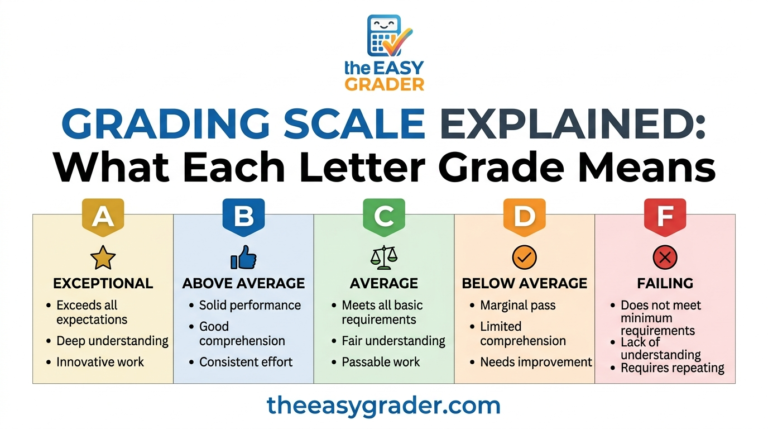
Each letter grade also corresponds to a specific percentage range. The full breakdown sits in our grading scale explained guide.
Your cumulative GPA averages every course grade across all semesters. A single semester GPA only reflects one term. Colleges typically review both numbers on your transcript.
What Is a Good GPA in High School?
A 3.0 GPA is the national average for high school students in the United States, according to data from the National Center for Education Statistics. That translates to a B average. Anything above 3.0 puts you ahead of most of your peers.
Here is a practical breakdown for high school students:
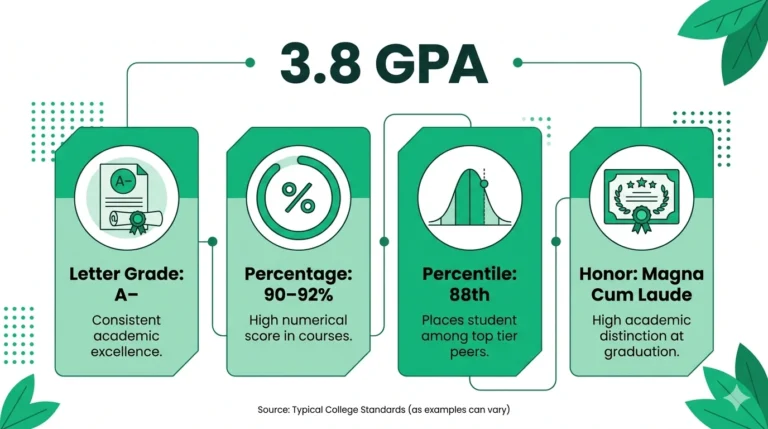
3.5 to 4.0 GPA: This range signals strong academic performance. It keeps you competitive for selective universities, merit scholarships, and honors programs. Most students in the top 10 percent of their class land in this range.
standardized3.0 to 3.4 GPA: A solid, respectable GPA. You qualify for thousands of colleges and many scholarship programs. You are not at a disadvantage for the majority of four-year universities.
Not sure how your school landed at the number on your transcript? Walk through the exact formula in our guide on how to calculate high school GPA
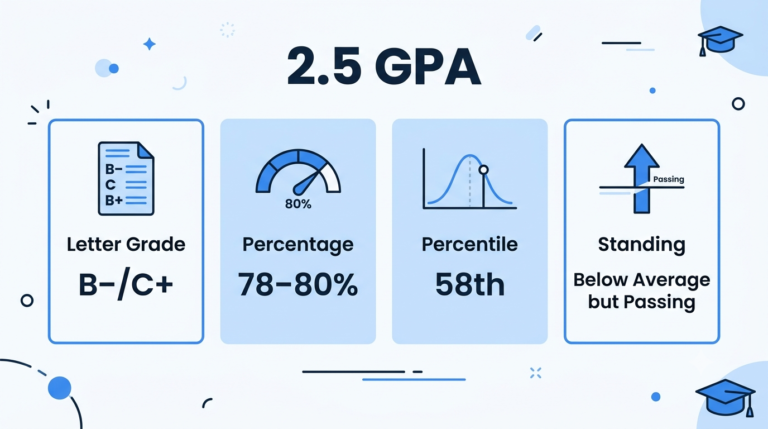
2.5 to 2.9 GPA: This GPA gets you into community colleges and less selective four-year schools. You can still build a strong college application by scoring well on the SAT or ACT.
Below 2.5 GPA: You have fewer four-year college options, but community college remains a real path. Strong standardised test scores, a compelling personal statement, and upward grade trends can still work in your favor.
A good GPA in high school depends on where you want to go. If your target is a highly selective university, aim for 3.7 or above on an unweighted scale.
What Is a Good GPA for College Admissions?
College admissions officers do not evaluate your GPA in isolation. They look at it alongside your course rigor, class rank, and test scores. Still, GPA remains one of the strongest predictors of college readiness.
Here are average GPAs for admitted students at different tiers of colleges in the United States:
- Ivy League and top 25 universities: Average admitted GPA of 3.9 to 4.0 (unweighted). Harvard, Yale, and Stanford routinely report averages above 3.9.
- Selective public universities: Average admitted GPA of 3.7 to 3.9. Schools like UCLA, the University of Michigan, and UNC Chapel Hill fall in this range.
- Moderately selective colleges: Average admitted GPA of 3.0 to 3.7. This covers a wide range of strong four-year institutions across the country.
- Open enrollment and community colleges: No minimum GPA requirement for most programs.
One important note: admissions offices often recalculate your GPA using their own formula. They may remove electives, weight AP or IB courses differently, or only consider core academic subjects. Your official transcript GPA and your recalculated admissions GPA can differ by several tenths of a point.
Weighted vs. Unweighted GPA: Which One Matters?
An unweighted GPA treats every class equally on a 4.0 scale. A weighted GPA gives extra points for harder courses. AP, IB, and honors classes typically add 0.5 to 1.0 extra points to your grade.
For example, a B in AP Chemistry becomes a 3.7 on a weighted scale instead of the standard 3.0.
Most colleges convert your GPA to their own unweighted scale during review. However, taking rigors courses still helps. A 3.5 unweighted GPA in challenging AP classes often looks stronger to admissions officers than a 3.8 unweighted GPA from easier coursework.
When discussing your GPA, always specify whether it is weighted or unweighted. The distinction matters more than most students realize.
What Is a Good GPA in College?
College GPAs follow the same 4.0 scale, but the stakes shift significantly.
3.5 to 4.0 GPA: This puts you on the Dean’s List at most schools and makes you a strong candidate for graduate programmes, competitive internships, and employer recruitment programmes. Many major companies screen resumes for a minimum 3.5 GPA.
3.0 to 3.4 GPA: A good, functional GPA in college. You maintain financial aid eligibility, qualify for most graduate school applications, and remain competitive for the majority of entry-level jobs.
2.5 to 2.9 GPA: You stay academically in good standing at most colleges. Some graduate programs and scholarship opportunities require at least a 3.0, so this range starts to close certain doors.
Below 2.0 GPA: Academic probation is a real risk. Many colleges place students on probation once they fall below a 2.0 cumulative GPA, which can affect federal financial aid eligibility.
What GPA Do You Need for Scholarships?
Most merit-based scholarships require a 3.0 GPA minimum. Competitive national scholarships, including the National Merit Scholarship and many private awards, typically expect a 3.5 or higher.
Athletic scholarships at the NCAA Division I level require a 2.3 GPA in core academic courses and a specific sliding-scale ACT or SAT score. Division II schools require a minimum 2.2 GPA in core courses.
If your GPA sits below scholarship thresholds, do not stop applying. Many financial aid programs weigh financial need, community involvement, and essay quality alongside academic performance.
Scoring around 77 percent on most assessments puts your GPA close to the bottom of scholarship eligibility. Read what 77 percent really means for students for the full impact.
What Is a Good GPA for Graduate School?
Graduate programs generally expect a minimum 3.0 undergraduate GPA for admission. Competitive programs at top research universities often admit students with a 3.5 or above.
Medical schools look at both your cumulative GPA and your science GPA separately. The average GPA for admitted medical students in the United States sits at 3.7 or higher. Law school admissions factor your GPA alongside LSAT scores, and a 3.5 GPA keeps you competitive at most ABA-accredited programs.
MBA programs at top business schools like Harvard, Wharton, and Stanford report average admitted GPAs between 3.7 and 3.9. However, they weigh work experience and GMAT or GRE scores heavily, which means a slightly lower GPA does not automatically disqualify strong candidates.
How to Improve a Low GPA
A low GPA is not permanent. Here are the most effective actions students take to raise their GPA:
- Focus on high-credit courses first. An A in a 4-credit course moves your GPA more than an A in a 1-credit elective.
- Retake courses where you earned a D or F. Many colleges replace the original grade in GPA calculations.
- Eliminate missing assignments immediately. A single zero damages your grade more than a bad test score.
- Use your professor’s office hours. Students who seek help early consistently earn higher final grades.
- Plan upcoming semesters strategically using the steps in our guide on how to raise your GPA, which covers the math behind every grade decision you make.
Small, consistent improvements compound quickly, especially early in high school or in the first two years of college when your cumulative GPA is still forming.
Frequently Asked Questions
Is a 3.5 GPA good?
Yes. A 3.5 GPA is above the national average, qualifies you for most merit scholarships, and keeps you competitive at a wide range of four-year colleges and graduate programs.
Is a 3.0 GPA good in high school?
A 3.0 GPA sits at the national average and is acceptable for most colleges. It opens the door to thousands of schools, though it limits your chances at highly selective universities.
What GPA is considered honor roll?
Most high schools place students on the honor roll with a 3.5 GPA or higher per semester. Some schools use a lower cutoff of 3.0 for a standard honor roll.
Does GPA matter after college?
GPA matters most during the first few years of your career. Many employers screen entry-level applicants for a minimum 3.0 GPA. After two to three years of work experience, your professional track record carries more weight than your college grades.
What is the average GPA in college?
The national average college GPA is approximately 3.1, higher than it was two decades ago due to grade inflation at many universities.
Conclusion
A good GPA is one that keeps your next goal within reach. For college admissions, target 3.5 or above. For scholarships, aim for at least 3.0. For graduate school, a 3.5 unweighted GPA makes you a competitive applicant at most programs.
Your GPA is not fixed. Every semester gives you a chance to bring it up. Use a GPA calculator to track exactly where you stand and what grades you need to hit your target.