Percentage to Letter Grade: The Full Conversion Chart
Last updated: November 9, 2026
To convert a percentage to letter grade, find the band that contains your score, then read across to its letter. On the common plus/minus scale in this chart, 85% is a B, 92% is an A-, and 89.9% is still a B+ unless your school rounds it up. Your school’s own scale always wins over any general chart.
Direct answer: match your percentage to its band, then read the letter
A percentage to letter grade conversion is a lookup, not a calculation. Take the final percentage, find the band whose lower limit it meets, and use that band’s letter. A score of 89.9% has not met the 90% limit for an A-, so it stays a B+ under a no-rounding rule.
First, turn points into a grade percentage: divide points earned by points possible, then multiply by 100. For example, 17 out of 20 is 85%, and 34 out of 40 is also 85%. Next, match that percentage to the chart below.
Percentage to letter grade: full conversion chart
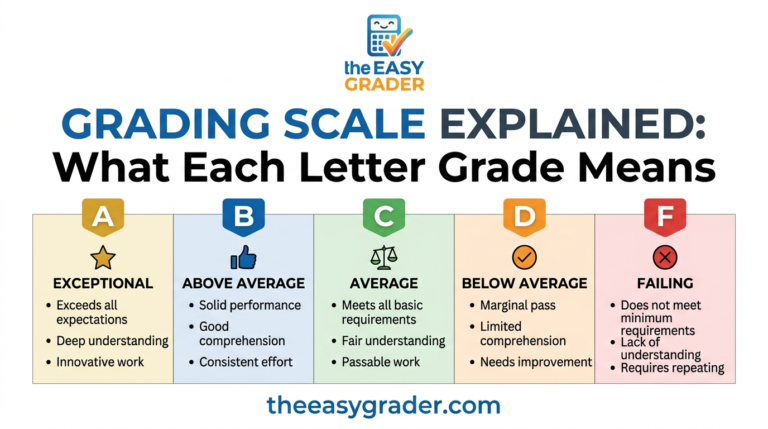
This letter grade scale is the common US plus/minus scale. For more on how scales differ, see the linked guide on the grading scale.
| Percentage | Letter grade |
|---|---|
| 97–100% | A+ |
| 93–96% | A |
| 90–92% | A- |
| 87–89% | B+ |
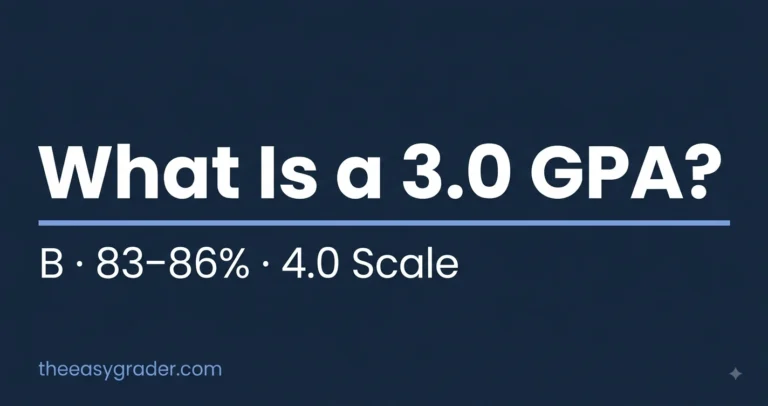
| 83–86% | B |
| 80–82% | B- |
| 77–79% | C+ |
| 73–76% | C |
| 70–72% | C- |
| 67–69% | D+ |
| 63–66% | D |
| 60–62% | D- |
| Below 60% | F |
If your school does not use plus or minus grades, collapse each group: 90–100% is an A, 80–89% is a B, 70–79% is a C, 60–69% is a D, and below 60% is an F. There is no E in this US system: the letter after D is F.
You can turn a letter into GPA points with a GPA calculator, but this article stays focused on percentage bands and letters.
Decimals and rounding: 89.4% / 89.5% / 89.9% / 92.5% decision table
Decimals cause most conversion errors because rounding rules differ. Some gradebooks round to the nearest whole number, some cut off the decimal part, and some apply the band exactly as written. Ask which rule your course uses first.
| Score | Rounded | Not rounded |
|---|---|---|
| 89.4% | 89%, B+ | 89.4%, B+ |
| 89.5% | 90%, A- | 89.5%, B+ |
| 89.9% | 90%, A- | 89.9%, B+ |
| 92.5% | 93%, A | 92.5%, A- |
Read the last row with care. Rounding 92.5% to 93% moves it into the A band, but keeping the decimal leaves it in the 90–92% A- band. Do not round twice. Round once, at the end, and only if your course says to round.
Which scale does my school use?
Check these four points in your syllabus.
- Where does A start? At 90% suggests a 10-point scale; at 93%, a 7-point scale.
- Are plus and minus letter grades used? If not, use the plain A, B, C, D, and F bands.
- Where does F begin? The common cutoff is below 60%, but some 7-point scales place F below 70%.
- What is the rounding rule? Look for rounded, truncated, or no rounding.
On a 10-point scale, 92% is an A- with plus/minus grades, or a plain A without them. On a 7-point scale, 92% is a B, 84% is a C, and 69% is an F.
See the University of Missouri Registrar grading system for a published university example. If they disagree, follow the syllabus.
Multi-assignment weighted example ending in a letter
A weight is the share of the final grade that a category controls. Multiply each category score by its weight as a decimal, add the results, and only then match the total to a letter.
Suppose homework counts 20% (88%), quizzes 30% (76%), a midterm 20% (92%), and a final 30% (84%).
- Homework: 88 × 0.20 = 17.6
- Quizzes: 76 × 0.30 = 22.8
- Midterm: 92 × 0.20 = 18.4
- Final: 84 × 0.30 = 25.2
- Total: 17.6 + 22.8 + 18.4 + 25.2 = 84.0%
On the chart above, 84.0% falls in the 83–86% band, so the final letter is B. The weights decide how much each score moves that total.
Common mistakes and quick tips
Do not round each assignment before weighting it. Rounding early can shift the final total enough to cross a band. Keep decimals through the weighted math, then apply your school’s rounding rule once at the end.
Do not use the wrong scale for a quick check. A 92% that looks like an A on one scale is a B on a 7-point scale, and a 69% that looks like a D on one scale can be an F on another. Do not average letters themselves. Convert scores to percentages, weight those numbers, and convert the final percentage once.
FAQs
What letter grade is 85 percent?
On the common plus/minus scale, 85% is a B, because it falls in the 83–86% band. On a plain scale without plus or minus grades, it is also a B, since that band runs from 80% to 89%.
Is 89.5% an A or a B?
It depends on rounding for your course. If your gradebook rounds to the nearest whole number, 89.5% becomes 90%, an A-. If decimals are kept or cut off, it stays a B+.
Does 89.9% round up to an A?
Not automatically. Under a no-rounding rule, 89.9% stays a B+, because it has not reached 90%. It becomes an A- only if your course rounds to the nearest whole number.
What letter grade is 92%?
On the common plus/minus scale, 92% is an A-, the top of the 90–92% band. On a plain scale it is an A, and on a 7-point scale it is a B, so check your school’s scale.
Why do different schools give different letters for the same percentage?
Schools set their own cutoffs, plus/minus rules, and rounding policies. One school may start A at 90%, while another starts it at 93%, so the same score can sit in different bands.
Check your grade now
Use the easy grade calculator to enter your points or weighted scores and see your percentage and letter at once. Compare the result with the percentage to letter grade chart above and your syllabus scale.
GPA scales differ between schools, so confirm your school’s or college’s official policy before making decisions.
For reference, the Penn State course grading scale shows A at 90–100% and F below 60%, while the Smith College grading policy on rounding shows strict no-rounding boundaries.