
What Grade Do I Need on My Final to Pass?
Finals week is stressful enough without doing math in your head. You know your current grade, you know the final is coming, but you have no idea what score you actually need to walk out of the semester with a passing grade.
This guide walks you through the exact calculation, step by step, for every common final exam weight. No guessing, no anxiety spiraling just the number you need and how to get it.
The Formula Every Student Should Know
Before the examples, here is the formula teachers use to calculate your final course grade:
Final Course Grade = (Current Grade x (1 minus Final Exam Weight)) + (Final Exam Score x Final Exam Weight)
To find what score you need on the final, you rearrange it:
Required Final Score = (Target Grade minus (Current Grade x (1 minus Final Exam Weight))) divided by Final Exam Weight
That looks complicated written out. The examples below make it obvious.
What Counts as Passing?
In most US high schools and colleges, a passing grade is 60%, or D. Some courses require a C or 70% to pass, especially prerequisites for other classes. Medical, nursing, and graduate programs often require 75% or higher.
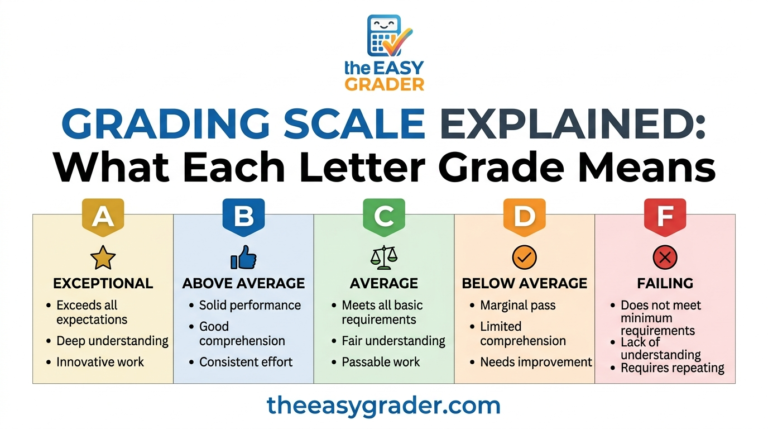
weight:Check your syllabus or ask your instructor. The number changes the calculation, and knowing the right target matters. Passing thresholds vary by school and program. For a full breakdown of every grade range and what it means, read our grading scale guide.
For these examples, the target grade is 60% to pass unless stated otherwise.
When Your Final Is Worth 20% of Your Grade
A 20% weighted final has the least pressure on it. Your semester work carries 80% of your grade, which means a bad final hurts less and a great final helps less.
Example: Current grade: 55% Target grade: 60% (passing) Final exam weight: 20% (or 0.20)
Step 1: Multiply your current grade by the remaining weight 55 x 0.80 = 44
Step 2: Subtract that from your target. 60 minus 44 = 16
Step 3: Divide by the final exam weight 16 divided by 0.20 = 80
A comfortable pass might still not be a strong GPA. See the full benchmarks in our good GPA guide to know where your number actually stands.
You need an 80% on the final to pass.
If your current grade is already at 60% or above, the math gets easier. A student sitting at 65% only needs a 35% on a 20% weighted final to stay above passing. Your previous work has already done most of the job.
When Your Final Is Worth 25% of Your Grade
A quarter of your grade sitting on one exam is where most students start to feel real pressure. It is still manageable, but the final exam pulls more weight here.
Example: Current grade: 58% Target grade: 60% Final exam weight: 25% (or 0.25)
Step 1: Multiply current grade by remaining weight 58 x 0.75 = 43.5
Step 2: Subtract from target 60 minus 43.5 = 16.5
Step 3: Divide by final weight 16.5 divided by 0.25 = 66
You need a 66% on the final to pass.
That is a very achievable score for most students. Even sitting a few points below passing going into finals, a 25% weighted exam gives you a clear path out.
Now flip it. If your current grade is 50%, here is what changes: 50 x 0.75 = 37.5 60 minus 37.5 = 22.5 22.5 divided by 0.25 = 90
You now need a 90% on the final. Still possible, but you have very little margin for error on exam day.
When Your Final Is Worth 30% of Your Grade
A 30% weighted final is the most common structure across college courses. Three-tenths of your entire semester comes down to one test. This is where students tend to either relax too early or panic unnecessarily.
Example 1 Borderline student: Current grade: 56% Target grade: 60% Final exam weight: 30% (or 0.30)
Step 1: 56 x 0.70 = 39.2 Step 2: 60 minus 39.2 = 20.8 Step 3: 20.8 divided by 0.30 = 69.3
You need approximately a 70% on the final to pass.
Example 2 Aiming for a C instead of just passing: Current grade: 62% Target grade: 70% (C) Final exam weight: 30%
Step 1: 62 x 0.70 = 43.4 Step 2: 70 minus 43.4 = 26.6 Step 3: 26.6 divided by 0.30 = 88.7
You need close to an 89% on the final. That is a much tougher ask. If you are in this position and aiming for a C, your study time needs to reflect that difficulty.
A 30% weighted final rewards consistent semester effort. Students who coast often end up needing scores in the 80s and 90s on the final just to reach a grade they assumed was already secure.
When Your Final Is Worth 40% of Your Grade
A 40% final is the most high-stakes scenario in standard coursework. Nearly half your grade lives here. One exam can genuinely rescue a rough semester or sink a solid one.
Example 1: The rescue scenario: Current grade: 48% Target grade: 60% Final exam weight: 40% (or 0.40)
Step 1: 48 x 0.60 = 28.8 Step 2: 60 minus 28.8 = 31.2 Step 3: 31.2 divided by 0.40 = 78
final,Once finals are behind you, the next move is rebuilding momentum for the semesters ahead. Here is how to raise your GPA strategically without wasting effort.
You need a 78% on the final. A failing-range semester grade is still saveable with a strong final. That is the upside of high-weight exams.
Example 2: The complacent student: Current grade: 72% Target grade: 70% (C, to keep scholarship or avoid repeating) Final exam weight: 40%
Step 1: 72 x 0.60 = 43.2 Step 2: 70 minus 43.2 = 26.8 Step 3: 26.8 divided by 0.40 = 67
You only need a 67% to keep your C. A student sitting at a comfortable 72% heading into a 40% final only needs to score above failing to protect their grade. That is useful to know before you burn yourself out studying.
What If You Need More Than 100%?
Run the formula and get a number above 100? That means passing is mathematically impossible in this course given your current grade and exam weight. It happens.
If this is your situation, the right move is talking to your instructor before the final not after. Some professors offer extra credit, incomplete grades, or alternative arrangements. None of those options are available after the semester ends and the final is submitted.
If passing this course is mathematically off the table, the long-term work is rebuilding your overall GPA. Start with our guide on how to calculate high school GPA so you know exactly what number you are working with.
Quick Reference by Scenario
Rather than memorising the formula, use this pattern each time:
First, find what percentage of your grade is already locked in. That is 100% minus the final exam weight.
Second, figure out how many total points your locked-in grade has already contributed to your course total.
Third, find how many points you still need from the final to reach your target.
Fourth, divide that gap by the final exam weight to get your required score.
Every calculation in this guide follows that exact sequence. Once you run it twice, it becomes second nature.
One More Scenario Worth Knowing
Students often ask whether getting 100% on the final can save them. Here is the honest answer.
If your current grade is 40% and your final is worth 30%: 40 x 0.70 = 28 100 x 0.30 = 30 Total: 58%
Even a perfect final score does not get you to 60%. This is why catching a failing grade early matters. The formula tells you the truth before it is too late to act on it.
Use a Calculator to Skip the Arithmetic
The steps above are worth understanding once so you know what is actually happening with your grade. After that, use a final grade calculator to run the numbers instantly. Enter your current grade, your target grade, and your final exam weight. The result appears in seconds.
If you’re earlier in the semester and want to know what you need on an upcoming midterm instead, try the Midterm Grade Calculator, which uses the same approach but for exams that happen partway through the term.
Knowing your required score before exam day changes how you prepare. You stop studying everything and start focusing on what the exam actually needs from you.