Midterm Grade Calculator: How to Calculate Your Midterm Grade and What You Need Next
Last updated: November 12, 2026
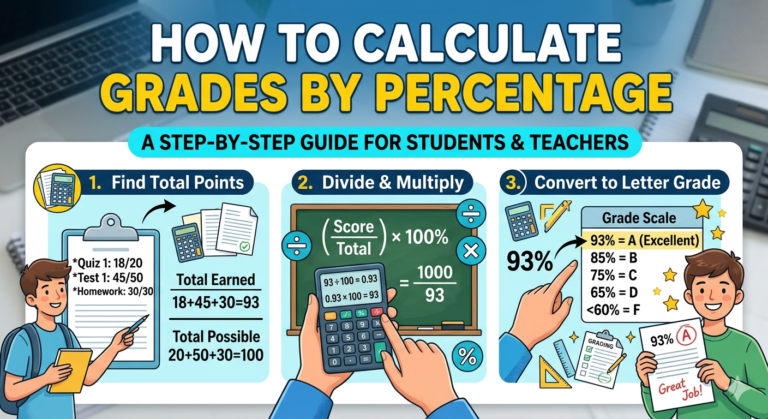
A midterm grade calculator helps you answer two questions at the midpoint of a course: where do you stand now, and what score do you need next? Enter your graded scores and the weight of each category from your syllabus, and it returns a weighted average, not a simple average. That average is your midterm grade.
The direct answer: your midterm grade is your weighted average on work completed so far
A midterm grade is the weighted average of the graded work in one course up to the midterm point, including the midterm exam once it is graded. Each category score is multiplied by its syllabus weight, the results are added, and the total is divided by the combined weight of graded work.
Weight is the share a category controls. A 50% category moves your grade twice as far as a 25% one.
Step-by-step: use the midterm grade calculator
Follow these steps, using percentages for every score:
- Copy each category weight from your syllabus, and check that the full-course weights add to 100%.
- For each category, find one average score. For several assignments, divide points earned by points possible.
- Multiply each average by its weight as a decimal, then add those points.
- If every category is graded, that sum is your midterm grade. If some weight is ungraded, divide the sum by the graded weight instead.
That last step matters for a midterm grade calculator college students use: a gradebook may count work not done yet as zero. Leave ungraded work out.
Worked example 1: Homework 20%, Quizzes 30%, Midterm 50%
Homework averages 88%, quizzes 82%, and the midterm exam grade is 76%.
- Homework: 88 × 0.20 = 17.6 points
- Quizzes: 82 × 0.30 = 24.6 points
- Midterm: 76 × 0.50 = 38.0 points
- Midterm grade: 17.6 + 24.6 + 38.0 = 80.2%
Worked example 2: midterm not yet taken — what score keeps each letter grade?
Before the midterm, only homework and quizzes are graded. Their points are 17.6 + 24.6 = 42.2, and their weight is 50%. Your average on completed work is 42.2 ÷ 0.50 = 84.4%.
To learn how to calculate midterm grade targets, use this formula:
Needed midterm score = (Target grade − Points already earned) ÷ Midterm weight
The midterm is worth 50%, so the needed scores are:
- A (90%): (90 − 42.2) ÷ 0.50 = 95.6%
- B (80%): (80 − 42.2) ÷ 0.50 = 75.6%
- C (70%): (70 − 42.2) ÷ 0.50 = 55.6%
- D (60%): (60 − 42.2) ÷ 0.50 = 35.6%
Above 100% means that target cannot be reached at this checkpoint. Check whether extra credit or a dropped score applies.
After midterms: what you need on remaining work
Suppose the 80.2% above counts as half the final course grade, with the other half remaining. You have banked 80.2 × 0.50 = 40.1 points.
Needed score on remaining work = (Target grade − Points banked) ÷ Remaining weight
| Target course grade | Needed on remaining work |
|---|---|
| A (90%) | 99.8% |
| B (80%) | 79.8% |
| C (70%) | 59.8% |
| D (60%) | 39.8% |
Keeping an A needs 99.8%, leaving almost no room for a weak assignment. If a final exam is the only work left, the same formula applies with the final exam weight, and the final grade calculator walks through that separate case. In other words, it answers what grade do I need on my final.
Midterm grade vs semester grade vs final grade — three different checkpoints
A midterm grade describes one course at its midpoint, as a progress check. UC Merced’s mid-semester grade policy says such grades are not recorded on the transcript and do not affect GPA, while the University of Maryland’s mid-term grade policy says they are for advising and not recorded on the transcript. Schools may handle a semester midterm grade differently.
A semester grade is recorded when the term ends. A final grade often means the same, but some people use it only for the final exam score. Check what your syllabus means by “final.”
For letters, the College Board’s 4.0 scale guide gives A as 90–100, B as 80–89, C as 70–79, D as 66–69, and E/F below 65. Many schools differ, so use your school’s scale.
Common mistakes
- Counting ungraded work as zero. This pulls the average down before the work exists.
- Double-counting the midterm. Count it once, inside a test category or as its own weight, not both.
- Using final-exam weights at midterm. That weight belongs to work that has not happened yet.
- Using a simple average when weights differ. A 76% midterm at 50% moves the grade far more than a small homework set.
FAQs
How do you calculate a midterm grade?
Multiply each graded category score by its syllabus weight, add the results, and divide by the combined weight of graded work. For example, homework at 88% worth 20% contributes 17.6 points. Leave ungraded work out until it is graded.
What grade do I need on my midterm to keep an A?
Use (Target − Points already earned) ÷ Midterm weight. With 42.2 points already earned and a midterm worth 50%, keeping a 90% needs (90 − 42.2) ÷ 0.50 = 95.6%. Check your school’s A cutoff first.
Does a midterm grade count toward my final grade?
Yes, when the midterm exam or midterm checkpoint is a weighted category in your syllabus, its points carry into the course grade. A separate progress-report grade, however, may be for advising only, so check your syllabus and school policy.
What if my midterm is worth 50% of my grade?
Then it moves your grade halfway toward your midterm score. From 84.4% before the exam, a 76% midterm gives 80.2%, while a 100% gives 92.2%. A heavier midterm leaves less room to recover later.
How do I calculate my grade after midterms?
Start with points already banked, then divide the remaining gap by the remaining weight. With 40.1 points banked from half the course, an 80% target needs (80 − 40.1) ÷ 0.50 = 79.8% on remaining work.
Calculate your midterm grade now
Enter your weights and graded scores, then compare the tool result with your hand calculation.
GPA scales differ between schools, so confirm your school’s or college’s official policy before making decisions. Use the calculator on the homepage to run your own numbers now.