What Is a 3.8 GPA? Letter Grade, % & Is It Good
What Is a 3.8 GPA? Letter Grade, Percentage & What It Means in 2026
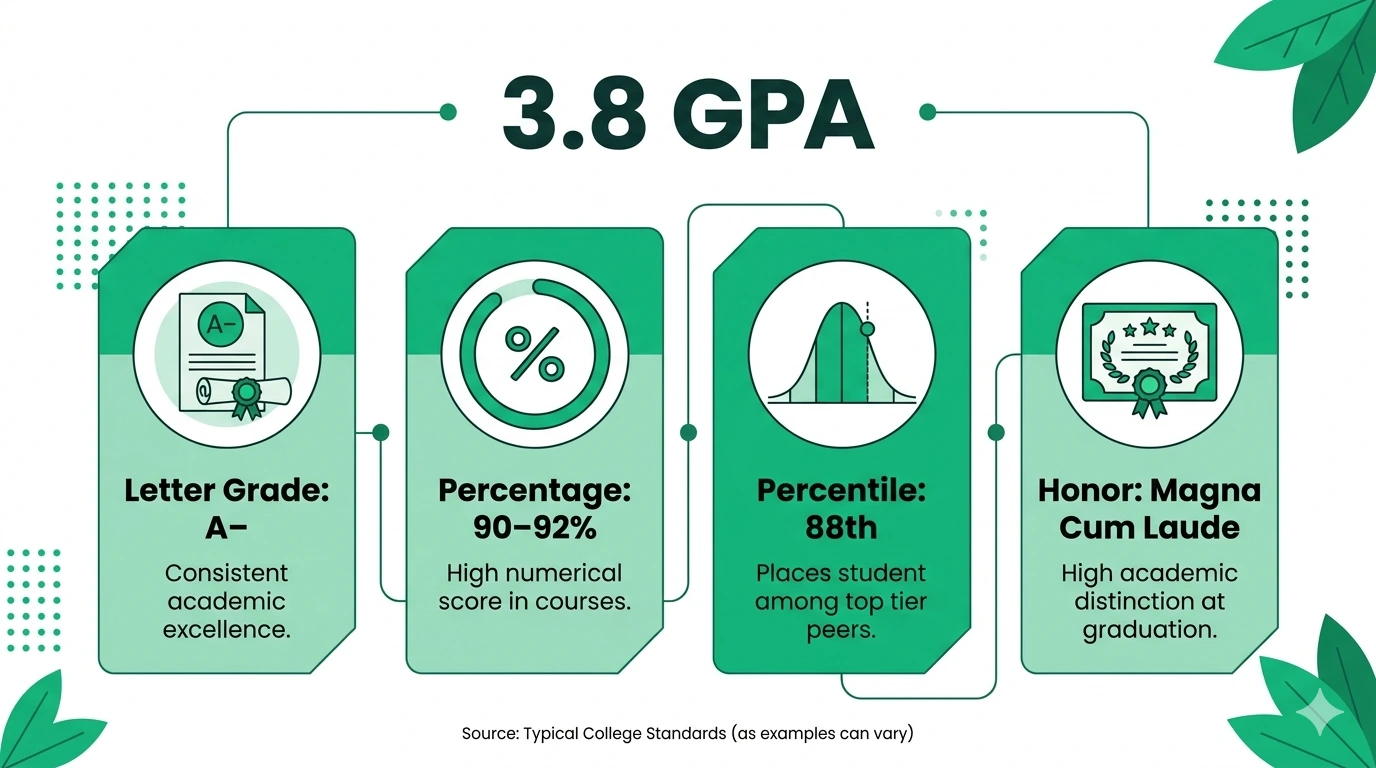
Quick answer: A 3.8 GPA is an A− letter grade, equal to about 90–92% on a percentage scale. It sits near the 88th percentile nationally, falls in the Magna Cum Laude range at most colleges, and is well above the U.S. average of around 3.1. So yes — a 3.8 GPA is a strong, competitive grade for both high school and college.
You opened your report card or transcript, saw a 3.8, and now you’re wondering what it actually means. Is it good? What letter grade is it? What colleges will take it? Will it win scholarships?
This guide answers all of that in plain English. Here’s what you’ll learn:
- What a 3.8 GPA equals in letter grade and percentage
- How it’s calculated and what grades you need to hit it
- The difference between a weighted and unweighted 3.8
- Whether it’s good in high school, college, and for jobs
- Which colleges and scholarships a 3.8 unlocks
Want your exact number first? Run your grades through our free GPA calculator and come back.
What Does a 3.8 GPA Mean? (Definition + Quick Facts)
A 3.8 GPA means you’ve earned mostly A grades with a few A− grades across your classes. On the standard 4.0 scale — where an A is 4.0 and an A− is 3.7 — a 3.8 sits right in the middle of the A− range, just two-tenths of a point below a perfect score.
3.8 GPA letter grade equivalent
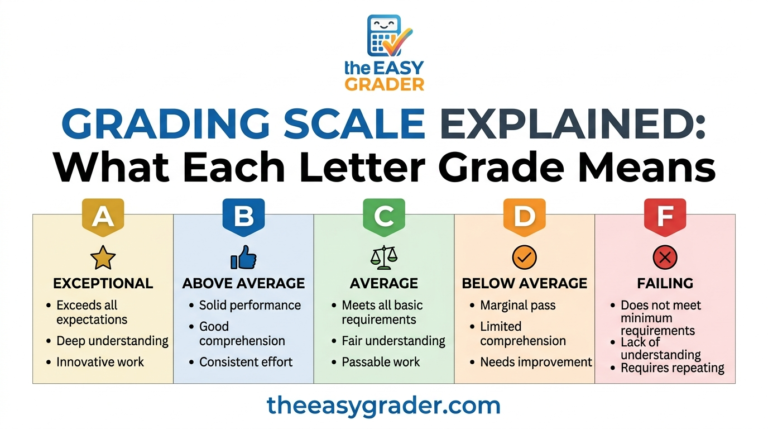
A 3.8 GPA is an A− letter grade. The A− band on the 4.0 scale runs from roughly 3.7 to 3.9, and a 3.8 lands squarely in the upper half of it. In practice, that means almost all A’s with a small number of A− or B+ grades pulling the average down slightly.
3.8 GPA to percentage
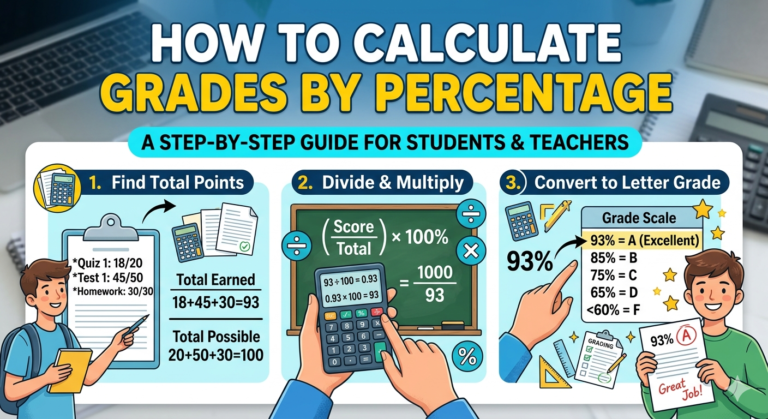
A 3.8 GPA converts to about 90–92% on most U.S. grading charts. Schools set their own percentage cut-offs, so the exact number varies — some treat 90–100 as a flat A, while others use plus/minus bands. As a quick rule, divide your GPA by 4.0 and multiply by 100 for a rough percentage. For a 3.8, that gives 95%, but most schools map the A− band closer to the low 90s.
Where 3.8 falls on the 4.0 scale

A 3.8 is near the top of the scale but not at the ceiling. The national average GPA for U.S. high school graduates is around 3.1 (NAEP High School Transcript Study), so a 3.8 puts you comfortably above most students. Here’s how the top of the scale lines up:
| GPA | Letter Grade | Percentage (typical) | Where It Stands |
| 4.0 | A | 97–100% | Perfect, top of scale |
| 3.9 | A / A− | 93–96% | Near perfect |
| 3.8 | A− | 90–92% | Excellent, ~88th percentile |
| 3.7 | A− | 90–92% | Very strong |
| 3.5 | B+ / A− | 87–89% | Above average |
Percentage bands vary by school — always check your school’s official chart.
How Is a 3.8 GPA Calculated?
Your GPA is the average of all your class grades, converted to points on the 4.0 scale. To get a 3.8, the points you earn across your classes need to average out to 3.8.
The standard 4.0 scale formula
The calculation has three steps:
- Convert each letter grade to points (A = 4.0, A− = 3.7, B+ = 3.3, B = 3.0, and so on).
- Multiply each grade’s points by the credits for that class to get quality points.
- Add all quality points and divide by total credits. The result is your GPA.
Example: how a student earns a 3.8
Say a student takes five one-credit classes and earns mostly A’s with two A−’s:
| Class | Grade | Points | Credits |
| English | A | 4.0 | 1 |
| Biology | A | 4.0 | 1 |
| U.S. History | A− | 3.7 | 1 |
| Algebra II | A | 4.0 | 1 |
| Spanish | A− | 3.7 | 1 |
Total points = 19.4, divided by 5 credits = 3.88, which rounds to a 3.8 GPA. Add one more A− or B+ and the average dips toward 3.7; one extra A nudges it toward 3.9. That’s how tight the margin is at this level.
What grades do you need for a 3.8 GPA?
To hold a 3.8 GPA, you generally need to earn A’s in roughly 80–90% of your classes, with the rest landing at A− or B+. There’s very little room for B’s and almost none for anything lower — a single C can pull a small course load below 3.8 fast. If you want to see exactly what grades you need next term to reach or keep a 3.8, plug your numbers into our GPA calculator.
3.8 Weighted vs 3.8 Unweighted GPA — What’s the Difference?

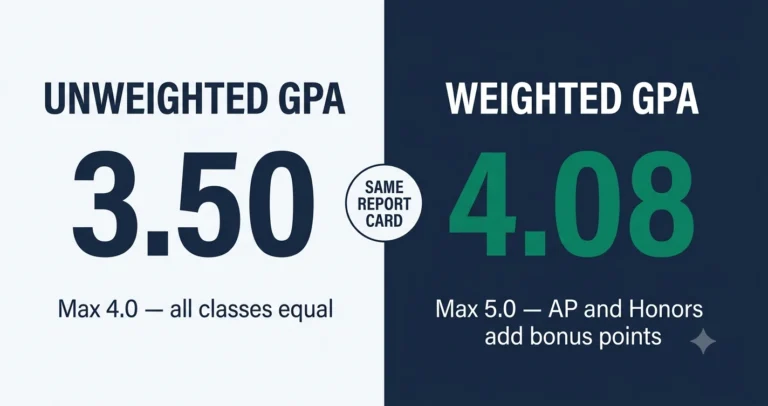
The same 3.8 can mean two very different things depending on whether it’s weighted or unweighted. An unweighted GPA caps at 4.0 and treats every class the same. A weighted GPA adds bonus points for harder classes (usually +0.5 for Honors and +1.0 for AP or IB), so it can climb above 4.0.
Is a 3.8 unweighted GPA good?
Yes — a 3.8 unweighted GPA is excellent. Since the unweighted scale tops out at 4.0, a 3.8 means you earned almost all A’s in your classes regardless of difficulty. It signals consistent, near-perfect performance and is one of the strongest unweighted GPAs you can report.
Is a 3.8 weighted GPA good?
A 3.8 weighted GPA is good, but it carries a different message. Because weighted scales can reach 5.0, a 3.8 usually reflects a mix of advanced and standard classes, or strong-but-not-perfect grades in tough courses. It still shows solid work, just with more context about course rigor. Colleges read a weighted 3.8 alongside your transcript to see which classes earned the bonus points.
Why colleges recalculate your GPA
Because weighting rules vary so much between schools, many universities recalculate your GPA using their own method. The University of California system, for example, computes a “UC GPA” from only 10th and 11th grade academic courses and caps how many honors points count. The University of Michigan strips weighting and recalculates an unweighted GPA from core academic subjects. The takeaway: report the GPA on your official transcript, but know that admissions offices often standardize it. For the full breakdown of how the scale works, see our 4.0 GPA scale explained guide.
| Factor | 3.8 Unweighted | 3.8 Weighted |
| Scale max | 4.0 | 5.0 (or higher) |
| What it means | Almost all A’s | Mix of grades + course rigor |
| Standout level | Top tier | Strong, context-dependent |
| Best used for | Comparing across schools | Showing you took hard classes |
Is a 3.8 GPA Good? (Honest Answer)
Yes, a 3.8 GPA is good. It places you near the 88th percentile nationally and well above the U.S. average of about 3.1. It’s competitive for the vast majority of colleges, strong enough for most merit scholarships, and a clear signal of academic discipline to employers and graduate programs.
Is a 3.8 GPA good in high school?
A 3.8 GPA is very good in high school. National transcript data puts the average graduate near 3.1, so a 3.8 sits roughly 0.7 points above the typical student. It usually qualifies you for the honor roll and keeps a wide range of colleges — including selective ones — firmly in reach. Paired with rigorous courses like AP or IB, it makes you a strong applicant almost everywhere outside the most elite schools.
Is a 3.8 GPA good in college?
Yes — a 3.8 GPA in college is excellent and typically lands you on the Dean’s List at most institutions. It signals you’ve mastered demanding coursework and keeps graduate school, professional programs, and competitive jobs wide open. At graduation, a 3.8 cumulative GPA often falls within the Magna Cum Laude range, one of the highest Latin honors a college awards.
Is a 3.8 GPA good for graduate school?
A 3.8 GPA is strong for graduate school applications. Most competitive master’s and doctoral programs look for a 3.5 or higher, so a 3.8 clears that bar with room to spare. It shows you can handle advanced study, though graduate admissions still weigh test scores, research experience, recommendations, and your statement of purpose alongside the number.
Is a 3.8 GPA good for jobs?
For jobs, a 3.8 GPA is a clear asset early in your career. Employers that screen for GPA — especially in finance, consulting, engineering, and competitive graduate programs — often set a 3.0 or 3.5 cut-off, and a 3.8 comfortably exceeds both. It reads as evidence of work ethic and reliability. Once you have a few years of experience, employers care less about GPA and more about your track record, so its value is highest for internships and first roles.
Colleges You Can Get Into With a 3.8 GPA
A 3.8 GPA opens the door to hundreds of colleges, from selective public universities to strong private schools. Your odds at any specific school depend on course rigor, test scores, essays, and activities — but the number itself keeps you competitive across a wide range. Here’s how to think about your list in tiers.
Ivy League and elite schools
At the most selective schools, a 3.8 is below the typical admitted profile but not disqualifying. Princeton’s 2024–25 Common Data Set, for example, lists an average high school GPA of 3.95 for entering students who submitted one. A 3.8 applicant can still be admitted, but the rest of the application — advanced coursework, standout activities, strong essays, and high test scores — has to carry real weight.
Highly selective universities
This is where a 3.8 shines. Schools like UCLA, the University of Michigan, NYU, and Boston University regularly admit students in the 3.7–3.9 range. With solid test scores and a rigorous transcript, a 3.8 makes you a genuinely competitive applicant at these institutions.
Strong match schools
At many excellent state flagships and private colleges — think Penn State, the University of Florida, the University of Arizona, or the University of Miami — a 3.8 often sits at or above the average admitted GPA. These are realistic, high-quality targets where your application is likely to be well received.
Safety schools
At a large number of colleges, a 3.8 is well above the typical admitted student, making admission highly likely and often unlocking automatic merit scholarships. These schools give you a secure foundation while you reach higher elsewhere.
| Tier | Example Schools | 3.8 GPA Outlook |
| Reach | Harvard, Princeton, Stanford, Yale | Possible with strong profile |
| Selective | UCLA, Michigan, NYU, Boston U | Competitive |
| Match | Penn State, U Florida, U Miami | At or above average |
| Safety | Many state & regional schools | Well above average |
Acceptance depends on your full application, not GPA alone. No GPA guarantees admission.
3.8 GPA Scholarships — What You Qualify For
A 3.8 GPA makes you eligible for most merit-based scholarships, since the common minimum thresholds sit at 3.0 or 3.5. While few awards are decided by GPA alone, a 3.8 clears the academic bar for the majority of opportunities and strengthens every application you submit.
Merit-based scholarships
Many colleges award automatic merit scholarships based on GPA and test-score brackets, and a 3.8 typically lands in the higher payout tiers. Some institutions reserve full-tuition or Presidential scholarships for students at 3.75 or above, often paired with a strong ACT or SAT score. Check the scholarship pages of every school on your list — these awards are frequently guaranteed if you meet the cut-off.
National and private scholarships
Beyond your colleges, national programs and corporate foundations offer merit awards where a 3.8 makes you a strong contender. These are competitive and usually weigh essays, leadership, and community service alongside grades, so a high GPA gets you in the door but your full profile wins the award. Honors college scholarships are another avenue — a 3.8 often qualifies you for the honors program and the funding attached to it.
How a 3.8 stacks up against scholarship thresholds
Most scholarship GPA minimums fall well below 3.8, which is exactly why this GPA is so useful:
| Common Threshold | Scholarship Type | Does a 3.8 Qualify? |
| 3.0+ | Broad merit & need-based | Yes, easily |
| 3.5+ | Academic / honors awards | Yes |
| 3.75+ | Top-tier institutional | Yes |
| 3.85+ | Full-ride / Presidential | Often — may need a small bump |
For a deeper look at which awards match your number, see our guide to GPA requirements for scholarships.
3.8 GPA and Academic Honors
A 3.8 GPA qualifies you for nearly every standard academic honor, from the high school honor roll to college graduation distinctions.
Dean’s List eligibility
Most colleges set their Dean’s List cut-off between 3.5 and 3.7 for a given semester, so a 3.8 comfortably earns the recognition. It’s a semester-based honor, meaning you can make the list term after term by keeping your grades high.
Honor roll qualification
In high school, a 3.8 almost always makes the honor roll. Many schools run tiered honor rolls — standard and high honors — with high honors often starting around 3.75, putting a 3.8 in the top group.
Magna Cum Laude range
At graduation, a 3.8 cumulative GPA typically falls within the Magna Cum Laude band, the second-highest Latin honor, which most colleges set roughly between 3.7 and 3.9. Exact ranges vary by institution, so confirm your school’s cut-offs — but a 3.8 graduate is usually in strong contention for this distinction.
How to Raise Your GPA From 3.8 (or Maintain It)
Here’s the honest truth: the higher your GPA, the harder it is to move. At a 3.8, you’re already near the ceiling, so small slips cost more than they used to, and big jumps get tougher every semester. How much room you have left depends heavily on your year.
How much your 3.8 can still change
| Grade Level | Realistic Ceiling | How Locked In It Is |
| Freshman | Up to ~3.98 | Lots of room to rise or fall |
| Sophomore | Up to ~3.92 | Still movable |
| Junior | Up to ~3.88 | Limited room left |
| Senior | ~3.82 at most | Essentially locked in |
Ranges are approximate and assume a typical course load.
Five strategies that actually work
- Protect against zeros. A single missing assignment hurts a high GPA more than weeks of strong work. Submit everything, even late, and ask about partial credit.
- Focus on high-credit classes. An A in a 4- or 5-credit course moves your GPA far more than a small elective. Spend your energy where the credits are.
- Use weighted classes wisely. If your school weights Honors, AP, or IB, strong grades in those classes can lift a weighted GPA even when the unweighted number holds steady.
- Study smarter, not just longer. Active recall and spaced repetition beat passive re-reading. Short, focused sessions retain more than late-night cramming.
- Build relationships with teachers. Office hours and genuine engagement help you catch problems early — and sometimes earn the rounding that tips an A− into an A.
For a full game plan, read our step-by-step guide on how to raise your GPA.
3.8 GPA Quick Comparison: How It Stacks Up
Seeing a 3.8 next to nearby GPAs makes its value clear. Here’s how the upper end of the scale compares at a glance:
| GPA | Letter | Percentile | Latin Honor | Tier |
| 4.0 | A | ~99th | Summa Cum Laude | Perfect |
| 3.9 | A / A− | ~93rd | Summa / Magna | Near perfect |
| 3.8 | A− | ~88th | Magna Cum Laude | Excellent |
| 3.7 | A− | ~85th | Magna / Cum Laude | Very strong |
| 3.5 | B+ / A− | ~75th | Cum Laude | Above average |
Curious how a slightly lower number compares? See our breakdown of what a 3.5 GPA means.