What Grades Do You Need for a 4.0 GPA?
What Grades Do You Need for a 4.0 GPA?
Last updated: November 21, 2026
If you are asking what grades do you need for a 4.0, the short answer is strict: on an unweighted scale, you need the top grade in every graded course. One lower grade pulls the average below 4.0, and later top grades cannot erase it. Below: the grade mix required, the cost of one B or A−, and when retakes or rounding change the picture.
What grades do you need for a 4.0? The direct answer
On an unweighted scale, a 4.0 GPA requires the highest grade in every graded course: a straight A average, with no B, A−, or lower grade. On a plus/minus scale, an A− counts as 3.7, not 4.0, so one A− breaks a perfect 4.0.
A GPA is a grade point average: letter grades become points, courses are weighted by credits, and total points are divided by total credits. Since 4.0 is the highest unweighted value, no later grade can average out a lower one, and a B in a 4-credit course hurts more than in a 1-credit course.
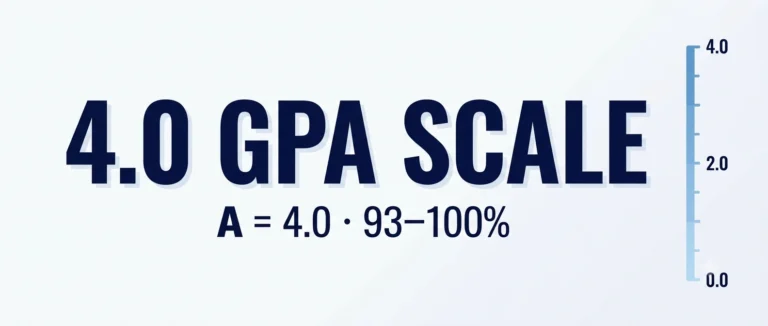
“Unweighted” means no extra points for harder classes. This covers the unweighted 4.0 gpa requirements behind how to get a 4.0 gpa, and what is a 4.0 gpa in practice. For point values, see the 4.0 GPA scale.
What grades do you need for a 4.0 by school type
Schools differ on the A cutoff and plus/minus grades. The table gives the minimum needed in every graded course.
| School type | Minimum every course | Breaks a 4.0 |
|---|---|---|
| Straight-letter | A | Any B or lower |
| Plus/minus | A, not A− | Any A−, B+, or lower |
| 90%-A, no plus/minus | 90% or higher | Any score below 90% |
| 93%-A, plus/minus | 93% or higher | Below 93%, including 90–92% |
That last row surprises many students: where a full A starts at 93%, a 92% may be an A− worth 3.7. Where A starts at 90% with no minus grades, 90% earns the full 4.0. The College Board’s guide to calculating GPA on a 4.0 scale also warns that schools calculate GPA differently, so the local rule controls.
One bad grade: how much damage does it do?
Damage depends on credits earned. The table assumes one 3-credit lower grade, all other credits at A (4.0), and shows the cumulative GPA after that course.
| Total credits | One 3-credit B (3.0) | One 3-credit A− (3.7) |
|---|---|---|
| 15 | 3.80 | 3.94 |
| 30 | 3.90 | 3.97 |
| 60 | 3.95 | 3.99 |
| 90 | 3.97 | 3.99 |
Early on, one B costs more, since it is a larger share of your record; later it costs less, but still leaves you below 4.0, and no later A’s can return a counted average to exactly 4.0.
Worked examples: one B in a term
Example 1: one B in five classes. Five equal classes: four A’s (16 points) plus one B (3) = 19. Divide by 5 to get 3.8 that term.
Example 2: nine A’s and one B in ten classes. Nine A’s (36 points) plus one B (3) = 39. Divide by 10 to get 3.9 — higher than Example 1, since the B is a smaller share, but still not 4.0.
Test your own mix by entering each course separately in the GPA calculator. A walkthrough is in how to calculate GPA in high school.
Can a retake restore a 4.0?
Sometimes, but only under a replacement rule — do not assume it. Some schools replace the first grade on retake; others average both attempts. The University of Illinois guidance on repeating courses shows both: without an elected replacement option, both grades are averaged; with it, the first is not used.
Where replacement is allowed, limits often apply: eligible grades, a cap on replaced courses or hours, and an election deadline. The original grade may stay visible on your transcript, and another school may still consider both attempts. Ask your registrar whether replacement applies to your course before counting on a retake.
Rounding edge case: a displayed 4.0 that is really 3.96
A GPA shown with fewer decimals can look perfect when it is not. Take 25 equal classes: 24 A’s (96 points) plus one B (3) = 99. Divide by 25 to get 3.96. Rounded to one decimal, that shows as 4.0, but a two-decimal transcript still shows 3.96.
So read the full number, not a rounded figure, and confirm the unrounded GPA on your transcript.
Common mistakes to avoid
- Assuming 90% is always a full A: at a 93%-A school, 90–92% may be an A− (3.7).
- Using a percentage average instead of a grade-point average.
- Ignoring credit weight: a low grade in a heavy course counts more.
- Assuming a retake wipes the slate clean; some schools average both attempts.
- Trusting a rounded display; confirm it to two decimal places.
FAQs
Can you get a 4.0 with a B?
No, not on an unweighted scale. A B is worth 3.0, below the 4.0 maximum, so averaging it with A’s always gives a result below 4.0. Later A’s can raise the GPA, but they cannot restore an exact 4.0.
Can you get a 4.0 with an A−?
No, not on a plus/minus scale where an A− is worth 3.7. That value is below 4.0, so one A− breaks a perfect average. At a school with no minus grades, an A-range grade may count as a full A.
How many A’s do you need for a 4.0?
You need an A in every graded course counted in that GPA. There is no fixed number, because the total depends on how many courses you take. If any counted course is below an A, the average falls below 4.0.
Can you recover a 4.0 after one bad grade?
Only if your school’s replacement rule removes the bad grade from the GPA calculation and you meet its terms. If both attempts stay in the average, later A’s will raise the GPA but cannot return it to exactly 4.0.
Is a 4.0 GPA the same as straight A’s?
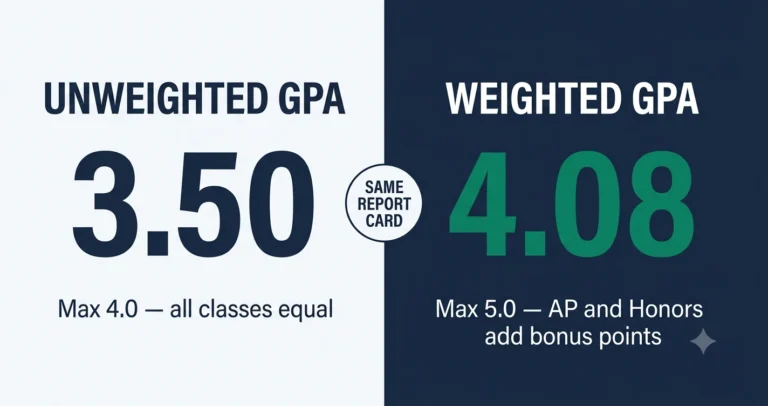
Yes, for an unweighted GPA, a 4.0 means a straight A average across counted courses. Straight A’s on that scale give a 4.0. Weighted GPAs differ, since extra points for advanced courses can push the figure above 4.0.
Check your path to 4.0 now
To reach a 4.0, earn the top grade in every counted course and watch your school’s A cutoff. GPA scales differ between schools, so confirm your school’s or college’s official policy before making decisions. To test your current mix, try the GPA calculator.