Weighted vs Unweighted GPA: Difference, Scales & Examples
Weighted vs Unweighted GPA: What’s the Difference?
Written by Safeer · Reviewed by Danish, former high school teacher · Last updated: August 2026
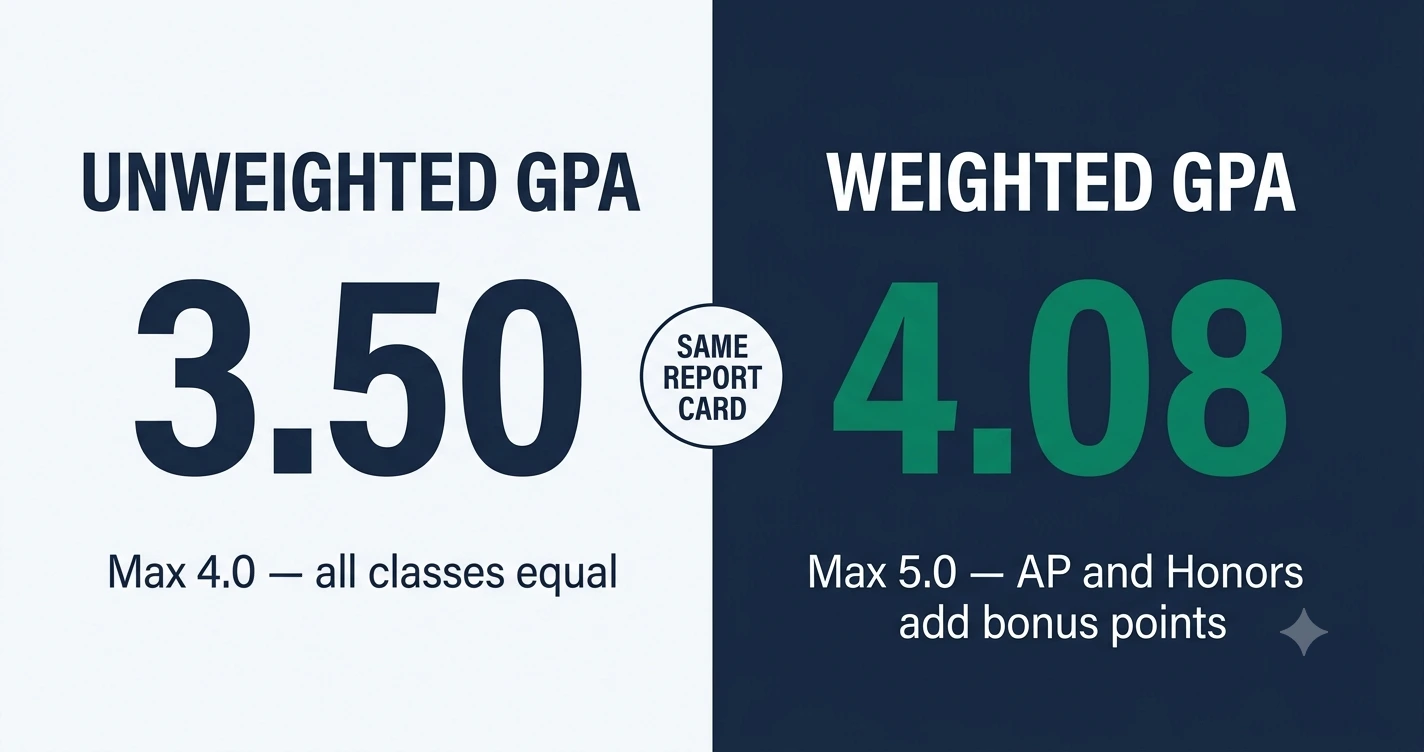
A weighted GPA adds bonus points for course difficulty and can rise above 4.0. An unweighted GPA measures every class on the same 4.0 scale with no bonus for rigor. The same report card produces two different numbers, and colleges often see both.
| Factor | Weighted GPA | Unweighted GPA |
|---|---|---|
| Scale max | Usually 5.0, varies by school | 4.0 |
| Counts difficulty | Yes | No |
| AP/Honors bonus | Commonly +1.0 AP/IB, +0.5 Honors | None |
| Typical range | 3.0 to 5.0 | 0.0 to 4.0 |
| Used by high schools | Common, not universal | Nearly universal |
| Used by colleges | Sometimes, often recalculated | Often, frequently recalculated |
| On transcript | Yes, when the school weights grades | Almost always |
| What it measures | Grades plus course rigor | Grades only |
What Is an Unweighted GPA?
An unweighted GPA is a grade point average that scores every course on the same 0 to 4.0 scale, giving an A the same value whether it was earned in a regular class, an honors class, or an Advanced Placement class.
An unweighted GPA cannot exceed 4.0. A student who earns straight A grades in the least demanding schedule available and a student who earns straight A grades in six AP courses both finish at 4.0. The number reflects grades only and carries no information about how difficult those courses were.
Most US high schools use this conversion for whole letter grades:
| Letter Grade | Percentage | Grade Points |
|---|---|---|
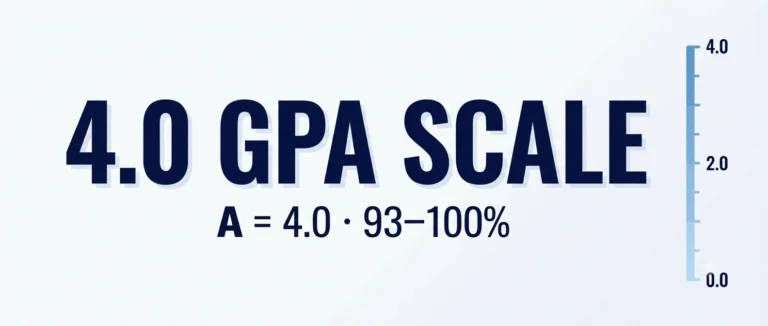
| A | 90–100 | 4.0 |
| B | 80–89 | 3.0 |
| C | 70–79 | 2.0 |
| D | 60–69 | 1.0 |
| F | Below 60 | 0.0 |
Schools that record plus and minus grades use additional values between these points. The complete grading scale guide covers every letter with its exact cutoff, and the 4.0 GPA scale explained breaks down the full point chart.

Plus/minus grading changes the math
Some schools assign separate values to plus and minus grades: an A− is 3.7, a B+ is 3.3, a B− is 2.7. Other schools use whole letters only, so every A counts as 4.0 and every B counts as 3.0.
That difference matters more than it appears. A student whose transcript is full of A− grades finishes at 3.7 under a plus/minus system and 4.0 under a whole-letter system, from identical classroom work. Your school handbook or the legend printed on your transcript states which scale applies.
What Is a Weighted GPA?
A weighted GPA is a grade point average that adds extra grade points to courses classified as more difficult, which allows the final number to rise above 4.0.
The bonus is applied course by course, based on the level the school assigns. The most common structure in US high schools works like this:
| Course Level | Bonus Added | An A Is Worth |
|---|---|---|
| Regular | +0.0 | 4.0 |
| Honors | +0.5 | 4.5 |
| AP, IB, or Dual Enrollment | +1.0 | 5.0 |

This structure is common, not universal. There is no national weighting standard, and each district sets its own policy. The St. Johns County School District in Florida, for example, publishes a weighted district GPA that adds 0.5 for honors courses and 1.0 for AP, dual enrollment, AICE, and IB courses, alongside a separate unweighted state GPA calculated under Florida statute.
Advanced Placement is a program run by the College Board, but the College Board does not decide how schools weight AP courses in a GPA. That decision belongs to your district.
Real variations you will encounter: some schools weight only AP and IB and give honors courses no bonus at all. Some treat dual enrollment at the honors level rather than the AP level. Some use fractional bonuses such as +0.33 and +0.67. Some do not weight grades at all.
Because weighted GPA depends entirely on local policy, two students with identical transcripts at different high schools can report different weighted GPAs.
Weighted vs Unweighted GPA: Side-by-Side
The clearest way to see the difference is to run one report card through both systems. Below is a single semester for one student across six courses of equal credit value, using the common +0.5 honors and +1.0 AP structure.
| Course | Level | Grade | Unweighted Points | Weighted Points |
|---|---|---|---|---|
| AP Biology | AP | B | 3.0 | 4.0 |
| AP US History | AP | B+ | 3.3 | 4.3 |
| AP Calculus AB | AP | B | 3.0 | 4.0 |
| Honors English 11 | Honors | A− | 3.7 | 4.2 |
| Spanish III | Regular | A | 4.0 | 4.0 |
| Health | Regular | A | 4.0 | 4.0 |
| Total | 21.0 | 24.5 |

Unweighted GPA: 21.0 ÷ 6 = 3.50
Weighted GPA: 24.5 ÷ 6 = 4.08
Same student, same grades, a gap of 0.58 between the two numbers.
Why the same grades produce two numbers
- Three AP grades each receive a +1.0 bonus and one honors grade receives +0.5, adding 3.5 points the unweighted calculation ignores.
- The two regular-class A grades are worth 4.0 under both systems, so they contribute nothing to the gap.
- Both totals are divided by the same six courses, so every bonus point raises the weighted average directly.
Weighted GPA pros
- Rewards students who choose harder courses
- Distinguishes a 4.0 earned in AP classes from a 4.0 earned in regular classes
- Commonly used for class rank, valedictorian selection, and some scholarship screening
Weighted GPA cons
- No national standard, so the number is not comparable between schools
- Can make a transcript look stronger than the underlying grades
- A student with lower grades in harder classes can outrank a student with better grades
Unweighted GPA pros
- Comparable across schools, districts, and states
- Simple to calculate and easy to verify
- The scale colleges most often recalculate to
Unweighted GPA cons
- Treats an A in AP Physics and an A in a study elective identically
- Can disadvantage students carrying heavy AP or IB loads
- Says nothing about course rigor on its own
How to Calculate Weighted GPA (Step by Step)
Weighted GPA follows the same quality-points method as any GPA, with one extra step: the course-level bonus is added to the grade points before credits are applied.
Weighted GPA = Σ (Base Points + Level Bonus) × Credits ÷ Total Credits
- Base points — the standard value of the letter grade, such as 4.0 for an A or 3.3 for a B+
- Level bonus — the extra points your school assigns, commonly +0.5 for honors and +1.0 for AP or IB
- Credits — the credit value of the course, usually 1.0 for a full-year class and 0.5 for a semester class
- Total credits — the sum of all credit values in the calculation
- Convert each letter grade to base points using your school’s scale.
- Add the course-level bonus to each base value: +0.5 for honors, +1.0 for AP, IB, or dual enrollment, or whatever your district specifies.
- Multiply each weighted value by the course credits to get quality points.
- Add all quality points together.
- Divide the total quality points by the total credits.
Here is the method applied to four courses:
| Course | Level | Grade | Base + Bonus | Credits | Quality Points |
|---|---|---|---|---|---|
| AP Chemistry | AP | A | 4.0 + 1.0 = 5.0 | 1.0 | 5.0 |
| Honors Algebra II | Honors | B+ | 3.3 + 0.5 = 3.8 | 1.0 | 3.8 |
| English 10 | Regular | A− | 3.7 + 0.0 = 3.7 | 1.0 | 3.7 |
| Health | Regular | A | 4.0 + 0.0 = 4.0 | 0.5 | 2.0 |
| Total | 3.5 | 14.5 |
Weighted GPA = 14.5 ÷ 3.5 = 4.14
That example covers a single term. Combining several terms into one figure follows the same formula across every semester, which the guide to cumulative GPA walks through in detail.
Common mistakes
- Ignoring credits. Averaging grade points across classes only works when every course carries the same credit value, which is rarely true once electives are involved.
- Applying the bonus in the wrong order. The bonus is added to the grade points first, then multiplied by credits. Adding it after the multiplication inflates the result.
- Assuming every school uses the same system. A weighted GPA calculated with the wrong bonus values will not match the number printed on your transcript.
- Assuming every advanced course earns the same bonus. Many districts weight AP and IB at +1.0 but treat honors or dual enrollment differently, and some weight nothing at all.
For the underlying quality-points method applied to unweighted, weighted, and cumulative figures, see the full guide on how to calculate GPA in high school.
Weighted GPA Scales: 4.5, 5.0 and 6.0
The maximum weighted GPA a student can earn depends on the bonus structure the district adopts, not on any national rule. Three structures appear most often:
| Scale | Common Bonus Structure | Highest Possible GPA |
|---|---|---|
| 4.5 scale | Honors and AP/IB both receive +0.5 | 4.5 |
| 5.0 scale | Honors +0.5, AP/IB/dual enrollment +1.0 | 5.0 |
| 6.0 scale | Honors +1.0, AP/IB +2.0 | 6.0 |
A 4.5 system caps the advantage of AP coursework, so the gap between a strong regular-track student and a strong AP student stays narrow. A 5.0 system, the most widely used, doubles the AP bonus relative to honors. A 6.0 system spreads students across a wider range, which changes how class rank behaves at the top of a graduating class.
The practical consequence: a 4.4 weighted GPA is near the ceiling at a 4.5-scale school and only mid-range at a 6.0-scale school. Comparing weighted GPAs between schools without knowing each scale produces misleading conclusions.
Do Colleges Look at Weighted or Unweighted GPA?
Colleges look at both, and many recalculate a GPA of their own rather than using either number exactly as your high school reports it. There is no single answer that applies to every institution.
Admissions offices receive applications from thousands of high schools using different scales, weighting rules, and course catalogs. A weighted GPA from one school is not comparable to a weighted GPA from another, so the number alone tells a reader very little. What they work from instead is the transcript itself, read alongside the school profile that describes which advanced courses were available.
Common practices at selective institutions include:
- Recalculating GPA using core academic subjects only, often excluding electives such as physical education
- Stripping weighting to produce a comparable unweighted figure, then evaluating course rigor as a separate factor
- Reading grade trends across four years rather than a single cumulative number
- Using the school profile to judge whether a student took the strongest schedule available to them
This is where a common misconception needs correcting. It is frequently claimed online that selective colleges simply prefer weighted GPA. In practice, many recalculate toward an unweighted core-academic GPA precisely because weighted numbers are not standardized, and they assess rigor through the course list rather than through the bonus points already baked into a number.
The University of California system is a well-documented example. According to UC admissions, UC calculates its own GPA using only A-G approved courses completed between the summer after 9th grade and the summer after 11th grade. Letter grades convert to points with pluses and minuses excluded, so an A+, an A, and an A− all count as 4.0. One extra point is added for each semester of a UC honors-level course, capped at eight honors points across 10th and 11th grade, with no more than four of those coming from 10th grade. Grades of D or F in an honors course earn no bonus.
That methodology produces a number that can differ noticeably from the weighted GPA a California high school prints on a transcript, and it applies to one university system only. Other institutions use entirely different rules.
On the Common Application, students do not choose which GPA to submit. The GPA reported is the one your high school records on the official transcript and school report, using the scale your school specifies. If your school prints both a weighted and an unweighted figure, admissions readers see both.
Research from the National Association for College Admission Counseling has consistently placed grades in college-preparatory courses and overall strength of curriculum among the top factors in admission decisions. Both of those describe what is on the transcript rather than which GPA formula produced the summary number.
So when the question is phrased as whether colleges prefer weighted or unweighted GPA, the accurate answer is that most read the transcript first and treat any single GPA figure as a summary that needs context. Policies vary by institution, and the only reliable source is the admissions page of the specific college you are applying to.
What Is a Good Weighted GPA?
On a 5.0 scale, a weighted GPA around 4.3 or higher is generally considered strong, and 4.5 or above is competitive near the top of most graduating classes. On a 4.5 scale, those same benchmarks shift down; on a 6.0 scale, they shift up.
A 4.0 weighted GPA is a useful reference point because it is so often misread. On an unweighted scale, 4.0 is the maximum. On a 5.0 weighted scale, 4.0 is mid-range: it typically describes a student earning A grades in regular classes, or a mix of A grades in regular classes and B grades in advanced ones. Neither reading is bad, but they are not the same achievement.
Three factors change what counts as good at your school:
- The scale in use, since the ceiling differs between 4.5, 5.0, and 6.0 systems
- How many advanced courses your school offers, since limited AP availability caps everyone’s weighted number
- How your figure compares within your own graduating class, which is what class rank measures
Because weighted benchmarks only make sense against a specific scale, comparing your number to a national average is rarely useful. For benchmarks across education levels and admissions contexts, the guide on what counts as a good GPA covers each tier in detail.
What Is a Good Unweighted GPA?
An unweighted GPA of 3.5 or higher is generally considered strong, and 3.0 sits near the US national average for high school students. Because the unweighted scale is standardized at a 4.0 maximum, these benchmarks travel between schools in a way weighted benchmarks do not.
Competitiveness still depends on where you are applying. A 3.5 unweighted GPA is comfortably above the bar at many state universities and below the typical admitted profile at highly selective institutions, where average admitted GPAs often sit near or above 3.8. Intended major matters too, since programs in engineering, nursing, and the health sciences frequently set higher minimums than the university as a whole.
The applicant pool matters as much as the number. A 3.5 in a graduating class where few students take advanced coursework reads differently from a 3.5 earned alongside five AP courses. For a closer look at where individual figures land, see the breakdown of a 3.8 GPA and the wider good GPA guide.
How to Convert Weighted GPA to Unweighted
To convert a weighted GPA to an unweighted GPA, remove the course-level bonuses and recalculate from the original grades. Work through the transcript course by course:
- Subtract 1.0 from each AP, IB, or dual-enrollment grade that received the full bonus.
- Subtract 0.5 from each honors grade that received a partial bonus.
- Leave regular-course grades unchanged.
- Recalculate using quality points and total credits.
If you do not have the course-level detail, the table below gives rough approximations only. These are estimates, not conversions:
| Weighted GPA | Approximate Unweighted Equivalent |
|---|---|
| 5.0 | 4.0 |
| 4.5 | 3.8 |
| 4.2 | 3.6 |
| 4.0 | 3.4 |
Exact conversion is impossible without four pieces of information: the original course grades, the school’s weighting policy, the credit value of each course, and the scale in use. A student with three AP courses and a student with eight AP courses can share the same weighted GPA and land at very different unweighted figures.
How to Tell If Your GPA Is Weighted or Unweighted
Four checkpoints will tell you which figure your school reports:
- Your transcript. Many schools print both numbers, labelled weighted and unweighted. The legend or key usually states the scale.
- Your school profile. This document, sent to colleges with your application, describes the grading system and weighting policy in full.
- Your student portal. PowerSchool, Naviance, Infinite Campus, and similar systems display GPA type in the grades or academics section.
- Your counselor. Ask directly which bonus values your school applies to honors, AP, IB, and dual-enrollment courses.
One reliable signal: a GPA above 4.0 is weighted, or comes from a scale that permits values above 4.0. The reverse is not true. A GPA below 4.0 can still be weighted, since a weighted average drops below 4.0 whenever grades are low enough, so a number under 4.0 does not confirm the figure is unweighted.
The Weighted GPA Trap Most Students Miss
If your weighted GPA already sits above 4.0, earning an A in a regular class can lower it.
The reason is arithmetic. A weighted average moves toward every new value added to it. A regular-class A is worth 4.0. If your current weighted average is 4.30, adding a 4.0 pulls the average down, even though an A is the best grade available in that course.
A student with four courses averaging 4.30 has 17.2 total points. Add a fifth course, a regular class with an A worth 4.0, and the total becomes 21.2 across five courses, or 4.24. The average fell by 0.06 on a perfect grade.
This is why a 4.0 weighted GPA is not a perfect weighted GPA. On a 5.0-style scale, the ceiling is 5.0, and figures around 4.5 to 5.0 represent the top of the range depending on the school’s system. Treating 4.0 as the target on a weighted transcript sets the bar in the wrong place.
The practical takeaway is not to avoid regular classes, which are often required for graduation. It is to understand why your weighted number moves the way it does, and to stop reading 4.0 as a finish line when your school uses a scale that goes higher.
Calculate Your Weighted and Unweighted GPA
Working both numbers out by hand is straightforward but easy to get wrong once credit values and course levels vary. The free GPA calculator at TheEasyGrader handles the quality-points math for you: enter each course, its letter grade, and its credit value to see your GPA instantly, with no sign-up required.
Run your current transcript through it first, then test what next semester’s grades would do to the number. Knowing exactly where you stand is more useful than estimating, particularly when a scholarship cutoff or an honors threshold sits within a tenth of a point. Start with the GPA calculator and add your courses one at a time.
Frequently Asked Questions
Straight answers on weighted vs. unweighted GPA, how colleges read them, and what to put on your resume.
Is a 4.0 weighted GPA good?
A 4.0 weighted GPA is solid but not exceptional on a 5.0 scale, because it usually reflects a mix of regular-class A grades and advanced-class B grades. On an unweighted scale, 4.0 is the maximum possible. The meaning depends entirely on which scale your school reports.
What’s the highest weighted GPA possible?
The highest weighted GPA depends on your school’s scale. On a 5.0 system, straight A grades in all AP or IB courses produce a 5.0. Districts using 4.5 or 6.0 scales cap at those values instead. No national maximum exists, so check your student handbook.
Can an unweighted GPA be above 4.0?
An unweighted GPA cannot exceed 4.0 under standard US grading, because 4.0 is the value of an A and no bonus points are added for course difficulty. A small number of schools award 4.3 for an A+, which is a scale variation rather than weighting.
Do colleges prefer weighted or unweighted GPA?
Colleges do not uniformly prefer one. Many selective institutions recalculate an unweighted GPA from core academic courses and evaluate course rigor separately using the transcript and school profile. Others accept the weighted figure a high school reports. Policies vary by institution, so check each college.
Is a 4.5 GPA weighted or unweighted?
A 4.5 GPA is weighted. Unweighted GPAs on the standard US scale stop at 4.0, so any figure above that comes from a system awarding bonus points for honors, AP, IB, or dual-enrollment courses. The exact bonus applied depends on district policy.
How much does an AP class raise your GPA?
An AP class typically adds 1.0 grade point to that course under a 5.0 weighted scale, so an A becomes 5.0 instead of 4.0. The effect on your overall GPA depends on how many total courses and credits you carry, since the bonus is averaged across everything.
Does college use weighted GPA?
College GPA is unweighted. Universities calculate GPA on a 4.0 scale using course grades and credit hours, with no bonus for difficulty, so an advanced seminar and an introductory elective carry the same maximum value per credit. Weighting is a high school practice.
Do honors classes raise your GPA?
Honors classes raise your weighted GPA at schools that assign them a bonus, most commonly +0.5. They do not raise an unweighted GPA, where an A is worth 4.0 regardless of course level. Some districts weight only AP and IB courses and give honors no bonus.
Which GPA do I put on my resume?
List the unweighted GPA on a resume unless an employer asks otherwise, because it is standard, verifiable, and comparable across schools. Include it only if it strengthens your application. Label it clearly, for example: GPA 3.6 (unweighted).
Do colleges see both GPAs?
Colleges see whichever GPAs your high school prints on the official transcript, which for many schools means both. Admissions readers also receive the full course list, so they can identify honors, AP, and IB coursework regardless of which GPA figure is reported.