How to Calculate GPA Without Credits (When You Don’t Know Credit Hours)
Last updated: November 19, 2026
If you have grades but no credit hours, you can still work out a GPA. A gpa calculator without credits treats every graded class equally: turn each letter grade into points, add the points, and divide by the number of classes. This guide shows how to calculate gpa without credits and when it matches a credit-weighted GPA.
Direct answer: without credits, every class counts equally
A GPA without credits is the simple average of grade points. Each graded class counts once, no matter its credit value. To find it, turn each letter grade into points on the 4.0 scale, add the points, and divide by the number of graded classes.
A credit hour shows how much weight a course carries. A grade point is the number value of a letter grade on the 4.0 scale: A is 4.0, B is 3.0, C is 2.0, D is 1.0, and F is 0.0. Plus and minus grades fall between those numbers, for example B+ is 3.3 and A- is 3.7. Check your school’s grading scale for its exact table.
GPA calculator without credits: formula and step-by-step
Use this formula:
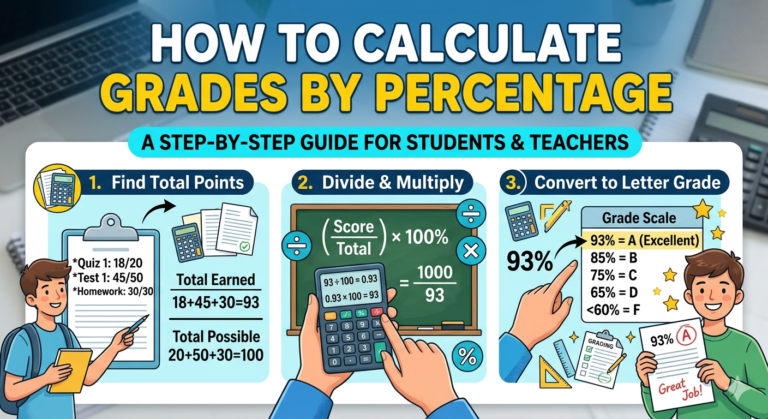
GPA without credits = total grade points ÷ number of graded classes
- List only classes with a letter grade. Leave out pass/fail, audit, and withdrawn classes.
- Turn each letter grade into points using your school’s scale.
- Add the points together.
- Divide by the number of graded classes.
- Round once, at the end, to two decimal places.
By contrast, credit weighting multiplies each point by its credits first, as covered in the guide on how to calculate GPA in high school. Use the no-credit method only when your school does not assign credits, or for a quick estimate.
Worked comparison: same report card both ways
Take one report card and run it both ways.
| Class | Grade | Points | Credits |
|---|---|---|---|
| English | A | 4.0 | 3 |
| Math | B | 3.0 | 4 |
| History | A- | 3.7 | 3 |
| Science | C+ | 2.3 | 4 |
Without credits: (4.0 + 3.0 + 3.7 + 2.3) ÷ 4 = 13.0 ÷ 4 = 3.25.
With credits: (4.0 × 3 + 3.0 × 4 + 3.7 × 3 + 2.3 × 4) ÷ 14 = 44.3 ÷ 14 = 3.16.
The answers are close here, only 0.09 apart.
The divergence case: A in a 0.5-credit lab vs C in a 4-credit course
Take just two classes: an A (4.0) in a 0.5-credit lab and a C (2.0) in a 4-credit course.
Without credits: (4.0 + 2.0) ÷ 2 = 3.00.
With credits: (4.0 × 0.5 + 2.0 × 4) ÷ 4.5 = (2.0 + 8.0) ÷ 4.5 = 10.0 ÷ 4.5 = 2.22.
The gap is 0.78, because the small lab gets the same vote as the large course. If all classes carry the same credits, the two methods agree exactly.
When schools use no-credit GPA
Some schools do not need credits for a term GPA. Middle schools often report grades by subject, with no credit hours attached, so an average gpa without credits fits the report card as it stands. Homeschool families may switch to credits for high-school transcripts. This method, also called a gpa calculator no credits tool, helps when a report card lists grades but not credits. It does not replace an official transcript GPA.
Which one does my school use?
Start with the document that lists your grades. A report card showing a credit value beside each class points to credit weighting. One showing only subjects and grades points to equal weighting. Check your handbook or school website for a grading policy page.
If you still cannot tell, ask your counselor or registrar: do you weight GPA by credit hours, and do you report weighted, unweighted, or both? Colleges may recalculate GPA using their own rules, as the College Board notes that it considers both weighted and unweighted GPAs.
Edge cases: pass/fail, audit, withdrawn, repeated, half-credit, rounding
Handle these cases before you divide.
- Pass/fail: Leave pass marks out, because a “P” has no grade points. The University of South Carolina regulations state that pass-fail courses are excluded from GPA. Check your school for a failing pass/fail mark.
- Audit: Leave audited classes out. You did not earn a grade.
- Withdrawn: Leave a withdrawn (W) class out. Check your school for late withdrawals.
- Repeated: Check your school. Some replace the old grade, others average both attempts.
- Half-credit: In a true no-credit method, a half-year class still counts once.
- Rounding: Add with full points, then round once at the end.
Common mistakes to avoid
Do not double-count a class, and do not include only elective grades that suit you. Do not mix scales in one average, such as a 4.0 point and a 5.0 weighted point, unless your school’s policy tells you to. Do not copy an estimate onto a form asking for an official GPA.
FAQs
How do you calculate GPA without credits?
Turn each letter grade into points, add all the points, and divide by the number of graded classes. For example, points of 4.0, 3.0, and 2.0 total 9.0, and 9.0 divided by three classes gives 3.00.
Is GPA without credits accurate?
It is accurate as a simple average of the grades entered, but it may differ from an official GPA. If your school weights by credits, the no-credit result is only an estimate.
Do colleges accept GPA calculated without credits?
Colleges review the GPA on your official transcript, not a self-calculated estimate, and many recalculate GPA with their own rules. A no-credit figure can help you plan, but report the official GPA when asked.
What if some classes are worth more credits?
Use the credit-weighted method for your official figure: multiply each grade point by its credits, add those products, and divide by total credits. The no-credit average overstates small classes and understates large ones.
How do pass/fail classes affect GPA without credits?
Pass/fail classes are normally left out because a pass has no grade points to count. Do not add a zero for a pass, and check your school’s policy before including any failing pass/fail mark.
Calculate your GPA now
Try your own grades with a gpa calculator without credits via our GPA calculator. For gpa without credit hours, the same rule applies: every graded class counts once.
GPA scales differ between schools, so confirm your school’s or college’s official policy before making decisions.