Weighted Grade Calculator: How to Calculate Weighted Grades (With Examples)
Last updated: October 30, 2026
A weighted grade calculator answers one question: what is your grade when each part of a course counts for a different share? Multiply each category score by its weight, add the results, and divide by the total weight. The rest of this guide shows it with real numbers, including weights that do not add to 100%.
Check your numbers with the weighted grade calculator after the first example.
How a weighted grade calculator works
A weighted grade is the average of your category scores after each score is given the importance your syllabus assigns to it. A category is one part of the course, such as homework or a final exam. Its weight is the share of the course grade it controls, usually shown as a percentage.
The formula is: weighted grade = sum of (category score × weight) ÷ sum of weights. That is a weighted average grade.
Weighted grade vs weighted GPA: do not confuse them
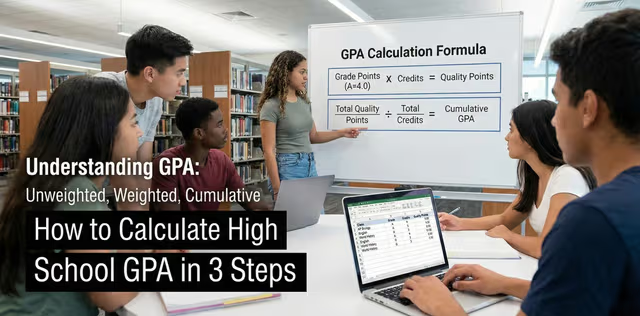
A weighted grade covers one course, using category shares such as homework 30% and tests 40%. A weighted GPA covers all courses, using credits plus bonus points some schools give for harder courses.
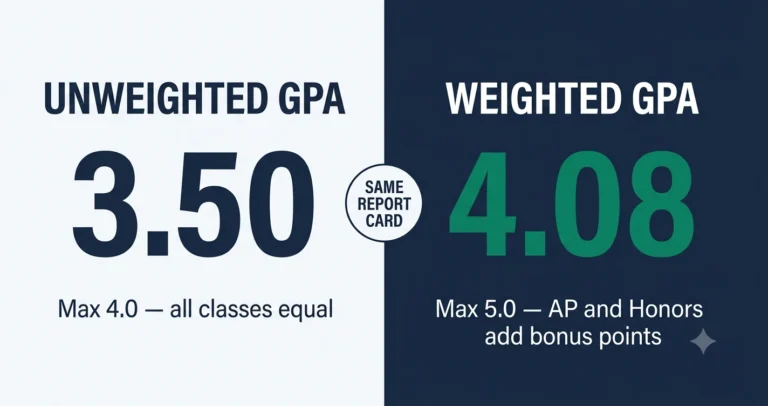
The College Board explains how schools use weighted GPA: some schools give AP and honors classes higher GPA points, and colleges may recalculate GPA using their own rules. That bonus is a GPA question, not a course-grade question, and bonus rules vary by school.
Step-by-step: calculate a weighted grade
First, find category weights in your syllabus. Real weights vary widely: one university syllabus weights quizzes 15%, homework 10%, exams 35%, and the final 30%. That is how a grade calculator weighted by category works. Second, work out one percentage for each category. If a category has assignments worth different points, add points earned and divide by points possible, rather than averaging percentages. Third, multiply each score by its weight. Fourth, add those products and divide by the total weight. A grade calculator with weights follows these steps.
Worked example 1: Homework 30%, Tests 40%, Final 30%
Scores: homework 88%, tests 82%, final 90%. This grade weight calculator problem is simple because weights add to 100%.
- Homework: 88 × 30 = 2,640
- Tests: 82 × 40 = 3,280
- Final: 90 × 30 = 2,700
- Total: 2,640 + 3,280 + 2,700 = 8,620
- Weighted grade: 8,620 ÷ 100 = 86.2%
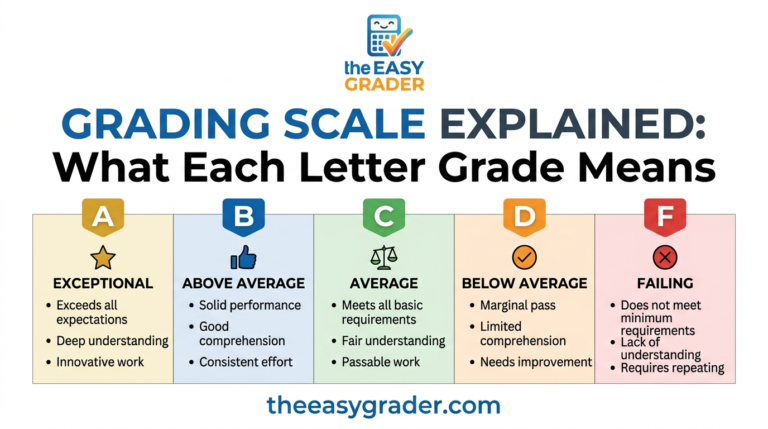
Your grade is 86.2%, a B under a university grading policy that lists A as 90–100% and B as 80–89%. A 10-point rise in tests adds 4 points overall, while the same rise in a 10% category adds only 1 point.
Worked example 2: Weights that do not add to 100%
Suppose only part is graded: homework 20% at 90%, quizzes 10% at 85%, midterm 25% at 78%, and project 25% at 92%. Weights add to 80%, so to how to calculate weighted grade here, divide by 80, not 100.
- Homework: 90 × 20 = 1,800
- Quizzes: 85 × 10 = 850
- Midterm: 78 × 25 = 1,950
- Project: 92 × 25 = 2,300
- Total: 1,800 + 850 + 1,950 + 2,300 = 6,900
- Current weighted grade: 6,900 ÷ 80 = 86.25%
This 86.25% is your grade so far, not your final grade.
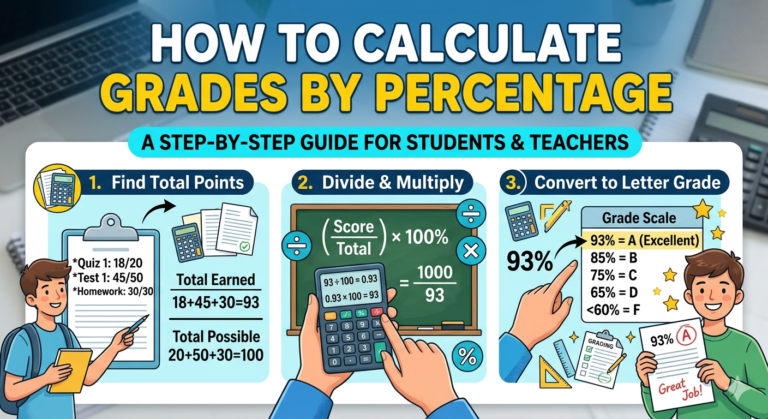
One conversion matters first. If homework has 18 out of 20 and 42 out of 50, add points first: (18 + 42) ÷ (20 + 50) = 60 ÷ 70 = 85.7%. Averaging 90% and 84% gives 87%, which is wrong, because the 50-point assignment should count more.
What score do you need on remaining work?
Use this table when some weight is still ungraded. It assumes 78% on 70% of the course, with 30% remaining. Needed score = (target − current grade × completed weight) ÷ remaining weight.
| Target grade | Score needed on remaining 30% | Possible? |
|---|---|---|
| A (90%) | 118.0% | No, unless extra credit applies |
| B (80%) | 84.7% | Yes |
| C (70%) | 51.3% | Yes |
| Pass (60%) | 18.0% | Yes |
The A row tells you early that an A is out of reach on graded work alone. For one final exam, use the same formula with the final exam’s weight, and check the grading scale for your school’s letter. A final grade calculator does that version for you.
Common mistakes
The most common mistake is averaging percentages as if every category counted equally. A 90% on homework and a 70% on a final do not average to 80% when the final is worth far more. The second mistake is entering a score before converting points to a percentage. The third is forgetting dropped grades: if quizzes are 68%, 88%, 92%, and 96%, and the lowest is dropped, the average is (88 + 92 + 96) ÷ 3 = 92%, not 86%. Recalculate after a drop, then weight it.
FAQs
How do you calculate a weighted grade?
Multiply each category score by its weight, add those products, and divide by the total weight. For example, 88% at 30% plus 82% at 40% plus 90% at 30% gives 86.2%.
What is the difference between a weighted grade and a weighted GPA?
A weighted grade is for one course, using syllabus category weights. A weighted GPA is across all courses in high school or college, using credits and, at some schools, AP or honors bonus points.
What if my weights do not add up to 100%?
Divide by the weight counted so far to get your grade on completed work. If weights add to more than 100%, check your syllabus, because a category was probably entered twice.
How do I calculate a weighted grade with extra credit?
Find out where your teacher puts it first. If it goes into one category, only that category rises. If it goes onto your final grade, the whole grade rises in that case.
Can a weighted grade be over 100%?
No, not from regular scores alone. A weighted average sits between your lowest and highest category scores. It can pass 100% only if extra credit pushes a category above 100% and your teacher allows that.
Conclusion
Separate category, score, and weight to get a weighted grade. Enter them correctly, divide by total weight, and you know where you stand. For a second check, use an average grade calculator. Calculate your weighted grade now with the weighted grade calculator and use the table above to set a reachable target.
GPA scales differ between schools, so confirm your school’s or college’s official policy before making decisions.