What Is a 3.0 GPA? Letter Grade Percentage and What It Means
What Is a 3.0 GPA? Letter Grade Percentage and What It Means
Last updated: November 15, 2026
A 3.0 GPA to percentage conversion gives two different-looking answers, and both need context. On the standard 4.0 scale, a 3.0 is a B average, equal to 83–86%. That is the transcript answer. The simple math answer, 3.0 × 25 = 75%, is not the same thing, because a B band does not start at 75%. Use 83–86% when you describe your grades, and use 75% only as a rough linear estimate.
Direct answer: 3.0 = a B average, 83–86% on the standard scale
A 3.0 GPA is a B average on the standard unweighted 4.0 scale, covering 83–86% in the usual letter-grade bands. It means your grades, averaged by credit, land squarely in the B range, not at the top or bottom of it.
That answers the 3.0 gpa letter grade question directly: B, 83–86%.
GPA means grade point average. A B earns 3.0 points here, and your GPA is the credit-weighted average of those points across all classes.
3.0 GPA to percentage: why you see three different numbers
There is no single official formula, so the result depends on the method. That is why one search can show 75%, about 84.5%, and 83–86% for the same GPA.
| Method | What it does | Result for 3.0 |
|---|---|---|
| Linear formula | GPA × 25 | 75% |
| Band midpoint | Middle of 83–86% | About 84.5% |
| Transcript mapping | Letter-grade band for B | 83–86% |
The linear formula treats 0.0 as 0% and 4.0 as 100%, with equal steps. Real bands do not work that way: F covers a wide range below 60%, while B covers only 83–86%. Use the midpoint for a single estimate, and 83–86% for a letter band.
Use this 3.0 gpa to percentage chart check: letter-band sources give 83–86%, while divide-by-4.0 sources give 75%.
Grade mixes that produce a 3.0
A 3.0 rarely means a B in every class. Higher and lower grades balance out, and credits matter: a 4-credit class pulls the average more than a 2-credit class. A weighted 3.0 can reflect lower raw grades, because bonus points lift it.
Worked example 1 — equal credits
One 3-credit A (4.0) and one 3-credit C (2.0) give 4.0 × 3 = 12.0 and 2.0 × 3 = 6.0. Added, that is 18.0 points over 6 credits: 18.0 ÷ 6 = 3.0.
Worked example 2 — different credits
A 4-credit B+ (3.3), a 4-credit B− (2.7), and a 2-credit B (3.0) give 13.2, 10.8, and 6.0 points. Added, that is 30.0 points over 10 credits: 30.0 ÷ 10 = 3.0.
Test your own mix in a GPA calculator first: a strong grade in a low-credit class may not offset a weak grade in a high-credit class.
Cutoffs a 3.0 meets or misses
Several programs draw their line exactly at 3.0. Meeting a minimum is not admission or funding: each program also checks residency, coursework, income, or other rules.
- Georgia HOPE — a 3.0 postsecondary GPA must be maintained at set checkpoints.
- Cal Grant A, high-school route — a 3.00 high school GPA meets its GPA requirement.
- UC freshman admission, California residents — a 3.0 capped, weighted GPA in A–G courses, with no grade below C.
- Federal GS-7, Superior Academic Achievement — 3.0 or higher on a 4.0 scale, overall or in the final two years.
What does a 3.0 miss? It is below the 3.4 UC minimum for nonresidents, and below the averages many selective colleges report. A minimum met in one system can still sit below a competitive range.
3.0 in high school vs 3.0 in college
In high school, a 3.0 is read with your coursework and grade trend, so demanding courses change how it reads. In college, it often works as a checkpoint for scholarships, programs, and initial screens, so staying at or above it carries ongoing consequences.
For comparison, what is a 3.5 GPA sits one band higher, at B+.
The floor warning: 3.0 as a line you can slip below
Treat 3.0 as a floor, not a cushion. Sitting exactly on the HOPE and Cal Grant A line means a small dip can cost eligibility.
Example: 3.0 after 30 credits means 90.0 points. A 15-credit term at B− (2.7) adds 40.5, for 130.5 over 45 credits: 130.5 ÷ 45 = 2.9.
Common mistakes to avoid
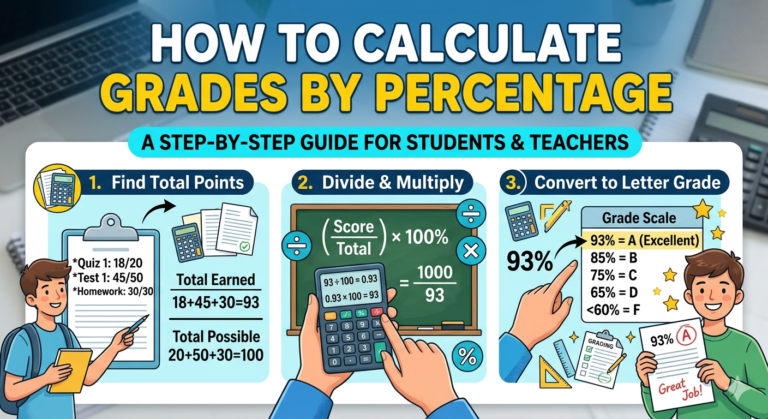
The most common mistake is quoting GPA × 25 as your percentage when a form expects a letter band. Another is averaging grades without credits. Check your school’s grading scale before you report a number.
FAQs
What letter grade is a 3.0 GPA?
A 3.0 is a B on the standard unweighted 4.0 scale. That B band is 83–86%, so a 3.0 describes solid B work across your classes, averaged by credit on your transcript.
What is a 3.0 GPA in percentage?
Use 83–86% for the letter-grade band, with about 84.5% as the midpoint. The linear calculation, 3.0 × 25 = 75%, is only a rough estimate and does not match the B band.
Is a 3.0 GPA good?
It meets several exact cutoffs, including Georgia HOPE, Cal Grant A, and UC admission for California residents. It is below the 3.4 UC nonresident minimum, so its strength depends on the program.
Can I get a scholarship with a 3.0 GPA?
Possibly, because a 3.0 meets the GPA line for Georgia HOPE and Cal Grant A. Awards also depend on residency, income, deadlines, and other rules, so check each program carefully before you apply.
How do I raise a 3.0 GPA to 3.5?
Earn grades above B, especially in high-credit classes, and sustain them over several terms. One strong term rarely moves a long transcript far, because earlier grades still count toward the average.
Check your GPA now
Check your own average with a GPA calculator and enter your real grades and credits, not just your letter average. That check shows whether you are holding the 3.0 line or slipping below it.
GPA scales differ between schools, so confirm your school’s or college’s official policy before making decisions.