What Is a 2.5 GPA? Letter Grade, Percentage & What It Really Means
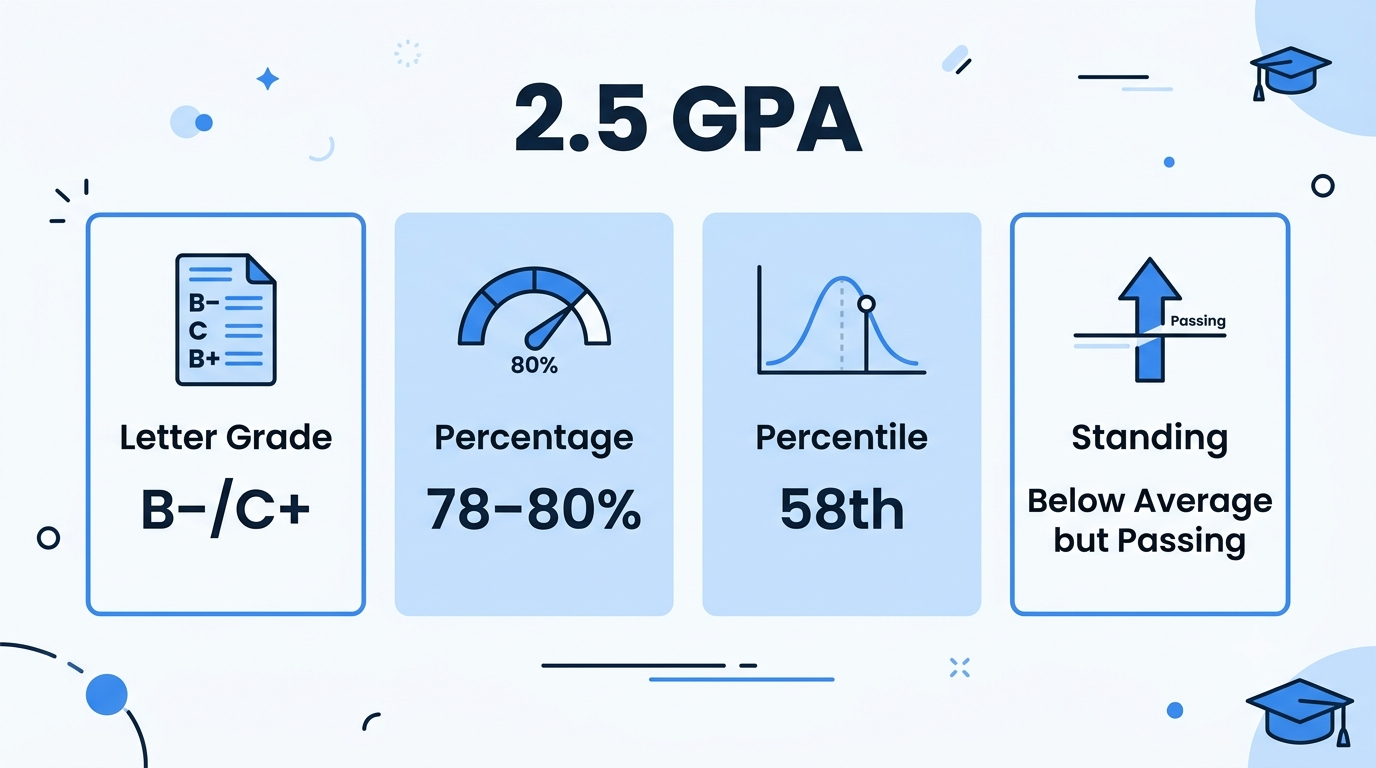
Quick answer: A 2.5 GPA is a C+ letter grade, equal to about 77–79% on a percentage scale, with 78% as the standard midpoint conversion. It sits half a point below the US national average of 3.0, which makes it a below-average academic record but still a passing grade that keeps community colleges, many regional universities, and most online degree programs fully open.
A 2.5 GPA is the number students see when their report card shows a mix of mostly C and B grades, with the average pulled slightly toward the lower end. It is not failing, it is not the end of college options, and it is not permanent. What it is, accurately, is a signal that the next term carries more weight than the last one and that the rest of the application has to do more work to balance the transcript. This guide explains what a 2.5 GPA means on the standard 4.0 scale, how it converts to letters and percentages (settling the conflicting numbers you may have seen online), how it plays in high school versus college, which schools and scholarships still accept it, and exactly how long it takes to lift a 2.5 back to a 3.0 with real projection math.
2.5 GPA at a Glance
| Detail | Value |
|---|---|
| GPA value | 2.5 (on 4.0 unweighted scale) |
| Letter grade | C+ |
| Percentage equivalent | 77–79% (midpoint 78%) |
| Class rank position | Below average, typically bottom 35–40% |
| Compared to US national average (3.0) | 0.5 points below |
| High school graduation | Eligible at almost all US schools |
| College graduation | Eligible at most colleges (2.0 minimum) |
| Four-year college admission | Possible at non-selective and open-admission schools |
| Honor roll | Not eligible (most cutoffs start at 3.0 or 3.5) |
| Dean’s List | Not eligible (most cutoffs start at 3.5) |
| NCAA Division I (core GPA) | Above 2.3 minimum, but close to the floor |
| NCAA Division II (core GPA) | Above 2.2 minimum, but close to the floor |
| Federal financial aid (Pell, FSEOG) | Eligible based on income, not GPA |
| Academic probation risk in college | Low (most triggers at 2.0) |
| Graduate school direct admission | Below most 3.0 minimums |
A 2.5 GPA represents roughly 62.5% of the maximum points on a 4.0 scale, which is closer to a C+ band of work than a B− band. Verify your own number using the GPA calculator before drawing conclusions, since manual estimates often miss credit weighting and pull the result off by a tenth or two.
What Letter Grade Is a 2.5 GPA?
A 2.5 GPA equals a C+ letter grade on the standard 4.0 unweighted GPA scale used by most US schools. The C+ band runs from 2.3 to 2.6 in grade point value, and 2.5 sits in the middle of that range, representing a transcript with a mix of C grades and a few B grades pulling the average up.
Some online sources confuse this conversion and report a 2.5 as a B⁻ or 80%. That is incorrect on the standard unweighted 4.0 scale used by US colleges, universities, and admissions offices. The B− grade point value is 2.7, not 2.5, and it corresponds to 80–82%, not 78%. The authoritative chart used by the College Board, NCAA Eligibility Center, and most US admissions offices treats 2.5 as a clear C+.
Here is how 2.5 lines up against the surrounding letter grades on the standard scale:
| GPA | Letter Grade | Percentage Range |
|---|---|---|
| 3.0 | B | 83–86% |
| 2.7 | B− | 80–82% |
| 2.5 | C+ | 77–79% |
| 2.3 | C+ | 77–79% |
| 2.0 | C | 73–76% |
Schools that use plus and minus grading typically record a 2.5 average as mostly C+ work with occasional B grades mixed in. Schools that use whole-letter grading record it as a mix of C and B with the C grades carrying more weight. For the full grade-to-GPA breakdown with every tier and cutoff, our grading scale explained guide covers each letter with its exact percentage range.
What Percentage Is a 2.5 GPA?
A 2.5 GPA is approximately 77–79% on a 100-point percentage scale. The cleanest single-number conversion used by most US schools and admissions offices is 78%, which falls in the middle of the C+ band.
The conversion is not exact because GPA and percentage measure slightly different things. GPA averages quality points across courses weighted by credit hours, while a percentage averages raw scores across assignments. Most US schools use the following standard equivalents when converting transcripts for admissions:
- 75% sits at the lower edge of the 2.5 GPA band
- 78% is the standard midpoint conversion
- 79% is the upper edge before crossing into B⁻ territory
If you are converting your GPA for a specific application, check the institution’s published conversion chart rather than relying on a single national average, since selective programs sometimes apply stricter cutoffs.
2.5 GPA International Equivalents
International grading systems do not map cleanly to the US 4.0 scale, but here are the common equivalents most universities use when reviewing transcripts:
| Country / System | 2.5 US GPA Equivalent |
|---|---|
| United Kingdom | Lower Second-Class Honours (2:2), roughly 50–59% |
| Germany | Note 3.0 (Befriedigend / Satisfactory), on a 1.0–5.0 scale where lower is better |
| India (percentage) | Approximately 70–75% |
| Canada | C+ letter grade, similar 4.0 scale |
| Australia | Pass (P), roughly 50–64% on the Australian grading scale |
| European ECTS | Grade D (Satisfactory) |
The German conversion confuses students most often because the German scale runs in reverse, where 1.0 is the highest grade and 5.0 is failing. A US 2.5 maps to a German note of roughly 3.0, which is the standard “satisfactory” mark. For US-to-international conversions on an official transcript, always use the chart published by the receiving institution rather than a generic online calculator.
Is a 2.5 GPA Good?
A 2.5 GPA is below average for US students and is generally not considered a good GPA for selective college admissions, competitive scholarships, or graduate school applications. The US national average high school GPA sits around 3.0, which means a 2.5 falls below most graduating peers and below the minimum threshold many four-year universities use to filter applications.
What “good” actually means depends entirely on context. The same 2.5 GPA can read very differently to an admissions reader depending on what surrounds it:
When a 2.5 GPA is reasonable:
- A clear upward trend across semesters (a freshman 2.5 that climbs to a junior-year 3.5 reads as growth, not weakness)
- A transcript loaded with advanced coursework (AP, IB, Honors) that pulled the unweighted average down
- Strong test scores, meaningful extracurriculars, or compelling personal essays that balance the record
- Applications to community colleges, regional state schools, or programs that practice holistic admissions
- A student returning to school after a gap, military service, or family responsibilities
When a 2.5 GPA falls short:
- Applications to selective four-year universities where average admit GPAs sit at 3.5 or higher
- Most merit-based national scholarships, which typically set the floor at 3.0
- Honor roll, Dean’s List, and other academic recognition programs
- Direct entry to graduate, law, medical, or dental school
- Specific major requirements (engineering, nursing, pre-med) that require higher GPAs in core courses
The question is 2.5 a good GPA does not have a universal yes or no answer. The honest read for most students: a 2.5 GPA is workable for community college, regional universities, and trade programs, but it limits access at the top end of selective admissions and competitive aid. For broader benchmarks across every GPA level, our good GPA guide breaks down what counts as competitive at each tier.
Is a 2.5 GPA Bad?
A 2.5 GPA is not bad in the sense of failing or being academically dangerous. It earns credit, allows graduation, and keeps the door open to many colleges. It is, however, a warning sign that some classes are pulling the average down and that the trajectory needs to change before it locks in further.
How concerning a 2.5 actually is depends heavily on where the student is in their academic timeline:
Freshman or sophomore year of high school: Not alarming if the trend is flat or improving. There is enough time to lift the cumulative GPA meaningfully before college applications, and admissions readers weigh later grades more heavily than freshman grades.
Junior year of high school: Concerning. Junior-year grades carry the most weight in admissions because they are the most recent full year available when applications open. A 2.5 here significantly narrows the college list and increases dependence on test scores and essays.
Senior year of high school: Less impactful on admissions if applications are already submitted, but a sharp senior-year drop can trigger acceptance reversals at colleges that require final transcript review.
College freshman year: Recoverable, but worth attention. Most colleges set academic probation at 2.0, so a 2.5 stays in good standing, but financial aid satisfactory academic progress requirements at some schools require maintaining a higher minimum.
Upper-level college years: Serious. Graduate school applications, professional programs, and certain employers look closely at the last two years of college GPA. A 2.5 in upper-division coursework signals the opposite of growth.
If the goal is to move the number quickly, the highest-leverage move is identifying which classes are pulling the average down and focusing on those, not spreading effort evenly. Our guide on how to raise your GPA breaks down the tactics that work in a single term versus those that take multiple semesters.
What Is a 2.5 GPA in High School?
In high school, a 2.5 GPA is a C+ average that typically places a student in the bottom 35–40% of their graduating class at a US public school. It clears the graduation bar at almost every school but falls below the threshold for most four-year university admissions and nearly all academic honors.
Here is what a 2.5 actually means at the high school level across the situations that matter:
Graduation: Most US high schools require a 2.0 cumulative GPA to graduate. A 2.5 clears that bar comfortably. A small number of districts set the minimum at 2.5 specifically, in which case the student is at the floor and a single bad term could create issues.
NCAA athletic eligibility: Division I requires a minimum 2.3 core-course GPA combined with a sliding-scale SAT/ACT score. Division II requires 2.2. A 2.5 clears both, but the margin is thin, and the core GPA is calculated only from approved core courses, not the full transcript. Student-athletes with a 2.5 overall GPA should confirm their core GPA separately through the NCAA Eligibility Center.
Honor roll: Effectively impossible. Most schools set honor roll at 3.0 or 3.5, and even schools with lower cutoffs disqualify students with any single grade below the band. Our honor roll guide covers the typical cutoffs and how one weak grade ends eligibility regardless of average.
Weighted vs unweighted: This matters for high schoolers in rigorous programs. A 2.5 unweighted GPA in a schedule full of AP and IB classes often converts to a 3.0+ weighted GPA, which selective colleges may recalculate either way during review. The unweighted number is what most external systems (NCAA, scholarships, transfer applications) use.
College admissions: A 2.5 GPA falls below the average admitted GPA at most four-year universities. It is fully sufficient for community colleges, competitive at less selective regional schools, and a long shot at flagship state universities and selective private colleges.
What Is a 2.5 GPA in College?
In college, a 2.5 GPA is a C+ cumulative average that sits above the academic probation threshold of 2.0 at most universities but below the cutoff for graduate programs, professional schools, and most merit-based aid. It allows enrollment, graduation, and good academic standing, but it limits post-graduation paths.
College GPA carries different weight than high school GPA because employers, graduate schools, and professional programs all look more closely at college performance, especially the final two years. A 2.5 in university comes with these realities:
Academic standing: Safe at almost every college. Probation typically triggers below 2.0, dismissal below 1.5–1.7. A 2.5 stays comfortably in good standing.
Graduation requirements: Most undergraduate degrees require a 2.0 cumulative GPA to graduate, so a 2.5 graduates without issue. A small number of programs (honors tracks, some pre-professional programs) set higher minimums.
Major-specific GPA requirements: This is where 2.5 often runs into walls. Many majors require a higher GPA in core courses than the overall cumulative average:
- Engineering: Often 2.5–2.7 in major courses, with some programs requiring 3.0
- Nursing: Typically 2.75–3.0 in prerequisite and clinical courses
- Pre-med: Effectively 3.5+ for competitive med school applications, though the bachelor’s itself may complete at 2.0
- Business: Many programs require 2.5–3.0 to enter the major after general education
- Education: Most state teaching certifications require 2.75–3.0
- Pre-law: No minimum to graduate, but competitive law school admission generally needs 3.5+
Financial aid Satisfactory Academic Progress (SAP): Federal aid (Pell Grants, FSEOG, federal loans) requires students to maintain Satisfactory Academic Progress, which typically means a minimum cumulative GPA of 2.0 and completing 67% of attempted credits. A 2.5 clears the federal SAP floor at almost every college, but some institutional aid programs set higher minimums.
Graduate school direct admission: Most master’s and doctoral programs require a 3.0 minimum undergraduate GPA. A 2.5 closes most direct paths, though conditional admission, post-baccalaureate coursework, and strong GRE/GMAT scores can sometimes bridge the gap.
Professional school: Law, medical, dental, pharmacy, and veterinary schools rarely admit students below 3.0, and competitive programs typically require 3.5+. A 2.5 closes these doors without significant additional coursework.
Merit scholarships: Almost all college merit awards require 3.0 or higher to award and maintain. Need-based aid is unaffected.
How Is a 2.5 GPA Calculated?
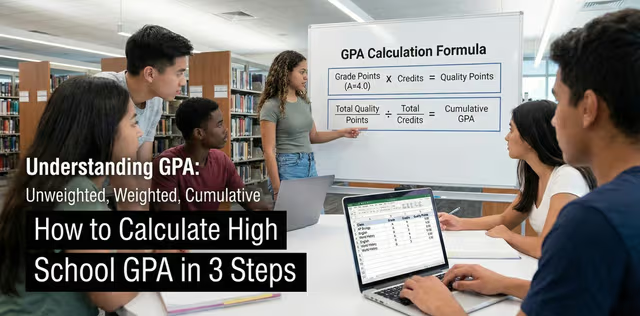
A 2.5 GPA is calculated by summing the quality points earned in every course and dividing by the total credit hours attempted. The formula is identical for high school and college on the standard 4.0 scale:
GPA = Total Quality Points ÷ Total Credit Hours
Quality points come from multiplying each course’s grade point value by its credit hours. A B (3.0) in a 4-credit class earns 12 quality points. A C (2.0) in the same class earns 8.
Here is a worked example showing a transcript that produces a 2.5 GPA:
| Course | Credits | Letter Grade | Grade Points | Quality Points |
|---|---|---|---|---|
| English | 4 | B | 3.0 | 12.0 |
| Algebra II | 4 | C | 2.0 | 8.0 |
| Biology | 4 | C+ | 2.3 | 9.2 |
| World History | 3 | B− | 2.7 | 8.1 |
| Spanish II | 3 | C | 2.0 | 6.0 |
| PE | 2 | A | 4.0 | 8.0 |
| Total | 20 | 51.3 |
GPA = 51.3 ÷ 20 = 2.57, which rounds to a 2.5 GPA on most school systems that report to one decimal.
The full process, including how to handle weighted classes, withdrawn courses, repeated grades, and pass/fail credits, is covered in our guide on how to calculate GPA in high school. The same formula applies for college, with credit values varying by course load.
2.5 GPA Compared to Other Common GPAs
How 2.5 stacks up against the GPAs students most often ask about:
| GPA | Letter Grade | Percentage | What It Signals |
|---|---|---|---|
| 4.0 | A | 93–100% | Perfect average, competitive everywhere |
| 3.8 | A− | 90–92% | Excellent, top-tier admissions ready |
| 3.5 | A−/B+ | 88–92% | Strong, honor roll and Dean’s List eligible |
| 3.0 | B | 83–86% | National average, college-ready |
| 2.7 | B− | 80–82% | Slightly below average |
| 2.5 | C+ | 77–79% | Below average, limited selective options |
| 2.0 | C | 73–76% | Graduation minimum at most schools |
| 1.5 | D+ | 67–69% | Below most graduation thresholds |
Each tier represents a meaningful shift in admissions and scholarship access. Moving from 2.5 to 3.0 unlocks dramatically more options, which is why GPA recovery plans focus on that specific jump first.
What Colleges Accept a 2.5 GPA?
Many colleges accept a 2.5 GPA, including nearly all community colleges, most open-admission universities, many regional state schools, and a wide range of online and faith-based institutions. A 2.5 closes the door at highly selective universities but leaves dozens of legitimate four-year options open in nearly every state.
Categories of colleges where a 2.5 GPA is competitive or admissible:
Community colleges: Nearly all US community colleges admit students with a 2.5 or below. Most practice open admissions, requiring only a high school diploma or GED. This is the most reliable path for students who want to eventually transfer to a four-year university with a stronger college transcript.
Regional state universities: Many state schools outside the flagship tier admit students with a 2.5, especially for in-state applicants. Universities at the regional or branch-campus level often publish minimum GPAs at or near 2.5.
Online universities: Programs like Western Governors University, Southern New Hampshire University, Liberty University Online, and University of Phoenix routinely admit students with a 2.5 or below, often with rolling admissions and accelerated terms.
Historically Black Colleges and Universities (HBCUs): Many HBCUs admit students with a 2.5 GPA, often weighing essays, recommendations, and interviews more heavily than the number alone.
Faith-based and private liberal arts colleges: A number of small private colleges admit students in the 2.5 range, particularly those with strong essays, leadership experience, or community involvement that matches the school’s mission.
Conditional or probationary admission: Some four-year universities admit students below their published minimum on a conditional basis, requiring a minimum GPA during the first semester or first year to continue enrollment.
What a 2.5 GPA typically rules out: Ivy League schools, top-25 national universities, top liberal arts colleges, and most state flagship universities. These schools admit average GPAs of 3.7 or higher, and a 2.5 application rarely clears initial academic screening regardless of other strengths.
State-specific options matter more than national lists for most students. Some states have a wide range of public universities willing to admit at 2.5, while others have stricter floors. For state-by-state breakdowns and a full list of colleges that accept 2.5 GPAs, see our dedicated colleges guide.
Scholarships for a 2.5 GPA
A 2.5 GPA qualifies for fewer scholarships than higher averages, but real options still exist. Most national merit scholarships set the floor at 3.0 or above, so the strongest paths for a 2.5 student run through need-based aid, identity-based awards, essay competitions, and local opportunities where applicant pools are smaller.
Scholarship categories that frequently accept a 2.5 GPA:
- Federal need-based aid: Pell Grants, FSEOG, and most state grants use family income rather than GPA, so a 2.5 has no impact on eligibility
- Essay competitions: Many essay-based scholarships set no GPA minimum or place it at 2.0–2.5
- Identity-based scholarships: Awards for first-generation students, military families, specific ethnicities, religious affiliations, and LGBTQ+ students often set minimums at 2.5 or lower
- Local community scholarships: Awards from local businesses, civic groups, foundations, and high school booster organizations frequently have lower GPA cutoffs and far smaller applicant pools
- Trade and vocational scholarships: Programs supporting skilled trades, healthcare technician roles, and technical certifications usually focus on commitment, financial need, and aptitude rather than GPA
- Career-specific scholarships: Industry-funded awards in fields like agriculture, hospitality, construction, and transportation often accept 2.5 with relevant experience or interest
National merit scholarships, top university merit aid, and most STEM-prestige awards remain out of reach at 2.5, but the total available scholarship pool for a 2.5 GPA student is still substantial. For the full breakdown of which GPA thresholds apply to which scholarship categories, see our GPA scholarship requirements guide.
How to Raise a 2.5 GPA
Raising a 2.5 GPA is most achievable in the first two years of high school or college, when the cumulative average has fewer course grades baked in. Each additional semester makes the math harder because new grades carry proportionally less weight against a larger credit pool. The tactical moves that actually shift the number:
Identify which classes are dragging the average. Run your transcript through the GPA calculator and isolate the specific grades hurting the cumulative. A single D or F in a high-credit class moves the GPA more than multiple C grades in low-credit electives. Focus effort proportional to credit weight.
Front-load attention on high-credit classes. A B in a 4-credit course moves your GPA more than an A in a 1-credit elective. Protect study hours for heavier classes first, electives second.
Read every syllabus for grade weights. Most syllabi list how much each assignment category counts. A final paper worth 40% deserves more preparation time than weekly homework worth 15% combined. This is the difference between studying hard and studying smart.
Track grades in real time. Students who check their current grade weekly catch problems while there is time to fix them. Use a weighted grade calculator after every major assignment to see what you actually need on the next one.
Replace failing grades where allowed. Many high schools and some colleges let students retake failed courses, with the new grade either replacing or averaging with the old one. The policy varies widely, so confirm with the registrar before signing up for a retake.
Talk to instructors early, not at the end. Office hours, extra credit, alternative assignments, and grade adjustments are all available before the semester ends. A C+ with one missing assignment is often a B with a single conversation in week 10.
Use AI tutoring and study tools strategically. In 2026, AI-powered tutoring (for concept explanations, practice problems, essay feedback) is a legitimate study lever, especially for foundational subjects like algebra, chemistry, and writing where targeted practice produces real grade improvements. The tools do not replace effort, but they replace ineffective effort with focused effort.
Drop strategically, not impulsively. Withdrawing from one class to protect the GPA in others can be the right move before a drop deadline, but withdrawal patterns also show on transcripts. Talk to an advisor before dropping more than one course in a term.
For the full set of tactics organized by timeframe and credit level, our how to raise your GPA guide covers what moves the number in a single term versus what takes multiple semesters.
How Long Does It Take to Raise a 2.5 GPA to a 3.0?
Raising a 2.5 GPA to a 3.0 typically takes one to four semesters, depending entirely on how many credits are already on the transcript. The earlier in the academic timeline, the faster the number moves. By senior year, hitting 3.0 may not be mathematically possible before graduation.
The math is straightforward: to raise a cumulative GPA, the new term must average higher than the current cumulative. The further new grades sit from the current average, the more they move it. Here is what a strong 15-credit semester at 4.0 does to a 2.5 cumulative at different credit levels:
| Credits Already Completed | Current GPA | Add 15 Credits at 4.0 | New Cumulative GPA |
|---|---|---|---|
| 15 | 2.5 | + 15 credits @ 4.0 | 3.25 |
| 30 | 2.5 | + 15 credits @ 4.0 | 3.00 |
| 45 | 2.5 | + 15 credits @ 4.0 | 2.88 |
| 60 | 2.5 | + 15 credits @ 4.0 | 2.80 |
| 75 | 2.5 | + 15 credits @ 4.0 | 2.75 |
| 90 | 2.5 | + 15 credits @ 4.0 | 2.71 |
The takeaway: a college freshman with 30 credits done can hit 3.0 with one perfect semester. A junior with 90 credits done needs multiple strong semesters and may still fall short of 3.0 by graduation, even with straight A’s.
To calculate the exact term GPA you need to hit a specific cumulative target, use this formula:
Required Term GPA = (Target Cumulative × Total Future Credits − Current GPA × Current Credits) ÷ Credits in Remaining Term
A more realistic recovery target than a perfect 4.0 is a 3.3–3.5 term GPA, which still moves the cumulative meaningfully and is achievable for most students with focused effort. Our cumulative GPA guide walks through how to project specific term targets for any cumulative goal.
Does a 2.5 GPA Affect Job Prospects?
A 2.5 GPA affects job prospects mainly during the first job search after graduation. After the first full-time role, work experience, accomplishments, and skills carry far more weight than the GPA on the diploma. Most employers stop asking about GPA within two to three years of graduation.
Where a 2.5 GPA does come up in hiring:
- First-job screening at large companies: Big tech, consulting firms, investment banks, federal agencies, and Fortune 500 graduate programs often filter resumes at 3.0 or 3.5
- Industries that publish GPA cutoffs: Management consulting (typically 3.5+), investment banking (3.5+), Big Tech new-grad roles (3.0+), federal honors programs (3.0+), Teach for America and similar service programs (often 2.5–3.0)
- Graduate and professional school applications: Always reviewed, regardless of years since graduation
- Some teaching and licensure jobs: State teaching certifications often require 2.75–3.0
Where a 2.5 GPA does not come up:
- Most small and mid-sized employers: Skills, portfolio, and interview performance matter far more than GPA
- Trade and skilled labor roles: Certifications, apprenticeships, and demonstrated ability replace academic metrics
- Sales, marketing, and creative roles: Portfolio and results outweigh GPA
- Career changes after 2+ years of experience: New employers rarely ask
How to present a 2.5 GPA on a resume: include it only if it meets or exceeds the listed minimum or the program average. Otherwise, omit the GPA entirely and lead with relevant projects, internships, and experience. Omission is standard practice and does not raise red flags for most employers.
What a 2.5 GPA Means for Your Future
A 2.5 GPA does not lock in any specific outcome. It narrows certain paths and leaves others fully open. The students who recover from a 2.5 most successfully usually share three habits:
- They treat the next term as the most leveraged term they have. A single strong semester changes both the cumulative GPA and the trajectory admissions readers see on the transcript. Trajectory often matters more than the single number.
- They project, not just track. Running the next semester through a GPA calculator before it starts turns vague goals into specific grade targets per class. Knowing you need a B+ in chemistry and an A− in English is more useful than knowing you need to “do better.”
- They build the rest of the application or resume. Test scores, essays, recommendations, work experience, and demonstrated growth all carry real weight at the schools and employers where a 2.5 is competitive. Strong supporting materials change how the GPA reads.
A 2.5 GPA is a starting point, not a verdict. The next term is the part that matters.
Frequently Asked Questions
Is a 2.5 GPA passing?
Yes, a 2.5 GPA is a passing grade. It sits above the 2.0 minimum required to graduate at most US high schools and colleges and earns full academic credit. It is below average but not failing.
What letter grade is a 2.5 GPA?
A 2.5 GPA equals a C+ letter grade on the standard 4.0 unweighted scale. The percentage equivalent is 77–79%, with 78% as the standard midpoint conversion used by US schools and admissions offices.
Is a 2.5 GPA bad in college?
A 2.5 GPA in college is below average but not academically dangerous. It sits above the 2.0 probation threshold at almost every university, allows graduation, and maintains federal aid eligibility. It does limit access to graduate school, professional school, and most merit scholarships, which typically require 3.0 or higher.
Can I get into a 4-year college with a 2.5 GPA?
Yes, many four-year colleges accept students with a 2.5 GPA. Regional state universities, less selective private colleges, online universities, HBCUs, and conditional admission programs routinely admit students at this level. Highly selective universities and top-25 schools rarely do.
Is a 2.5 GPA good for high school?
A 2.5 GPA is below average for high school. The US national average sits around 3.0, so a 2.5 falls below most peers. It is enough to graduate at most schools but below the threshold for honor roll, competitive college admissions, and most merit aid.
What percentage is a 2.5 GPA?
A 2.5 GPA equals approximately 77–79% on a 100-point percentage scale. The standard midpoint conversion used by most US schools is 78%. International programs may use slightly different ranges.
Can I get scholarships with a 2.5 GPA?
Yes, scholarships exist for students with a 2.5 GPA, though fewer than for higher averages. Need-based federal aid, essay competitions, identity-based scholarships, local community awards, and certain career-specific scholarships often accept 2.5 or have no GPA minimum. Most national merit-based scholarships require 3.0 or higher.
Is 2.5 a good GPA for graduate school?
A 2.5 GPA is below the minimum for most graduate programs, which typically require 3.0 or higher. Some programs admit students conditionally with strong GRE or GMAT scores, relevant work experience, post-baccalaureate coursework, or compelling personal statements. Direct admission to competitive graduate programs is rare with a 2.5.
How fast can I raise a 2.5 GPA to a 3.0?
A 2.5 GPA can be raised to a 3.0 in one to four semesters, depending on how many credits are already on the transcript. Freshmen and sophomores can often hit 3.0 in a single strong term. Juniors and seniors may need multiple semesters, and late-stage students may not reach 3.0 before graduation due to credit accumulation.
Does a 2.5 GPA affect financial aid?
A 2.5 GPA does not affect most federal financial aid, since Pell Grants and need-based programs use family income rather than GPA. It clears the federal Satisfactory Academic Progress floor of 2.0 at almost every college. Merit-based institutional aid almost always requires 3.0 or higher.